Wednesday, 27 June 2012

Farewell lunch at Restaurant Gordon Ramsay

This afternoon, I visited Restaurant Gordon Ramsay with another friend who was also about to leave London. He decided that he couldn't leave without having had a meal at this iconic chef's flagship establishment, and I was only too happy to accompany him. I noticed that some items on the Prestige Menu had changed so I was eager to try those, and I also emailed the restaurant beforehand to substitute some of the staple dishes on the Prestige Menu which I'd already tried last year - this was organised without any hassle. (My friend had the standard Prestige Menu which you can see from my first review of this restaurant last November.)

We were both late for almost an hour due to unforseen circumstances, and had to call the restaurant at the last minute to inform them about pushing back our early reservation time, which was both embarrassing for us and probably troublesome for them to organise, since the restaurant is always fully booked, with customers potentially coming in for a late lunch and needing the table after us. However, we were met with an extremely warm welcome from the front-of-house staff and maître d' Jean-Claude, none of whom displayed signs of irritation or impatience. (Well, they knew we were both going for the long tasting menu so probably wouldn't have allocated our table to later customers anyway!) Some of the staff recognised me immediately despite a long absence of nearly six months, and our main server (a lad from Bournemouth) said he had a surprise for me in the desserts since I'd requested some menu changes - mmm, I love surprises!

Amuse-bouche: mint-infused ricotta cheese, topped with pea mousse, cucumber, tomato, radish, pansy petal and rocket garnish.


A very nice change from the chestnut velouté offered for the chilly climate last year. This was an exquisite opener to the meal showcasing all that is good about summer produce. A velvety layer of ricotta was topped by feather-light sweet pea mousse, and the small chunks of vegetables had an appealing juicy and crunchy texture. The subtle infusion of mint, and rocket garnish were complementary breaths of fresh air within this light and wholesome dish.

First starter: slow-braised pied de cochon (pig's trotter) pressed then pan-fried with alternating layers of black pudding and ham knuckle, poached quail's egg on a muffin base with melted cheddar and a slice of Bayonne ham, hollandaise sauce and red wine reduction.


In contrast to the amuse-bouche, this was a wonderfully indulgent dish, with a tender, succulent texture and incredible savoury depth provided by the generous slab of meat. The black pudding (two thinner layers) had a delicate, slightly gelatinous, almost melt-in-the-mouth kind of texture. The pig's trotter (thickest bottom layer) was firm yet moist. Generous lashings of creamy hollandaise and red wine sauces further enhanced the richness of this dish. The accompanying mound, a posh take on Eggs Benedict, had the most amazing execution - an egg with a fragile, gelatinous white layer, and a perfectly runny yolk, was draped over with a layer of melted cheddar so thin that it appeared translucent (I didn't figure out it was cheese until I asked a server!), served on a rather dense muffin base with a small chewy piece of ham for a good bite. I detected a refreshing whiff of lemon somewhere; this could have come from the hollandaise sauce. The presentation of the dish was bold and fun, with a striking contrast of yellow and brown.

Second starter: poached Scottish lobster tail with lardo di colonnata, baby vegetables à la grècque and coral vinaigrette (lobster roe, tomato, tarragon, olive oil, touch of sambuca).


Another eye-catching dish with bright colours effectively highlighting the freshness of the centrepiece. This was not bad, but I did find the lobster a tad overcooked and rather tough to cut through (especially since it was a very thick chunk); thankfully it was still reasonably moist and retained a spring in the bite. The tender poached vegetables complemented the subtle sweetness of the lobster very well. The coral vinaigrette was the component I had real reservations about - the olive oil base had an excellent fruity aftertaste, but this was nearly overwhelmed by the extremely sharp-tasting red mixture consisting mainly of roe and diced tomato (I couldn't decide whether it was too salty, or sour, or both). I did like the grainy texture of the dressing though.

First main course: Isle of Gigha halibut with Atlantic king crab, cauliflower and pine nut couscous, finger lime and ras-el-hanout infused broth.


This was an incredible dish, luxurious yet delicate. The texture of the fish was amazing - meaty yet tender and moist. The surrounding Moroccan-inspired clear broth had some lovely aromas that, unlike a similar dish I tried at Le Gavroche recently, enhanced rather than overpowered the typically subtle flavours of white fish. The king crab topping was nice and sweet, but too insignificant a portion to discuss further (find it on this picture if you can!). The bed of extremely finely-chopped cauliflower had a nice grainy bite to it, while pine nuts in the mix contributed a delightful crunch and further depth in flavour.

Second main course: suckling pig, crispy belly (cooked for 36 hours) with fresh and caramelised apples, homemade sausage, roasted loin on a bed of crushed potatoes, spring onions and ham knuckle, apple purée, chou farci (minced pork cheek wrapped in Savoy cabbage).


This was totally out of this world. None of the parts of the pig are wasted in this dish, and like the pied de cochon starter, was proof of what gastronomy at the highest level could do with a seemingly common pub dish. This sophisticated take on the classic pork-and-applesauce combination had something different to offer in each component, from the roasted loin medallions that were so lean, yet tender in texture and velvety in mouthfeel, that they tasted almost like a liver paté, to the sausage that was well-seasoned, succulent and juicy, to the chou farci that was packed tightly with smooth minced pork cheek. The best component and worthy of mention in its own right was the crispy pork belly; this was execution at a level any chef should aspire to. An incredibly delicate crispy layer of skin tops the most melt-in-mouth meat one could ever taste, and the juicy apple bed was the perfect foil to this intense and luxurious morsel. I wished that the Sunday roasts I've tasted were even a fraction as good as this. Unforgettable. 

First dessert / palate cleanser: green apple and lime sorbet with shiso sugar sprinkling, diced green apple, avocado cream, eucalyptus jelly, eucalyptus and shiso leaf garnish.


This was my first 'surprise', and I hadn't expected the kitchen to make me a dessert that was on the more expensive Seasonal Inspiration menu (available only during dinner). This was a real pleasure to have after the pork dish - so amazingly refreshing, with the perfect balance of sweetness and acidity. The sorbet was intense in flavour yet unimaginably light and smooth in texture; this was well complemented by the rich and slightly sweet avocado cream. The one component that really made this dessert stand out was the shiso sugar sprinkling - I am extremely partial to the distinctive preserved-plum-like aroma and flavour of this Japanese mint, and with its well-known anti-bacterial properties (hence its usual function as a garnish for sashimi), it is also very good for you! What a masterpiece to behold, a perfect harmony of colours and flavours.

Second dessert: smoked chocolate cigar with blood orange purée and cardamom ice cream.


The chocolate cigar itself probably isn't a new idea for desserts in fine-dining restaurants, but what made this really special was the savoury and smoky flavour that was infused into the chocolate, and this addition worked perfectly with the deep and rich taste of high-quality cocoa. The cardamom ice cream was another unusual flavour, but the spiced pairing was an entirely appropriate concept for this distinctive chocolate. Dollops of rather tart blood orange reduction provided the balance for this luxurious dessert. Needless to say, this was also such a pleasure to look at; I almost couldn't bear to start eating this exquisite piece of food art.

Third dessert: banoffee pie soufflé, vanilla ice cream.


A relatively down-to-earth way to end this wonderful meal after two fancy items. On the surface it might have looked pretty ordinary, but as they say in English, the proof of the pudding is in the eating, and on that count, this dessert certainly didn't disappoint. The texture of the soufflé was amazing - all at once smooth, creamy, light and airy. The fragrance of baked bananas was unmistakable and intoxicating. I was looking for the toffee part of the dessert when I finally noticed a generous amount of the melted stuff at the bottom of the container - how wonderfully and unashamedly decadent! The ice cream was very good too, but hardly a match for the formidable soufflé.

Petit fours: strawberry ice cream in white chocolate coating, dark chocolate ganache, rosewater-flavoured Turkish delight; violet sorbet.


Not much to comment since these are the usual petit fours, with the exception of the violet sorbet which was a nice little extra; this was richly perfumed, with an unusually thick syrupy texture but fortunately didn't taste too sweet - very nice indeed.

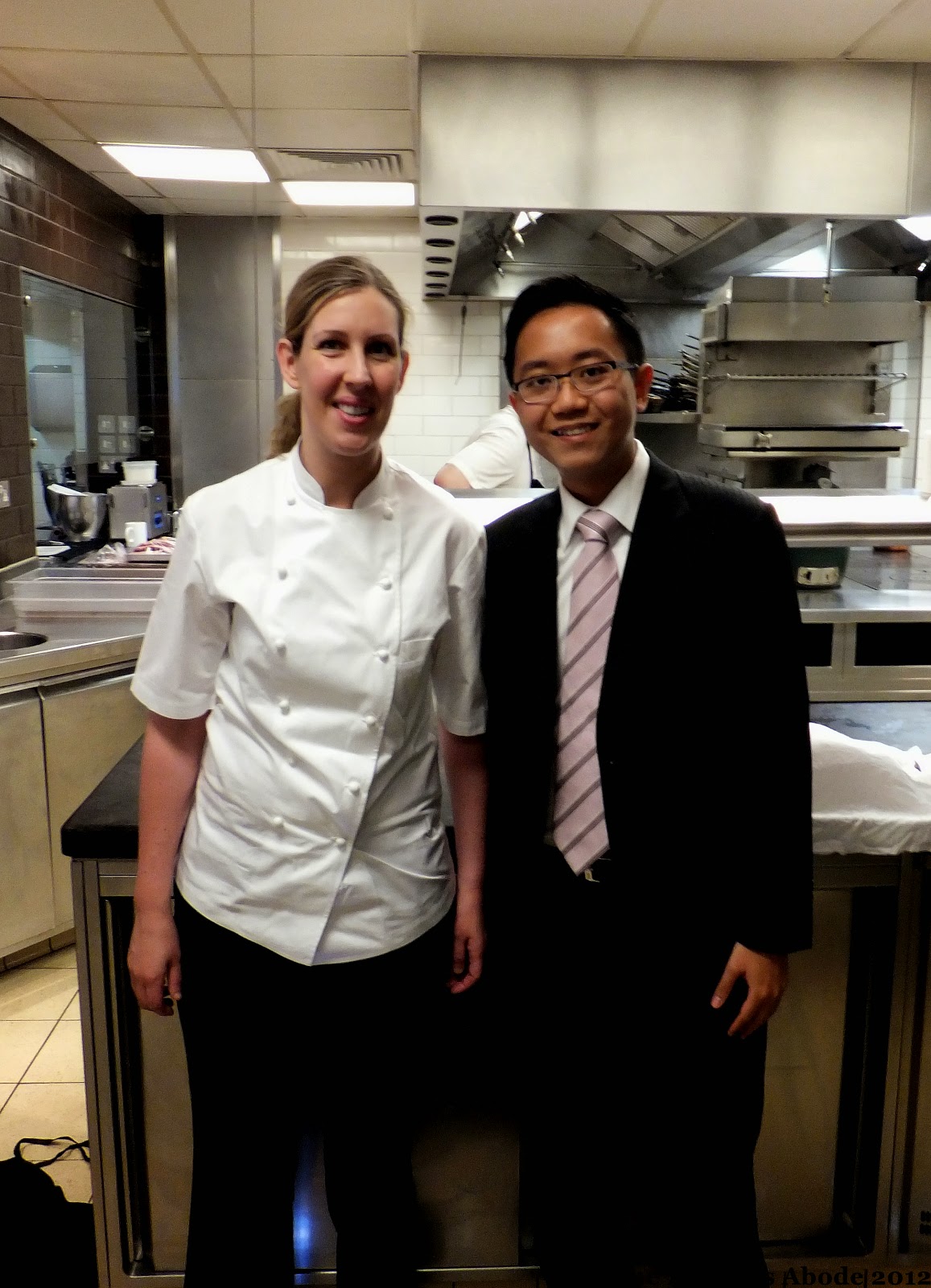
I had arranged for a kitchen tour beforehand and Jean-Claude brought us there after our lunch. This was the first viewing of a Michelin 3-starred kitchen for both of us. I was genuinely surprised by how compact the kitchen was, compared to that at Marcus Wareing's flagship - I guess size really doesn't matter! We also had a brief but nice chat with Head Chef and Ramsay protegé Clare Smyth. 

Two behind-the-scenes photos to give you an idea of what it's like in the kitchen...


With head chef Clare Smyth

I think I've just about covered most of the signature dishes in this stellar restaurant, but I certainly wouldn't mind going back as soon they have something new to offer with the changing seasons. Excellent food and service all round - what's there not to love about this place? I feel fortunate to be living in London for the moment.

Monday, 25 June 2012

Farewell lunch at The Square

It is the season when people are finishing their studies and moving out of London, and this afternoon, I took two friends to The Square for a farewell lunch. This was my first visit in quite a few months and the first Michelin-starred restaurant experience for my friends, so we were really looking forward to what they had to offer. We went for the 3-course set lunch, and covered all the options between us.

Amuse-bouche: a mixture of egg whites, spring onions and red onions, served in a lightly curried mayonnaise, with a watercress garnish.


This reminded me of classic potato & egg mayonnaise salad - pleasant if somewhat unspectacular. The curry flavour was present but a tad weak for our taste; fortunately, helped somewhat by the peppery twig of watercress. No potatoes used here, but the mix of hard boiled chunks of egg white with crunchy and aromatic chopped onions, in a creamy sauce, was comforting.

Starter 1: home cured bresoala with artichoke, beetroot and horseradish cream, topped with a rocket and chive garnish.


The bresoala or beef ham, a traditional delicacy of Italy's Lombardy region, and cured in-house in the restaurant's cellar over a few weeks (so we were told), had a very interesting flavour - like most premium hams, it was not overly salty, and had a very rich taste which I can't quite put in words. It was also very lean and tender. Its savoury flavours were well matched by the sweet and juicy chunks of artichoke and beetroot, and the lashings of spicy horseradish cream and peppery rocket leaf garnish gave the palate a refreshing kick.

Starter 2: marinated aubergine with sweet peppers, goat's curd, crushed black olives, deep fried red onion rings and chopped caramelised red onions, basil, and an olive oil and balsamic vinegar dressing.


Ain't no ordinary extra-virgin olive oil...

This was my friend's dish and she was initially concerned that it might not be entirely to her taste because she doesn't take aubergine a lot, but I believe this dish changed her mind about this vegetable. Its naturally creamy texture and sweet taste were most delightful, and extremely well matched with the juicy peppers, and fruity olive oil from Provence in France (an excellent olive oil does wonders for any dish, as restaurant manager Cesar told us). The onions added a nice crunch and appealing aromas, while the rich goat's curd and crushed black olives gave the dish an appealing savoury depth and touch of luxury. I could not imagine a salad more wholesome and delicious than this.

Main 1: glazed short rib and rump of White Park beef, with smoked creamed potato, spinach, caramelised baby carrot and red onion, red wine sauce.


The first thing that struck me about this dish was the tenderness of the meat and that unmistakeable melt-in-the-mouth feeling one gets from cooking sous-vide over extended hours. The creamed potato had an incredibly smooth consistency, and the sauce was a completely apt pairing for the luxurious meat. The portion was also generous and left one feeling extremely satisfied.

Main 2: fillet of sea trout with buttered summer vegetables (cabbage, baby carrots and radishes, peppers, fava beans, white and green asparagus), herb gnocchi and sorrel.


Another excellent main. This nicely pan-seared cut of fish had a light crispy top which I totally love, while the rest of the flesh remained moist and flaked effortlessly. The accompanying vegetables were fresh and sweet, and contained my favourite seasonal asparagus! The surrounding soup tasted quite nice too - sweet and slightly buttery, but I found it a tad too watery. A thicker/creamier texture would have been more appropriate to match the rich flavour of the fish.

Dessert 1: crème fraîche tart with sour cherries and crème fraîche ice cream.


This looks incredibly rich but was actually very refreshing. The English translation of the original French name, 'fresh cream', would be a misnomer: this is actually a type of sour cream with lower viscosity but higher fat content, which is perfect for making desserts that feel indulgent yet very light. It is also not too acidic, and easy on the palate. The tart filling had an amazingly fragile wobbly texture to it beneath the burnt glaze and looked exactly like an excellent crème brûlée, but actually tasted more of lemon curd (I'm pretty sure lemon was in the mix, unless the cream used was of an exceptional variety); on the other hand, the ice-cream felt more like thickened natural yoghurt, true to the taste one expects from a bacterially-soured cream. The preserved cherries were mouth-wateringly large and juicy. On the whole, a most enjoyable dessert.

Dessert 2: gooseberry fool with gooseberry jelly and vanilla panna cotta, with a sprinkling of biscuit crumbs.


A quintessentially English summer dessert, the word 'fool' is derived from the French fouler (to press), for the sourish seasonal fruits (in this case gooseberry) that are mixed into thick sweet cream (imagine a more indulgent version of strawberries and cream). It did look like a lumpy mess but its taste was exceptional. The thick top layer of cream was generously studded with large and juicy gooseberries. In the middle was a thin layer of gooseberry jelly, supported by rich vanilla panna cotta at the bottom, with intense flavours coming from real crushed vanilla pods within the panna cotta. The amount of cream could have been overwhelming but the natural acidity of gooseberry kept the dessert nicely in check.

To finish off the pleasant afternoon, we were offered the usual petit fours of nougat and salted chocolate truffles. We had all enjoyed the food immensely and service as usual was welcoming and friendly (especially from Cesar, and a new Italian waiter with a thick French accent - admittedly he was quite difficult to understand but he did his best!), and my friends were put at ease very quickly. I will be back!

Monday, 4 June 2012

Diamond Jubilee weekend dinner at Marcus Wareing at The Berkeley (Chef's Menu)

It is the Diamond Jubilee weekend here in the UK, and the entire city of London is in a festive mood. I too made use of the extra-long weekend for a spot of fine-dining and celebration in style. For this I chose to return to Marcus Wareing, which I had not been back to since January. I had noticed quite a few changes to their Chef's Menu, and was eager to try the new dishes they had to offer. Booking for dinner this evening was surprisingly hassle-free (perhaps because everyone was at the BBC concert and fireworks in nearby Hyde Park?) but getting there on the Tube was hellish!

Anyway, on to the food - I noticed that the Chef's Menu had shrunk slightly although the price remains unchanged; instead of the usual ten courses there were now only nine including cheese and chocolate (in comparison, the Taste Menu now has only 7 fixed courses; cheese comes at a supplement). I am not a particular fan of cheese, so I asked to switch that for a fish dish which was conspicuously missing from the menu. I also asked to try a new dessert as I'd already had the apple and cinammon in January.

Canapés: breaded fish cake with lime mayonnaise, pickled egg with pork crackling and a dash of black pepper.


The fish cake was excellent - well-seasoned, warm & moist on the inside, with a thin, light & crispy crust. The lime mayonnaise gave it a further touch of richness whilst also balancing this deep-fried comfort food with its mild acidity. I liked the pickled egg rather less - while the thick, perfectly smooth and creamy texture was delightful (I wonder how they did it!), it was all a bit too sourish for my taste. The two savoury pieces of pork crackling were much more agreeable - crispy, non-greasy and didn't stick to the teeth.

I was expecting another customary amuse-bouche after this, so I was a little surprised when the menu proper began immediately after the canapés. Oh well, never mind.

First starter: konbu (Japanese seaweed) jelly, tartare of langoustines with Oscietra caviar, mirin (Japanese rice wine similar to sake, but with lower alcohol content) broth, coriander cress garnish.


This excellent cold dish brought back fond memories of my travels to Kyoto, where I was fortunate enough to dine at some of the finest kaiseki restaurants in Japan. It was so authentic that it wouldn't have been out of place at three Michelin-starred Kikunoi, for example. The konbu jelly was feather-light in mouthfeel but intense in flavour, complementing the raw langoustines which were incredibly fresh and naturally sweet, with a firm and succulent texture.  Touches of caviar and chopped onions within the mound gave the langoustines both savoury and aromatic depths. A peppery cress garnish and delicate mirin broth completed this picture of culinary perfection with a slight kick to the palate.

Second starter: herb (incl. cinnamon)-crusted foie gras mousse, pineapple carpaccio with reductions of pineapple & balsamic vinegar and cinnamon. Accompanied by a thick slice of toasted brioche.


A very good dish - the smooth and creamy foie gras mousse was very well complemented by its aromatic herb crust, and balanced with mildly acidic pineapple-based accompaniments. The appealing fragrance of cinnamon was present but not overpowering. The one component that stood out for me, perhaps rather surprisingly, was the brioche - very thick, but so incredibly soft, fluffy and warm; it was certainly good enough to be eaten on its own.

Third starter: veal sweetbread topped with a slice of caramelised lemon, on a bed of grapes, macadamia nut purée, chopped macadamias and almonds, amaretto (almond liqueur) jelly; garnish of bitter cress.


A picture of understated luxury. A generous chunk of succulent, sweet-tasting and velvety sweetbread was complemented by equally sweet and juicy grapes, a smooth and creamy macadamia purée to enhance its richness and depth of flavour, and other delightful nut-based accompaniments for variety in texture. The garnishes also made a real impression - the lemon slice with its balancing acidity, as well as the bitter cress which cut through the richness of this dish with an astonishingly peppery kick to the palate.

Fourth starter: pan-fried scallops, asparagus, smoked egg, sea kale.


A simple and delightful dish designed to bring out the best of seasonal produce. The scallops were cooked only slightly such that they retained all their natural juices and a tender texture. Their sweetness was enhanced by the asparagus in both poached and puréed forms (with chunks of sea kale within the purée); I loved the crunchy and tender texture of the asparagus and sea kale. Dollops of smoked egg yolk highlighted the savoury aspect of the scallops' flavour whilst imparting a luxurious mouthfeel with its thick creamy texture.

Fun facts: sea kale is one of the few vegetables still in existence which is truly native to Britain. It grows naturally along the shores of the east coast, though it is now illegal to pick sea kale or grow it in the wild. Sea kale is sometimes known as winter asparagus; the similarities in taste and texture between sea kale stems (the best part of the plant) and asparagus are striking. Sea kale is now grown and supplied commercially in the UK by only one farm in Scotland, thereby accentuating its rarity.

Fifth starter: smoked salmon parcel, pea pannacotta and fresh peas, preserved lemon purée with a touch of mango, garnishes of fresh radish and garden cress. 


This was my replacement for the cheese course; from the Taste Menu, a posh take on a classic fish-and-peas combination. The lightly smoked salmon had a very rich flavour without excessive saltiness, and was very moist and tender, flaking effortlessly - nothing out of this world, but extremely well executed. The preserved lemon purée was very refreshing, with a nice balance of sweetness and acidity. The component that really stood out for me was the pea pannacotta - sweet, smooth, and velvety; miles better than a traditional pea mash (but of course one would expect nothing less from this restaurant!). Overall a very clean-tasting and wholesome dish with exquisite presentation.

Main course: Galloway beef fillet done medium rare, Dorset snails, horseradish potatoes, parsley purée, garnish of celery, chopped shallots and cress.


A very substantial and hearty course. The chunks of beef remained tender and succulent despite their thickness, and the surrounding sauce made of beef stock was utterly delish! The few morsels of snails were very juicy and retained a nicely firm & springy texture. The generous portion of potatoes were surprisingly light and non-starchy, and their horseradish cream coating cut through the richness of the meat whilst delivering a nice kick to the palate. The rest of the vegetable accompaniments - the fresh-tasting parsley purée, roasted celery seasoned with salt, and the peppery cress had the same effect of balance. Solid execution throughout.

Pre-dessert: a layered glass consisting of lime ice, fresh diced mango, coconut streusel, and passionfruit crémeux (cream). A completely apt palate-cleanser after the previous course, with refreshing tropical flavours and a delightful variety of textures.


First dessert: white chocolate parfait with popcorn, grapefruit sorbet served on popcorn, fresh grapefruit pieces, with a sprinkling of (I believe it was orange) sugar.


The first of two desserts I was about to have, taken from the lunch menu. The white chocolate parfait was excellent - rich and smooth with strong vanilla notes. This was aptly paired with a grapefruit sorbet and fresh grapefruit pieces which had a refreshing acidity. The sprinkling of orange-flavoured sugar also delivered a nice crunch and further citrus flavour. I had my reservations about the use of popcorn - instead of being warm, fluffy and crunchy as one might expect, it had (perhaps unsurprisingly) become rather cold, hard and soggy. In terms of flavour it couldn't have contributed much either since the white chocolate and sugar had already done such a good job. My other minor complaint would be that the dessert was served a tad too cold and firm, and that both components broke off in bits on the plate when I tried to scoop them up, instead of coming off nicely in the spoon; however, this was easily solved by allowing the dessert to linger in my mouth for slightly longer than usual, unleashing its full flavours and textures.

Second desssert: carrot and walnut cake with cream cheese frosting and sprinkling of frozen carrot, cream cheese ice-cream, soft meringue cubes, coriander cress garnish.


Another posh take on a traditional dish, all components were truly excellent. The cake was fluffy and moist with generous chunky bits of walnuts within for extra flavour and texture, and the cream cheese components had a delightful richness tempered with a mild lemony acidity (also present in the cubes and coriander cress) such that the whole dessert didn't feel as overwhelming as it might have been. The texture of the ice-cream was amazing - firm but completely smooth and velvety.

My only complaint was that this dish was not explained to me by the person who served it - he simply said 'carrot cake' (I thought that was pretty obvious anyway) and hurried off. I had to verify some of the components with the acting restaurant manager later. I can appreciate that everyone was busy with a full restaurant, but that is no excuse for such a service lapse.

Chocolate: (left) 55% Ecuadorian chocolate with a salted caramel filling, (right) 70% Cru Virunga chocolate from Congo.


The final chocolate course, now with a new type of chocolate. The Ecuadorian variety was not particularly striking but I loved the salted caramel filling (you can see a  large sea salt crystal on the bottom right of that piece). The spring water-based Cru Virunga ganache remains one of the most extraordinary chocolates I've tried so far, with strong notes of forest berries.

To end off another nice visit to the restaurant, the customary visit to the kitchen. Marcus wasn't in the kitchen (missed him again!) but I still got to witness the assembly of a beautiful lamb dish (I believe this is the 'suckling lamb, beans, oregano, Flower Marie' option on the tasting menus) by sous chef Mark and an assistant. 


Summary notes: another enjoyable evening at the restaurant; despite the slightly reduced menus I think it was still reasonable value-for-money - and the food was undisputedly excellent with some very minor misses (which could be a matter of personal taste). Service was yet again improved and I wish to mention Daniel in particular, a long-time permanent staff member who was taking care of me for most of the evening - he gladly obliged my requests for menu changes, brought me to the kitchen and chatted animatedly about food and restaurants at the end of the meal (I really wouldn't mind tagging along to Noma or El Cellar de Can Roca if he could get a reservation!). There were lots of fresh faces this evening, including a couple of French apprentices who had very thick accents and were probably not entirely comfortable in English, but I could tell they were doing their best, and everyone has to learn the ropes from somewhere anyway. The acting manager (replacing Dmitri who was on holiday) who served and introduced most of the dishes for the evening appeared a tad cold at the beginning, but warmed up quickly as the dinner moved on, and was patient with all my questions on the food. I will be back in due course!

Friday, 18 May 2012

Meeting with a friend from home, over lunch at The Ledbury

A friend of mine was visiting from home and I thought it would be nice to leave her with good food memories from London without burning a huge hole in her pocket. I decided to take her to The Ledbury, which offers very reasonably-priced set lunch and à la carte menus on weekdays, in addition to the tasting menu which I had on my previous visit.

At the time of visiting, The Ledbury had just risen in the St. Pellegrino's rankings by an impressive 20 places (earning The Highest Climber award along the way) to reach 14th position on The World's 50 Best Restaurants 2012 list. Naturally, I arrived with very high expectations that the meal would indeed turn out to be a highlight of my friend's trip.

Canapé: wild asparagus and parmesan tartlette.


This was a bite-sized piece of heaven. The savoury parmesan cream and powder were well complemented by generous, sweet and juicy chunks of poached green asparagus. An  extremely moreish and seasonal combination - if only we could have more than a piece each!

Starter (set lunch): breast of quail with hand rolled macaroni, peas and Riesling. 


This was actually my friend's dish, and it looked extremely similar in concept to the quail starter that I had on my very first visit for Sunday lunch. The roasted quail breast was extremely moist and succulent, and its savoury depth was enhanced by the topping of iberico ham. This was paired with a well-seasoned and somewhat crispier confit of the leg. Subtly sweet pea purée and Riesling sauce completed this unassuming picture of culinary delight.

Starter (à la carte): steamed white asparagus with duck ham, parmesan and mousserons  (a type of mushroom from France with lacy deep gills and very thin stems), cooked in Earl Grey tea.


This was a stunningly varied dish with seemingly disjointed components that actually worked really well together. At the centre of attention was of course the white asparagus, which was incredibly juicy, sweet and tender. I am extremely partial to white asparagus, and fresh ones are in season for only a few weeks each year, making this a real treat. (The Ledbury is also the only fine restaurant in London I've noticed to serve the white variety.) The white asparagus was effectively paired with savoury duck ham, crispy and well-seasoned duck tongue (!) fritters, a touch of parmesan cream, and wonderfully earthy and aromatic mousserons (both sautéed and puréed). This was truly an explosion of flavours which both intrigued and delighted. The only component I really didn't detect at all was the Earl Grey - perhaps overwhelmed by the other competing flavours and aromas? Still, this was a thoroughly enjoyable dish. Shoots of wild green asparagus, carefully plated round the main components, completed the exquisite presentation.

Main course (set lunch): fillet of brill with barley, radishes and a cream of white beer.


This was the highlight of my friend's lunch, according to her. A generous chunk of moist and succulent fish, perfectly roasted with a nice crispy top, sat on a substantial bed of finely-sliced radish and barley grains mixed with mussels. The fresh and intense flavours of the sea were further enhanced by a mildly spicy shellfish consommé (surrounding the fish) that truly stimulated the palette. In fact, the portion was so large that she left some of the grains and vegetables on the plate so that she would have space for dessert. A simple yet delightful experience it must have been.

Main course (à la carte): roast Dover sole with thyme milk skin, mussels and mousserons.


My decision was immediate when I saw this dish on the menu - I had to have it. Seldom does one get the opportunity to enjoy a substantial portion of the most premium sole variety (the Queen's favourite, apparently!). My choice turned out to be utterly amazing - the thick fillet was succulent yet tender, and its delicate flavour was aptly complemented by a layer of mousserons stuffed into a slit made along the middle of the fillet (hidden from view). This was way better than the lemon sole I had last year at RGR (which to my memory now seemed a tad dry and tough), and at least as good as the Dover sole with morels that I had recently as part of the tasting menu at The Waterside Inn.

Cauliflower, a common accompaniment to delicate white fishes, was found here in two forms: as a florid topping of incredibly thin shavings for the fillet, and roasted with a well-seasoned crusted top (both sweet and savoury - delicious). The two mussel fritters were good on their own but didn't add much to the dish. The one standout component that I will remember was the thyme milk skin, so delicate in texture (like Japanese yuba) yet so intense in flavour and aroma; it really lifted the dish to a higher plane amidst all the tried-and-tested combinations on the plate (not that there's anything wrong with that!).

Dessert (set lunch): whipped ewe's milk yoghurt with strawberries, blueberries, sweet cicely meringues, frozen white chocolate and warm citrus beignets.


Generous dollops of creamy light sheep's milk yoghurt were interpersed with juicy wild Gariguette strawberries and blueberries, two scoops of smooth and light strawberry sorbet, warm sugared citrus donut balls, a sprinkling of white chocolate, and crunchy sheets of meringue with a subtle flavour of anise. A delightful preview of summer, with clean flavours and bright colours throughout the plate.

Dessert (à la carte): millefeuille of mango and vanilla, with kaffir lime ice cream.


This was rather more straightforward and indulgent, with layers of vanilla cream and  mango chunks in a filo pastry, accompanied and balanced by a scoop of lime ice cream. The vanilla cream was thick and intense in flavour, the mango was fresh and juicy, the pastry was delicate and flaky, and the ice cream managed to be refreshing, rich and velvety all at once - this was pure comfort food with a truly delightful mix of textures and flavours.

As a surprise extra we got another dessert to share, the passionfruit soufflé with Sauternes ice-cream that I had tried on my first visit. Every bit as good as the last time, and now I was also able to taste the full-bodied complexity of the Sauternes ice-cream as it had arrived very firm (good!) and did not melt immediately into the soufflé when put into the pierced opening.


Takes true skill and precision
for a souffl
é to rise so evenly!

We both agreed that it had been a stellar meal. The only thing that I found missing, given this restaurant's usual generosity, was the lack of an amuse-bouche, but in hindsight we weren't going to complain because we were really full after 3 large courses and an equally huge extra dessert. I certainly don't remember feeling this full after my previous visits! Service was professional and efficient as usual. I will be back soon!

Saturday, 12 May 2012

Weekend lunch at Dinner by Heston Blumenthal

This afternoon was unusually nice and sunny, and what better way to spend a lazy weekend than with more nice food? I finally made it to Dinner by Heston Blumenthal by calling the restaurant on the morning itself and squeezing myself in for a late lunch slot (advance online reservations, especially on weekends, are impossible - just call and hope for the best). The chef and founder of the famous Fat Duck restaurant needs no introduction, and his London outpost, having only opened at the end of January 2011, has done amazingly well - picking up a Michelin star within 2 months of opening, and then making it to the top of UK restaurants in this year's St. Pellegrino's list of The World's 50 Best Restaurants (double honours of 9th position and the Highest New Entry, to be exact, edging out even The Fat Duck, which has fallen to 13th position).

Despite the restaurant's location in the very posh Mandarin Oriental hotel in Knightsbridge, the atmosphere is surprisingly open and casual. Lots of natural light, amply-spaced tables and no stuffy dress codes. You can see the open kitchen at work from almost anywhere in the restaurant, and if you get a seat by the window you can also witness people picnicking on the grass in the adjacent Hyde Park - doesn't get better than this for a start, I think.

Spacious bar area

Main restaurant area

Look at that wine cellar... oh my god.
Designed to impress, surely!

Live ice-cream making at the table, using one
of those Heston liquid nitrogen machines.

Fun fact for the day - who'd have thought that
whale vomit could be so good?!

Two types of bread - sourdough and ordinary brown. Both warm and
substantial. The butter with sea salt was velvety and utterly luxurious.

On to the food; diners expecting revolutionary cuisine like those at The Fat Duck might be disappointed. Dinner's emphasis is really on recreating historical British recipes with a touch of modern fine-dining sophistication; as such, the food mostly looks more 'normal' than what one might expect, though in true Heston style, certain dishes still manage to intrigue, such as my starter:


Any idea what that really is? :) A further hint - here is what it looks like internally:


Meat Fruit (ca. 1500) - mandarin, chicken liver parfait and grilled bread. The combination of flavours was simple and effective - a generous chunk of the creamiest liver parfait, coated with an outer layer of tart mandarin jelly that balanced its potentially overwhelming richness. The grilled bread with lashings of herb oil was extremely aromatic and a nice base for spreading the luxurious parfait. What really took this dish to a higher level, though, was its clever presentation - the 'mandarin' was utterly lifelike in size and shape, and even the naturally uneven surface of the rind was so convincingly executed, that one would not have been able to guess what it really was, without being given some hints. Very delightful start to the meal.

Next, my main course: roast turbot (ca. 1830) with leaf chicory and cockle ketchup. The side of Jersey Royal new potatoes baked in herb butter is an extra order - it should be noted that the mains in this restaurant don't typically come with any side garnishes. If you're not too keen on paying Michelin prices for very ordinary sides (choice of peas, fries, mashed or baked potato and I forget what else), save your money and stomach space for an extra dessert order at the end of the meal. The potatoes were nice and a good portion, but they were just potatoes.


I can't even begin to describe how good the fish was - expensive, yes, but worth every penny for this generous chunk. It had retained all its natural juices, which oozed out appealingly with every slice of the knife and bite in the mouth. The flesh itself was smooth, meaty and tender, with a nice, slightly crispy top from roasting. The fresh and delicate flavours of the fish were aptly complemented by the cockle 'ketchup', basically a sort of vinaigrette with cockles, pickled capers and gherkins, as well as a bed of incredibly aromatic chicory leaves sautéed in crushed garlic. This dish was a picture of understated perfection.

Finally, sweet endings to the meal: upon my server's recommendation, I ordered the Tipsy Cake (ca. 1810) with spit-roasted pineapple. 


A posh take on traditional bread pudding, this was essentially a large brioche baked with generous lashings of sugar, brandy and Sauternes (hence the 'Tipsy' name), which resulted in a thick, custardy / condensed milk-like coating surrounding the warm and fluffy brioche. It was all at once aromatic, sweet, and full-bodied from the liquors used - absolutely delightful. The juicy and lightly caramelised strip of pineapple was a good balance to this rich dessert, with its mild acidity.

I was still feeling peckish after the first dessert so I ordered another light one to finish the meal. This is poached rhubarb (ca. 1590) with rosehip jam and rhubarb sorbet.


What an appealing colour and
perfectly quenelled shape!

This was a really refreshing end to the very rich lunch (more like a palate cleanser than a dessert!) and a delightful experiment in the possibilities of rhubarb: juicy poached strips in campari topped with freeze-dried bits of rhubarb and sugared films with rhubarb powder; on the other side, a perfectly smooth and shaped rhubarb sorbet with a candied rhubarb strip, sitting on a bed of sweet rosehip jam infused with orange, freeze-dried caramel bits, and rich vanilla cream for balance. There was a lot of rhubarb on the plate, but the execution of each component was spot-on and the balance of flavours and textures was very well planned, so that on the whole the dish did not feel overwhelmingly one-dimensional and/or acidic on the palate. I should also mention that the presentation was incredibly pretty!

Petit fours: dark chocolate ganache infused with Earl Grey, and caramel shortbread with caraway seeds. The chocolate itself was extremely rich and velvety but I would have liked a stronger hint of bergamot to complement the intensity of the chocolate; on the other hand, the shortbread was excellent and the unmistakable fresh aroma of caraway seeds was an unusual yet completely apt balance to the buttery richness of the biscuit.


More views of the restaurant as I was leaving (and you can see the open kitchen taking centrestage):


Lovely ambience, good service, and so many more dishes on the à la carte menu left to try - I will have to return soon!