This evening, barely days after returning from Vienna, I finally made it to a restaurant that had been on my wish list for the longest time. The Fat Duck and El Bulli (Spain) were pioneers of molecular gastronomy in the early 2000s; the latter has already closed for good, but fortunately for us food lovers this iconic Bray restaurant by Heston Blumenthal still exists. It has held 3 Michelin stars since 2004 and was rated the World's Best Restaurant in 2005. Its ranking on the latter list has slid since then, perhaps not surprisingly, as gastronomy has evolved in so many different ways and diners now have so many more choices; still, it is one of those places you've probably read so much about and need to try at least once if you really love your food. Blumenthal also has a second and much newer restaurant in London, Dinner, which serves similar cuisine at more down-to-earth prices and seems to be overtaking its parent in terms of popularity; I visited it once last year and liked it very much, so imagine my excitement at turning up at the flagship!
Like all other chefs whose cuisine has been slapped with the molecular label, Blumenthal's dislike for the label is well-known; for him, food science and new cooking techniques are not for confusing or patronising the diner, but the means to a fun and challenging experience involving all the senses. As a proud British person, Blumenthal is also passionate about recreating historic British recipes in his idiosyncratic modernist style.
The Fat Duck serves only one tasting menu at lunch and dinner, and they don't take single diners, which is why I've only visited now. Trying to get like-minded people to commit was an uphill task, and the penalty for a no-show is huge. Reservations were also difficult to get, especially during weekends, as it is a small restaurant with only 13 tables. Having previously dealt with the reservations team before I realised they didn't take single diners, I can also confirm that they are not the friendliest people on earth - I nearly considered skipping this place altogether because of a certain lady over the telephone, until her manager tried to placate me via a lengthy email. In the end, I thought I would give this bucket-list establishment a go anyway, and through a friend I finally managed to get a couple to fulfill a reservation which I'd made two months ago, and was just on the verge of cancelling (not the first time I must say - I usually got the online reservation first before trying to look for my companions!). We met for the first time at the train station and new friendships were forged very quickly.
The restaurant is housed in a 450-year-old building that used to be a pub; it is so understated that I remember missing it completely when I passed it in a taxi en route to The Waterside Inn for the very first time. Just next to The Fat Duck is a larger gastropub The Hind's Head, also belonging to Blumenthal.
 |
| Finally! (and with perfect weather - what more could one ask for?) |


After stooping to avoid banging our heads into the low door frame, we were swiftly led to our table by an immaculately dressed waiter. We couldn't help noticing how well-cut all their suits were - this restaurant easily wins the prize for best-dressed service staff amongst all the places I've been to so far. The interior was also a real surprise; the ancient timber structures had been preserved but the space was completely modernised, and delightfully incongruent with the surrounding quaint village feel - in short, a world of its own yet not without references to tradition, very much like the cuisine we were about to be served. Within this cosy yet austere atmosphere, it was clear that the food would do all the talking.


Oddly, we were each presented with this menu - not like we would have a choice anyway! - but the oversized leather-bound format (like one gets with historical tomes) did set the tone for a grand yet playful affair.

Canapé: aerated beetroot with horseradish cream.

This was shaped like a French macaron, but not quite what you expect in terms of texture. The outer shells were prepared using a vacuum jar to increase the size of air bubbles in the process, due to the lack of air pressure. The resulting bumpy surface appearance with lots of air pockets was like a bed of coral reefs. We were advised to pick it up very gently and eat it in one mouthful. The sensation was incredible; the cold beetroot shells disintegrated immediately and completely within the warmth of the mouth, leaving a strong and refreshing aftertaste of sweet earthiness, punctuated by a spicy touch from the equally light horseradish cream. We were all amazed at how ephemeral yet full of flavour this morsel was, and it certainly set a very promising tone for the gastronomic adventure ahead.
Tien and her husband Richard decided to do the wine flight, while I stuck with water, so I can't really comment on the details of the wine; however they did comment throughout the meal that all the pairings were lovely, so I guess it's something you could consider if you had a little more spare cash.
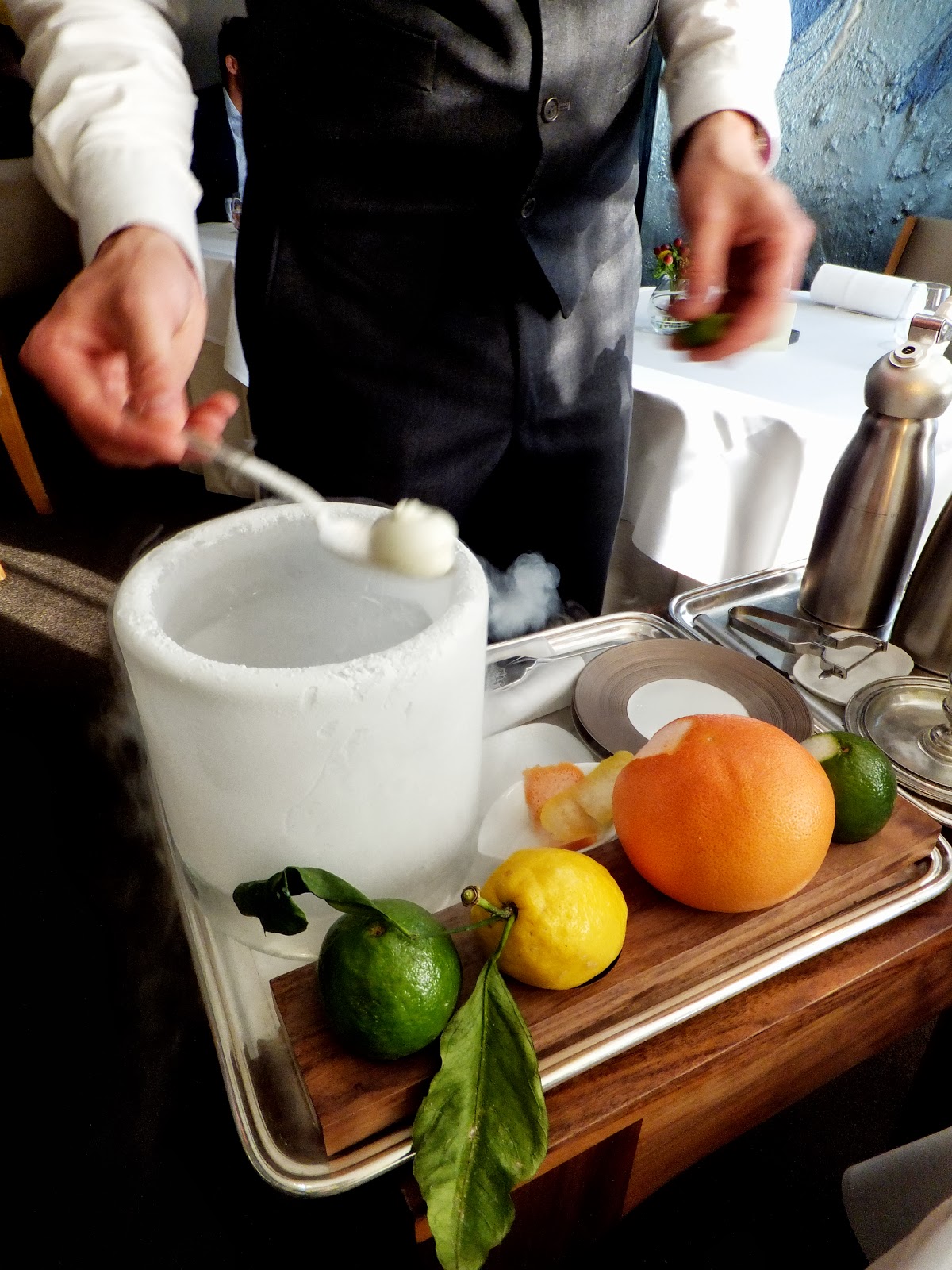
Shortly after the menus had been taken away, the signature liquid nitrogen preparation trolley was pushed over, and we knew that we were in for another treat.
Course 1: 'nitro-poached apéritifs' - choice between vodka & lime sour, gin & tonic, tequila & grapefruit. We took one of each but I forgot to photograph Richard's G&T (aptly infused with warm and spicy coriander seeds); they all look pretty similar though!


 |
| Tien's tequila and grapefruit, infused with a touch of basil - both refreshing and aromatic. |
 |
| My vodka and lime sour, with a touch of matcha. You can also vaguely see some green tea powder at the base of this morsel. Very pleasant and crisp bitterness. |
A modernist twist on pre-meal cocktails, these delightful little palate cleansers were prepared by squirting an alcoholic egg white and pectin-based meringue-like gel from the appropriate canister onto a spoon, squeezing a few drops of the appropriate juice onto the gel, then swirling this mixture around in an insulated bowl of 'steaming' liquid nitrogen at -196 degrees Celsius for a few seconds. The instant deep-freezing produces something like a puffed-up marshmallow or macaron shell. As with the aerated beetroot canapé, we were advised to eat these in one mouthful, and just before that our server also spritzed a citrusy perfume into the air above us to intensify the refreshing experience.
These 'apéritifs' were very cold and fragile to the touch. Again, what a sensation! The texture was revelatory and quite difficult to put in words - a very delicate crunch that was also slightly chewy, like a cross between a marshmallow and a macaron shell. As with the beetroot canapé, these morsels disintegrated almost instantly within the mouth, bursting with icy and bitter citrus flavours that really awoke and stimulated the palate. This fleeting intensity was as intriguing as it was memorable, and there was a real sense of anticipation at what might happen next.
Course 2: red cabbage gazpacho with pommery grain mustard ice cream.

I had a very similar dish last year at L'Arpège in Paris (with tomato instead of red cabbage) and I'm pretty sure that it was inspired by this original version. Blumenthal's experiments with savoury ice creams are well-known (e.g. his bacon and egg ice cream, a reinvention of English breakfast which was sadly not on this tasting menu) and this red cabbage-mustard combination has been a staple in the restaurant for as long as I can remember.
The vivid purple gazpacho with a base of red wine mayonnaise was extremely light and smooth, with a full-bodied, aromatic and slightly sharp sweetness. This was effectively balanced by the mustard ice cream which had a warm spiciness with a hint of vinegary bitterness and acidity that reinforced the crisp nature of this dish. The coarsely ground mustard seeds within the ice cream as well as small diced chunks of compressed cucumber beneath it provided a lovely crunchiness and further bursts of freshness. Very straightforward, clean and enjoyable flavours on the whole.
Sourdough bread was then served with salted unpasteurised butter from northern Ireland. These were of very high quality but (perhaps not surprisingly) underwhelming compared to everything else this evening; I don't suppose bread and butter are intended to be the most important offerings here anyway!

Course 3: Quail consommé jelly covered in pea royale and crayfish cream, topped with chicken liver parfait garnished with chives and a fig tuile. Sides of oak moss and truffle toast.
The presentation of this dish was nothing short of theatrical. First, a teaser for the tastebuds: in each of those small plastic cases was a thin film containing essence of oak moss, to be dissolved on the tongue. This had a pleasant earthy taste.

Then, the most dramatic bit while the taste of moss was still lingering on our palates: water was poured directly over the moss layer, activating a most impressive display from the dry ice at the bottom of its wooden container. I imagined a walk through misty undergrowth. Fresh grassy aromas were diffused all around the table, enlivening our sense of smell as well.

With the smoke clearing up, and all our senses fully stimulated and prepared, we were now ready to relish the food proper. As mentioned above, this came in two parts:


The main 'dish' of quail, crayfish, and chicken liver was served in a futuristic-looking bowl. We were advised to eat all the layers together, and the combination was absolutely lethal. The quail jelly in the middle, despite its small amount (no more than a teaspoonful's worth), packed a real punch with its concentrated and sharp taste due to the process of ice filtration. The velvety crayfish cream had an incredible umami (like a thickened lobster bisque), and the pea royale at the bottom served as a balancing act with its fresh and delicate sweetness. The smooth and creamy quenelle of chicken liver parfait on top added a further touch of luxury with its deep musky flavour, while the crunchy and sweet fig tuile and aromatic chive garnish were the proverbial icing on this masterpiece of a cake.

On the side, a slither of truffle toast was the perfect complement to both the rich flavours of the main body and the oak moss prelude. Its lightness and apparent fragility belied a potent earthiness that was only slightly tempered by the garnish of fresh baby radish and chervil. The spread was made with real truffle butter chock-full of black truffle pieces, with an unusual touch of oak extract - not surprising in this context though - and the toast, using thinly sliced pain de seigle (a lighter and more flavourful version of rye bread), was fried in foie gras fat - artery-clogging maybe, but oh-so-delicious!
This was the first dish of the evening to engage most of the senses with such intensity, and we had only just begun this journey!
Course 4: snail porridge with Ibérico Bellota ham and shaved fennel.

A hot dish finally! This was comfort food of the highest order. The strikingly green porridge, a mixture of parsley, garlic, oats, mushrooms, almonds and top-notch Ibérico ham, was sumptuous and tasty, and I loved the firm bite of individual grains. It was topped with really tender and juicy snails, and raw shaved fennel which contributed a lovely crunch and a fresh anise-like flavour to every mouthful. I must say this was a completely successful marriage of French and English culinary traditions!
Course 5: roast foie gras with sesame and crystallised seaweed, crab biscuit, braised kombu, barberry purée and balsamico.

As some might say, what Michelin-starred menu would be complete without a course of foie gras? This was a good reminder that all great chefs should never forget their roots in classical training, no matter how far they continue to develop their own style.
This foie gras dish was simply amazing - indeed, one of the best I've ever tried. The knife provided for this course was surprisingly sharp, and with good reason: beneath the surface crust lay an interior that was so soft and creamy that a blunt knife would have created a greasy mess on the plate. Placing each impeccably cut piece into the mouth was to experience a sheer explosion of flavour; the silky foie simply melted like a rich ice cream, unleashing its full-bodied muskiness. This was delightfully complemented by an incredibly uniform and crisp caramelised crust which gave the foie a bittersweet edge.
The accompaniments were not in the least trivial either. Sprinklings of crystallised seaweed and a bed of braised kombu (Japanese kelp) imparted a wonderful umami to the foie. The crab biscuits were the other star of this dish: light, crisp and incredibly moreish with the perfect sweet-savoury balance, I could eat these any day as my guilty snack pleasure. Sesame seeds enhanced the foie's blowtorched crust with a lovely crunch and aromatic nuttiness. Finally, against this backdrop of sheer decadence, barberry purée and drops of balsamico provided much-needed refreshment and balance with their tartness. While this course might have been relatively conventional compared to the other offerings on the tasting menu, it was remarkably well-executed and utterly enjoyable; there's nothing like a good dose of tradition sometimes!
Course 6: 'Mad Hatter's Tea Party' (c. 1850) - mock turtle soup, pocket watch and toast sandwich.
Based on an episode from Alice in Wonderland as well as on a real historic British recipe, this was a hell lot of fun! First, a bookmark highlighting its appearance within this famous children's novel by Lewis Carroll, and explaining the history of mock turtle soup in real life. I'll leave you to read this for yourself:


Then, 'teabags' in the form of soluble 'pocket watches' (concentrated beef and mushroom consommé with soy and sherry) wrapped in edible gold leaf were presented in a really stylish watch box:

Dissolve by swirling in some hot water in a teapot...

Not egg in the teabowl, but sweet jellied turnip (which looked whimsically like a turtle shell) with enoki mushrooms sticking out of the top, surrounded by cubes of compressed cucumber, pickled turnip and calf's tongue, and a parsley garnish.

Pour the liquid from the dissolved 'pocket watch' (which really looked like tea) into the bowl...

And voilà! Mock turtle soup, made principally with beef substitutes.

No tea is complete without sandwiches, and whilst we were having our soup, a waiter placed this large and impressive cake stand (in the shape of a feathered hat, no less) in the centre of our table. The presentation for these seemingly humble sandwiches was somewhat over-the-top if you ask me, but it certainly left a deep impression!


So what did I make of the food after the theatrical effects had worn off? The soup was extremely light, aromatic and tasty. The accompaniments were no less excellent - each unassuming morsel was a remarkable burst of flavour. I particularly enjoyed the calf's tongue which had a firm gelatinous bite, and the cucumber which had a surprisingly tender and juicy crunch. The crisp turnip components provided a welcome refreshment.
The sandwiches were a lot more substantial than one would normally think. The fillings were bone marrow, cucumber and sherry vinegar reduction on one side, and truffled mayonnaise and anchovy butter on the other, separated by a piece of toast (yes, toast within a sandwich). The result was a mélange of incredibly rich flavours and textures, with tiny pieces of cucumber as well as the toast layer in between providing a delightful crunch. It was quite amazing how the kitchen managed to lift this everyday lunch item out of the ordinary and into the realm of gourmet food. Pretentious, you say? Well, it has to be tried to be believed!
Course 7: 'sounds of the sea' - sashimi of mackerel, abalone and yellowtail, with a foam of seaweed and vegetable stock, and 'sand' made of tapioca flour, miso oil and crushed pan-fried baby sardines for extra flavour.


This was another multi-sensory dish that is almost synonymous with the restaurant itself. We were asked to put on the earphones attached to an IPod within the accompanying seashell, and listen to the sounds of waves, ship's horns, seagulls, and children laughing, while enjoying this course, for an enhanced experience. The audio effect was so compelling and convincing that I was immediately transported to an idyllic beach, imagining the waves at my feet on an infinite coastline. The food certainly complemented this effect; the foam of receding waves was realised in a bubbly and crisp seaweed stock which seemed to carry the smell of fresh sea breezes with it. The grainy 'sand' was both equally evocative and full of umami. The sashimi was incredibly fresh and all the delicate flavours of the seafood spoke for themselves. A garnish using various coastal herbs (including the ever-popular samphire) and presentation on a box filled with crushed pebbles completed this gastronomic equivalent of a relaxed day by the sea. This was certainly one of the highlights of the evening, and not even having read and seen so much about this course could detract from the magic of actually experiencing it for ourselves.
Course 8: salmon poached in a licorice gel, with golden trout roe and toasted coriander seeds; asparagus, grapefruit, vanilla mayonnaise, balsamic reduction and olive oil from Girona.

This salmon was a complete surprise in both flavour and texture. Raw fillets were coated in a licorice gel made with licorice stock and gelatin, then cooked sous-vide at a low temperature after the gel had set. We were all taken aback by how mild the barely-cooked salmon tasted - as you know, red fishes usually have a deep and characteristic flavour due to their natural oils - and how moist and flaky it was. I might not have guessed it was salmon if I hadn't known! The licorice, a most unusual choice of coating, did remarkably well, with its bittersweet taste effectively enhancing the delicacy of the salmon. A topping of trout roe provided not only an essential savoury depth but also complemented the licorice coating with their juicy gelatinous bite. A sprinkling of toasted coriander seeds peppered the piece of fish very aptly with warm citrusy notes.
On the side, the impeccably-prepared stalks of asparagus had an extremely tender and juicy crunch, supported generously by a warm and sweet vanilla mayonnaise, and an extremely light and fruity olive oil from Girona in Spain. A scattering of grapefruit pulp and drops of reduced balsamico completed and balanced this understatedly glorious dish with their tartness. The very unique usage of vanilla and licorice here truly challenged our notions of savoury cooking; in many ways this course was so dessert-like but it still worked excellently somehow, with all the disparate elements harmonising as if they were the most natural combination. A stroke of culinary genius indeed.
Course 9: lamb with cucumber (c. 1805), with green pepper and caviar oils, and a purée of onion and fennel. Served with sides of lamb consommé jelly with mint vinaigrette, and lamb offal (sweetbread, heart and tongue) on a bed of caramelised shallots.


Another contemporary realisation of a historic recipe, this was another sublime dish which really hit the spot. The lamb was incredibly tender and succulent, and its rich flavour was well balanced by the crisp accompaniments on the plate. Nothing was superfluous, and I loved everything from the spicy pepper oil, to the cucumber pieces which had been grilled for a delicate smoky edge, and the purée which was surprisingly sweet, fresh and non-pungent (more fennel than onion, I think).
On the side, various derivatives from lamb were featured on a wooden slate. Despite its smaller portions, this part actually packed a much heavier punch than the main dish, due to a combination of very rich flavours all round. However, everything was so tasty, I definitely wasn't complaining! First, in the fancy tilted bowl there was a most powerful consommé jelly with a taste so concentrated it was bordering on sharpness; the spicy and refreshing dollop of mint vinaigrette was a welcome diversion indeed. A sophisticated take on the classic pairing of lamb with mint sauce, and a jolly successful one, I thought. On the bone-shaped dish was an assortment of offal, with sweetbreads deep-fried and made into crispy wafers (my absolute favourite), and cubes of tongue and heart, sitting on a bed of caramelised shallots. They were all extremely tasty, with some really lovely aromas and textures. This main course certainly ended the savoury section of our dinner on a high note.
Of course we were hardly finished yet; I couldn't wait to be enthralled by the desserts to follow! As a precursor of all the fun and surprises we could continue to expect, we were served this signature palate cleanser of the restaurant.
Course 10: hot and iced tea.

Of course you ask, how could the same cup of tea possibly be hot and cold simultaneously? This is where the kitchen's ingenuity kicks in; a small amount of gelatin was added to the tea, then whisked to give a viscous syrupy texture once the mixture had set into a jelly. Half of this liquid gel was then warmed up, leaving the rest cold. Meanwhile, a fitting divider had been placed vertically into each of these glasses. The liquid gels at two different temperatures were then poured into each side separately, and the divider was finally lifted, leaving what seemed to be a single liquid, but was in reality two thick fluids that would stay separate long enough for the diner to feel the obvious difference in temperatures. We were advised to drink this as soon as possible. For me the sensation was simply delightful - I had started on the cold side, and tilting the glass towards my mouth caused the hot side to creep in after a few seconds. Experiencing both temperatures at once for those few seconds truly stimulated all the senses and set the stage for the sweet courses. The tea itself was a very pleasant and fresh Earl Grey, with strong aromatic overtones of bergamot and lemon.
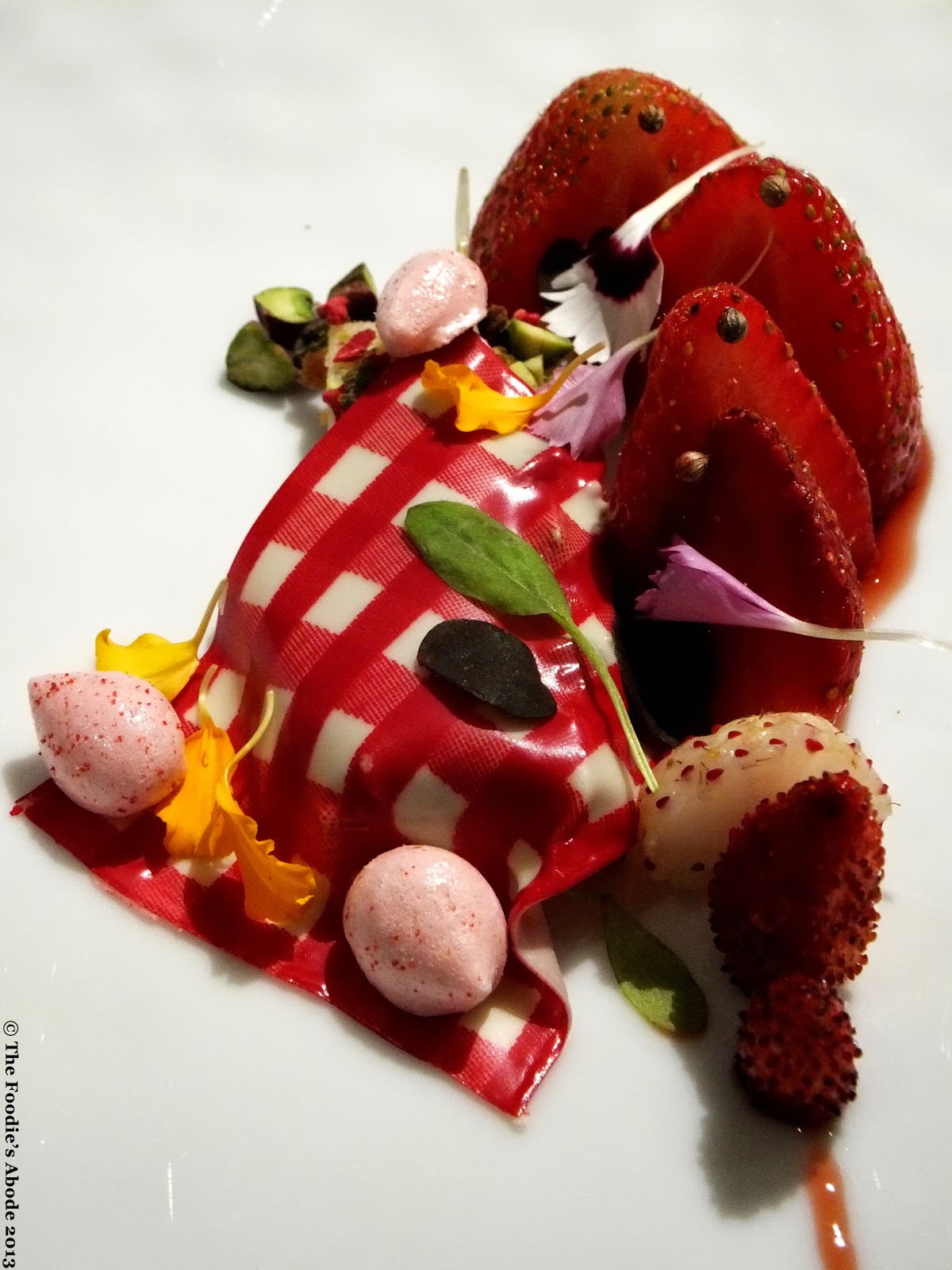
Course 11: macerated strawberries, chamomile and coriander jelly on an olive oil biscuit base, under a 'picnic blanket' made of white chocolate, garnish of flowers, coriander seeds and chopped pistachios. Side of Earl Grey ice cream and strawberry jam in a cornet made of filo pastry dusted with strawberry sugar.

The cornets were first served in a wooden container filled strikingly with metal beads, as a prelude to the main body of this dessert. The Earl Grey soft ice cream had a rich and creamy texture, and a most refreshing citrusy flavour and aroma with a hint of bitterness, which went very well with the sweet strawberry jam at the bottom of the cornet. The cornet itself was extremely delicate and crisp, and dustings of strawberry sugar and Earl Grey powder reinforced this excellent combination.
The main dessert was so pretty that it was almost a shame to have to eat it! Various types of fresh strawberries, macerated to give an incredibly soft and juicy texture, were the stars of this plate with their sheer intensity of flavour. They were accompanied by a strawberry fluid gel and small pieces of freeze-dried strawberries and aerated strawberry meringues, whose lightness in texture also belied a vivid fruitiness. The other part of this plate, hidden under an uncannily realistic 'picnic blanket' made of white chocolate, was an absolutely delicious olive oil biscuit topped with chamomile and coriander jelly. The biscuit base was extremely delicate to the bite yet surprisingly creamy in mouthfeel due to the use of olive oil in the dough, while the jelly had a remarkably smooth curd-like texture and delightful aromas. Sprinklings of coriander seeds and pistachios were the perfect complements to both the crisp nuttiness of the olive oil biscuit and the mellow sweet-smelling aromas of the jelly. The flavour combinations surrounding the strawberries might seem curious, yet they were effective beyond any doubt. This was a sublime dessert that tasted every bit as good as it looked.
Course 12: eggs in verjus (c. 1726), verjus in egg (c. 2013).


The intriguing title of this dessert had caught my attention at the beginning of the meal, and I was eager to experience what this relatively new recipe had to offer. A juxtaposition of history and modernity, this was presented to us as a large 'egg' sitting on a 'nest' of sugar work (the shimmering golden strands) and knafeh (vermicelli) pastry, and surrounded by shredded kabosu and sudachi (Japanese citruses) jelly with an aromatic lemon thyme garnish (hence the 'egg in verjus' bit). The only catch, of course, was that the 'egg' wasn't what it seemed to be - the shell was actually made of white chocolate sprayed with cocoa for an incredibly realistic colour, complete with the brown speckled look. Cracking the shell open revealed what looked like a soft-boiled egg with a runny yolk, but was in fact vanilla panna cotta infused with verjus and lemon thyme, with a centre of verjus and citrus (lemon, orange, grapefruit, passion fruit) gel (hence the 'verjus in egg' bit). This dessert was both ingenious in presentation and crisp in taste. The strong citrus element and verjus (itself quite acidic) kept the palate fresh and light throughout, while the smooth and creamy panna cotta and white chocolate shell contributed a delightful touch of sweetness and luxury. The nest and shell also provided a lovely crunch amidst the predominantly soft textures. All in all, a great way to conclude the main body of tonight's tasting menu.
An assortment of signature petit fours followed. First up, on a wooden photo frame:
Course 13: whiskey wine gums.

Stuck onto a framed map of Scotland (with a fragment of North America), and in the shape of whiskey bottles, were wine gums made of whiskies of various regions and maturities. Their provenance was displayed by the specific spots of the map onto which they were stuck. We were advised to eat them from numbers 1 to 5. Even for a non-whiskey connoisseur it was indeed very interesting to trace the progression of flavours from mild to full-bodied. I personally liked number 4 (Laphroaig aged 10 years) the best for its complex and intense smoky flavour - this is apparently one of the most strongly flavoured of all Scotch whiskies. A lovely introduction to the most famous product of this region.
Course 14: 'like a kid in a sweet shop'.

 |
| 'Smell me!' - evoking warm childhood memories with a whiff. |


 |
| Turned out to be white chocolate with a centre of raspberry jam! |
The very last course of this evening was presented to us in a paper goodie bag (convenient for a takeaway if one is already stuffed by this point) with a scented card listing the various treats. This card had the aroma of a traditional candy shop which brought us all back to our childhoods with a whiff. Lovely. The four different treats in the bag amused as much as they satisfied with their creativity - we wouldn't expect anything less from a Heston kitchen would we? I particularly loved the shredded coconut infused with tobacco for its realistic packaging (in a loose tobacco packet) and dark colour (from palm sugar), and unusually deep smoky flavour, as well as the apple pie caramel with an edible (!) wrapper which tasted uncannily of apples, cinnamon and buttery pie dough. These sweets were truly in a class of their own and ended the meal with typical Hestonian aplomb.
After 4.5 hours of delightful food theatre, we were finally ready to leave. I was so engrossed in this experience that I nearly boarded a different taxi from my companions when we left the restaurant to go to Maidenhead train station! It was already close to midnight and fortunately we caught one of the last few trains back to London.
On the whole, tonight's service was masterful, slick and well paced, almost as theatrical as the food itself. The front-of-house staff were thoroughly familiar with the dishes and their details (ingredients, preparation etc.) and explained them with admirable precision and enthusiasm, despite probably having repeated the same descriptions or encountered the same questions from customers countless times.
Would I return? Although this was some of the most innovative and delicious food I've ever had, I felt that once would be enough as the menu rarely changes. A repeat visit could hardly be as novel or magical. In that context, I am not surprised by the seemingly greater current success of Blumenthal's London restaurant 'Dinner' - location and prices aside, the menu there does have greater variety and seasonality. Having said all that, however, The Fat Duck remains a must-do destination for all foodies at least once in a lifetime. It doesn't matter how much you've read or how many videos you've seen about the dishes; a personal visit will still be as mind-blowing as you can imagine. Of course the experience doesn't come cheap, but is justified by the labour-intensive cuisine (42 chefs cooking for a maximum of 42 diners in each lunch/dinner service) and the large and professional front-of-house team which caters to just about every need. In these times of overhyped celebrity restaurants, this is one establishment that truly lives up to its reputation.


