Showing posts with label Macau. Show all posts

Tuesday, 1 January 2013

New Year's Day dinner at The Eight, Macau

For our last fine-dining stop in Macau we visited The Eight restaurant within the grounds of the Grand Lisboa casino. Compared to the two previous restaurants and their surroundings this was probably the gaudiest of them all - extremely crowded at all times with loud Mainland tourists, and the most opulent pieces of Chinese art and sculptures scattered round the lobby that bordered on the outlandish. Not the most elegant or sophisticated of places, I have to admit; it is very obvious what kind of customers this casino and its shops and restaurants are targeting. Bemusingly, the famous French chef Joël Robuchon has chosen this casino in which to open the only 3-starred restaurant in Macau (I really wonder why?); I had been hoping to visit it, but unfortunately it was fully booked for the whole period we were there.

Anyway, we figured that we couldn't go very wrong with another starred restaurant on the same grounds, so here we were. Within a casino context the name of the restaurant could hardly have been a coincidence, 8 being an auspicious number (representing prosperity) for Chinese people. Upon arrival we were struck by how this number was incorporated into the curtain-like décor, as well the huge red gourd vases at the door, with dragon and phoenix carvings that are symbols of good fortune. Of course, the symbolisms didn't stop there; as the receptionist led us into the restaurant, we were struck by how theatrical and over-the-top the whole set-up was - almost too much of a good thing, one might say. It was quite difficult not to be taken by the lavishness of it all, but I switched my focus quickly enough to what really mattered - food and service.


Live animation with koi under your feet as
you go through the sliding doors - woah.

And the next set of sliding doors open to reveal...

Centrepiece of the restaurant - a huge crystal
ball with a glass optic fibre curtain descending
from the ceiling, with mirrors to give an extra
sense of space. Theatrical, almost surreal, like
entering another world. The symbolism of the
goldfish on the walls was not lost upon us either.

HUGE table with plush leather seating

We were still feeling pretty full from a heavy lunch we had earlier, and in any case after two days of feasting we felt like we needed a break, so we went mainly for lighter dishes with a good amount of vegetables. Our waitress tried to persuade us to order more 'substantial' (read: expensive) dishes, and she didn't seem too pleased when we didn't take up her suggestions. These were what we had:

Barbecued pork with French goose liver 法國鵝肝金錢雞 - MOP$33 per piece


A truly East-meets-West starter, this was a delightful and luxurious combination of ingredients. The pork was sliced a little thick for my taste, but fortunately still pretty tender and moist. This sweet and savoury meat went very well with the intense musky flavour and creamy & velvety texture of the pan-fried foie gras. The overall richness in mouthfeel was enhanced by a thin surprise layer of pork belly sandwiched between the foie gras and the barbecued pork - the additional mini-explosion of fat and juices with each bite was just so gratifying and left one craving for more; shame that each piece was so small and gone in a matter of minutes!

Stewed eggplant with shredded conpoy and crabmeat 貝絲白玉脆茄子 - MOP$130 per serving


The eggplant had a lush creamy texture and a mildly sweet taste, and were very well complemented by a thick starchy sauce of egg white and crabmeat that was poured over them. The chunks of crabmeat within the sauce were succulent and sweet whilst the scrambled egg whites had a light gelatinous bite to them. Sprinklings of fried shredded conpoy added a pleasant crunch and depth of flavour to every mouthful. This dish was indeed a picture of understated luxury - light, wholesome and generally delicate in flavours, yet displaying a remarkable variety of textures that elevated it above the ordinary.

Braised shredded cucumber and baby spinach with fried conpoy and conpoy sauce 太極金絲綠柳 - MOP$135 per serving


A very generous portion of greens fancily arranged in the form of a Chinese tai-chi symbol, this was another healthy and delicious dish. The braised cucumber was particularly sweet, tender and juicy. The thick and savoury conpoy sauce that was poured over the spinach part of the dish gave the delicate vegetables a real depth of flavour and richness in texture with chewy shreds of conpoy, whilst the small mound of deep-fried conpoy on the cucumber imparted a nice crunch. Very simple but thoroughly enjoyable.

Deep-fried and sautéed scallops in X.O. chilli sauce with broccoli X.O. 醬西蘭花金銀帶子 - MOP$190 per serving


This was a decent if unremarkable dish. To be fair, the scallops were pretty good done both ways, remaining quite tender and juicy, though the broccoli seemed a tad much in proportion. The chilli sauce (which, by the way, has nothing to do with cognac - it's actually a spicy dried seafood sauce that is commonly used in Cantonese cuisine and marketed as a premium product, hence the X.O. branding) did add a nice touch of flavour and 'kick' to the generally delicate dish. However, I was expecting to be wowed by a Michelin-endorsed kitchen and this dish somehow didn't do it for me; there wasn't really anything in its run-of-the-mill conception or presentation that I wouldn't find out of an average Chinese home kitchen.

30 years vintage tangerine peel chicken 三十年陳皮雞 - MOP$190 per half-chicken


This dish came under the section of 'Chef's Recommendations' so I was expecting something quite special (plus I love the taste of vintage tangerine peel), yet like the previous dish, this was rather underwhelming. There were very few actual slithers of tangerine peel; most of whatever flavour there was came from a watery and rather bland citrus sauce that certainly didn't do justice to the supposed maturity of the peel. The chicken was good though - very tender and succulent flesh, completely de-boned into bite-sized chunks, with a perfectly thin, fatless and crisp layer of skin. What I really didn't expect or understand was the broccoli pairing; if the waitress had mentioned it while we were ordering, we might have chosen something else to avoid continuing the broccoli overload. The dish surely had its nice bits, but as a whole felt oddly unfocused and imbalanced.

After all these almost-too-healthy dishes were done, we thought it would be appropriate to indulge in a couple of desserts. We chose the ones we thought to be the most interesting, and weren't disappointed. Whilst not losing their traditional Chinese roots, the following desserts were presented in a very creative manner that bordered on the whimsical, and mostly also displayed slight Western influences in terms of ingredients and execution.

Puff pastry with red wine pear 紅酒雪梨酥 - MOP$28 per serving


Chunks of nashi pear were marinated in red wine to give their mild sweetness a fuller body and depth of flavour, then baked to a tender and juicy perfection within the delicate pear-shaped pastry. To finish, a short stick of chocolate imitating the stems was inserted into the top of each piece. On the whole this was pretty good, the only minor reservation being that I'd have preferred a slightly greater filling-to-pastry ratio.

Puff pastry with ginseng-flavoured egg custard 奶皇人參酥 - MOP$32 per serving


Presented in the form of three nice and fat ginseng roots, this was very good indeed in both form and substance. The puff pastry layer was crisp and feather-light, while its contents were rich and velvety. The ginseng flavour pairing was quite ingenious in conception but unfortunately rather less stellar in execution; apart from the loose strands of real ginseng root imparting a very faint touch of bitterness to balance the sweetness of the custard as I chewed on it, I couldn't actually detect any ginseng within the custard - and the balancing of flavours was supposed to be the whole point wasn't it? Still, taking this dessert for what it was, it was a hearty and thoroughly enjoyable affair - though thankfully just one piece per person or it might have gotten all too cloying for us.

Chilled pomelo with lemon and Cointreau 清香柚子涷 - MOP$28 per serving


A stark contrast to the previous dessert, this citrus jelly was indeed a welcome breather. The balance between sweetness and acidity was very well controlled, with bits of pomelo pulp  contributing a pleasant bite and juiciness. A dash of Cointreau in the mix imparted a touch of bitterness to the overall flavour and enhanced the jellies' crisp and refreshing nature. Excellent!

Deep-fried turtle gelatine accompanied with cotton candy 脆皮參蜜龜苓膏 - MOP$35 per serving


Awww!!

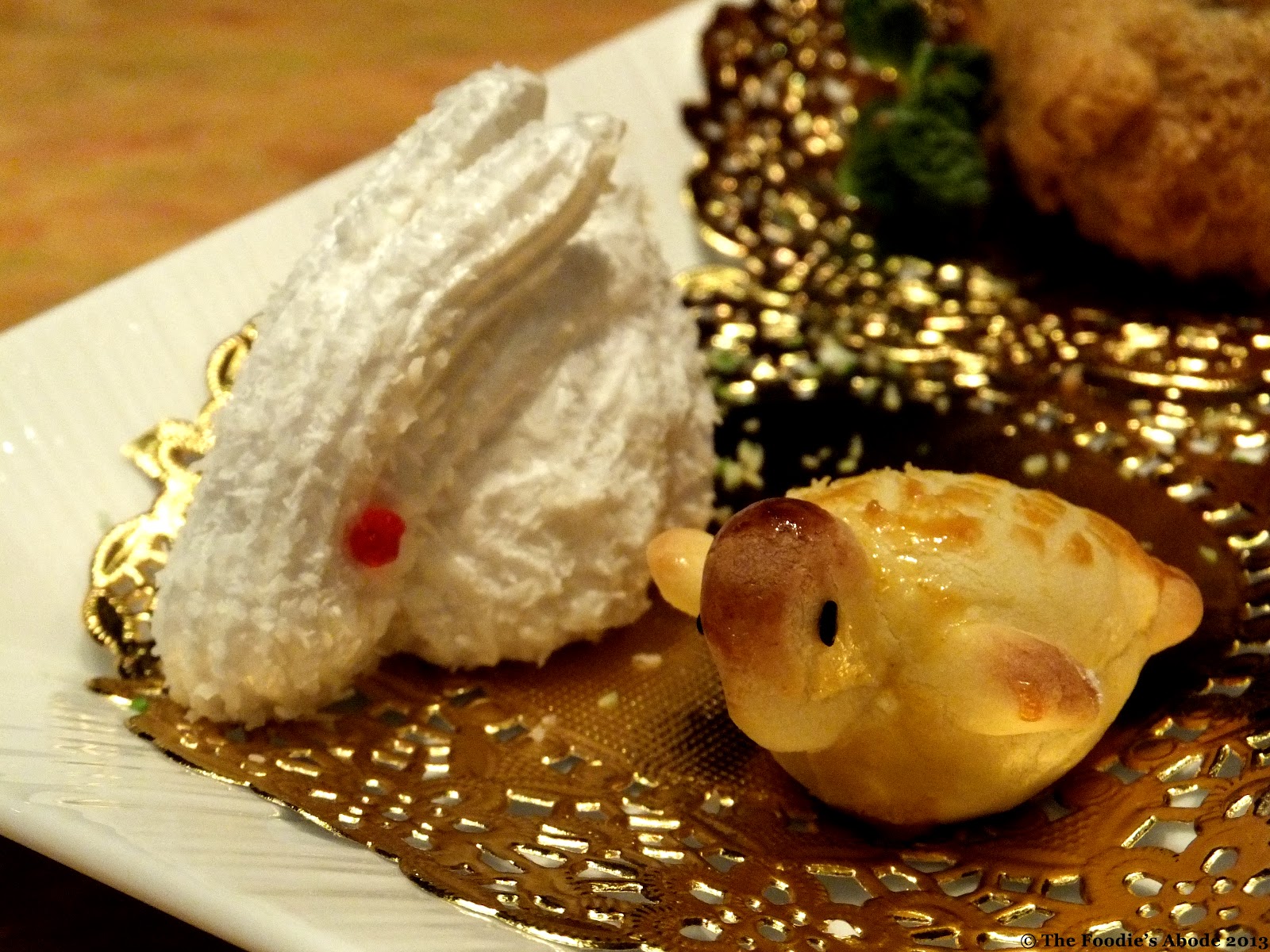
The pièce-de-résistance of the evening, this was probably the most unusual and effective of the lot. A very traditional Chinese dessert of turtle jelly (made of a mixture of powdered plastron and herbs which is supposedly very good for the complexion) was presented not in a bowl (as it usually is) but as two battered and fried chunks. I had my misgivings initially about treating this healthful dessert in the same way as fried ice-cream and Mars bars (in those cases I usually find the thick layer of batter unnecessary and the result terribly greasy and cloying), but here the batter was extremely light and airy, and in fact enhanced instead of detracted from the refreshing bitterness of the jelly. To temper the bitterness, a side dip of ginseng-infused honey was provided (traditionally it is poured over the jelly in a bowl). These two components alone would have made an excellent dessert, but there were two more delightful morsels on the plate: a marshmallow rabbit coated with dessicated coconut, and a custard puff in the shape of (what else?) a turtle. To be honest these did seem somewhat 'tacked on' to the dish, but they were so incredibly cute that I couldn't help being completely mesmerised.

Surprisingly, no petit fours were served unlike what I had read from Tripadvisor reviews; this was probably due to the fact that we had started quite late and were one of the last few tables to leave, and towards the end of the evening the wait staff seemed somewhat more interested in cleaning up to go home than serving us. Or perhaps our orders were deemed too cheap to deserve a few little extras at the end of the meal. In any case, we were already feeling quite full.

The following pictures are of the opulent interiors before we left. We saw ourselves out after payment and some perfunctory thank-yous from the waitress who collected our money. There were no greetings at the door or the like - not the most professional way to end a Michelin-starred meal, if you ask me.


Summary notes: service was quite inattentive. The staff pretty much left us to our own devices after each dish was served, and when collecting the plates all but one waitress didn't bother asking if we enjoyed our food. Despite the number of staff circling around the main dining area (which surprisingly wasn't really full while we were there) we often had to wait a long time for our empty cups of tea to be refilled, and on one occasion when my mum got fed up of waiting and out of her seat to pour it for herself, a waitress finally noticed and rushed over to apologise for their negligence. Towards the end of the evening the staff seemed to be more interested in cleaning up to go home than to serve the remaining few tables. 

In terms of food the creative desserts were probably the most memorable part of the meal. The savoury dishes were definitely competent but mostly lacked an inspired streak. On the whole this had been a decent but unremarkable experience that was all but indistinguishable from my visits to regular Chinese restaurants; I failed to sense how this could have been an elevated Michelin experience, apart from the superficial aspects such as the restaurant's impressive décor. Not too tempted to return, to be honest.

Monday, 31 December 2012

New Year's Eve dinner at Wing Lei (永利軒), Macau

This evening, we visited Wing Lei restaurant in the Wynn casino for dinner before going to join in the countdown celebrations on Nam Van Lake just outside the casino. Whilst planning the gourmet itinerary back home Wing Lei struck me as a very reasonably priced restaurant despite its Michelin accolades, and it seemed like the most logical and convenient choice for our celebration plans.

Being located within a casino, this restaurant attracts a somewhat different sort of crowd, and perhaps not surprisingly, approaching this restaurant through smoky gambling rooms and the sounds of chips and jackpot machines didn't feel quite as elegant and sophisticated  as Zi Yat Heen had yesterday. That didn't matter too much though - we were there only for the food and service within the restaurant.


First impressions were pretty negative, to be honest - we were greeted by a very sullen waitress (caught her in the following photo unintentionally) whose impatience clearly showed through when I requested for a few moments to take a picture of the entrance. She remained unsmiling while showing us to our table. Well, it is New Year's Eve, but you are paid to work after all - and this isn't just any Cantonese restaurant in Macau, but a Michelin-starred one!


The restaurant was pretty full, and the atmosphere was quite informal. Many casually dressed families with children were present that evening, and thankfully the young ones were well-behaved.


We were promptly shown the menus, and to my delight there was a seasonal menu with several appealing dishes, so we decided to sample some items from there as well as from the standard à la carte menu. The manager who took our orders was quite friendly and helpful.

A few more things to mention before moving on to the food: first, the Longjing green tea that we ordered was brewed with water that was too hot, which resulted in a very bitter liquid initially as all the tannins were extracted. I suspect the tea leaves themselves weren't of the highest quality either - they lost their potency and aroma after a few infusions (no thanks to the overheated water as well), and we soon felt as if we were drinking mildly flavoured hot water. I don't usually comment on tea served in Chinese restaurants as long as it is not offensive to the palate, but here the careless brewing really spoiled the delicate and mellow nature of this green tea. In the restaurant's defense, when the bill arrived, we did note that the tea was the cheapest amongst comparable restaurants - as reflected by the quality (or lack thereof) of the brews.

Furthermore, the young man who poured our tea was rather careless - some liquid spilled over into the saucers and onto the tablecloth. The latter was also not well set up - crumpled tablecloths (not our doing!) are a pet peeve of mine in fine restaurants. I wouldn't be highlighting these seemingly insignificant issues for an average Chinese restaurant because one tends to expect rather brusque service and overlooking of minor details anyway, but in an internationally recognised and considerably pricier one such as this, the lack of meticulousness and refinement in general seemed especially glaring.

Table setting with very crumpled tablecloth and
mediocre tea. At least, the colour scheme was
contemporary and aesthetically pleasing.

Sauce dips arranged in a fancy 'bagua' 八卦 dish -
red chilli sauce (sweet and spicy) and
green chilli with herbs (aromatic and refreshing)

And now for the food proper:

Deep-fried king prawn with almond and crispy squash 香脆山葵杏蝦伴黃金勝瓜 - MOP$228 per serving (from the seasonal winter menu)


This was a most comforting start to our meal. Large juicy prawns were coated in a light batter and almond shavings before being deep-fried. The firm springy bite of the prawns and their fresh sweet flavour was very nicely juxtaposed with the crunchy texture and intense nutty aroma of their coating. A creamy and mildly spicy mustard-like sauce drizzled over the prawns aptly enhanced their flavours without overpowering them. The squash accompaniment, done tempura-style, was no less excellent; the light and fluffy batter concealed a rich and moist flesh within, while the black and white sesame seed topping imparted a nice toasty edge to the sweet taste of the squash - a most fitting vegetarian equivalent to the prawn component. A small mound of deep-fried dried seaweed nestled between the prawns and squash completed this satisfying dish with a delightful touch of umami.

Tea smoked crispy chicken 京典茶皇雞 (half) - MOP$138 per serving (from the standard à la carte menu)


A lovely combination of sweet-smelling and smoky aromas, no doubt reinforced by the sprinkling of roasted tea leaves, stuck our noses as the dish was being served, and truly whetted our appetites. This dish tasted every bit as good as it smelled; the flesh was tender, succulent, and extremely tasty from the process of roasting and smoking, while the skin was incredibly thin and crisp, with a pleasant charred taste and just the right amount of underlying fat so that it wasn't in the least cloying. Simple yet effective.

Wok-fried fresh crab meat and crab roe with egg white 蟹黄鲜蟹肉炒蛋白 - MOP$328 per serving (from the seasonal winter menu)


We agreed unanimously that this was the best dish of the evening - light yet luxurious. Its unpretentious composition and execution with minimal seasoning were completely successful in allowing the freshness and quality of each ingredient to shine through. Sweet and succulent chunks of crab meat were paired with a generous amount of bright-orange crab roe that was as appealing in its rich lumpy texture and sweet taste as it was in its colour. A base of egg white provided a pleasantly firm and gelatinous bite, and supported the generally delicate flavours of this dish very well.

Chilled sliced eggplant with shredded barbecued duck and pomelo 柚子鴨絲燒茄子 - MOP$48 per serving (from the standard à la carte menu)


This was actually listed as an appetiser on the menu and its arrival only after three main savoury dishes was very odd indeed. We had almost forgotten that we ordered it! Surely this, with very little actual cooking required, couldn't have taken as long to put together as the three dishes that preceded it? To be fair, it is pretty normal practice for Chinese restaurants to serve whatever is ready first, with little regard for order or progression of dishes; however, in a fine-dining Michelin-starred context such as this, I was certainly expecting more care for such matters.

To be honest, this chilled dish was itself also a bit of a let-down. The shredded duck was a tad tough and dry, and its naturally robust taste clashed with that of the eggplant which had been rather unsubtly marinated in vinegar, amongst other seasonings. Bits of pomelo pulp scattered within the mound were also a strange addition. On the whole I thought that there was very little harmony in this combination of flavours - perhaps they were all too strong and individualistic to co-exist on the same plate.

Wok-fried mixed mushrooms with fresh asparagus and macadamia nuts 夏果蘆筍炒素丁 - MOP$118 per serving (from the standard à la carte menu)


This was a most welcome relief from the disappointing appetiser. In the yam basket lay a generous assortment of exotic premium mushrooms, all with different textures, pleasant aromas, and a deep earthy taste with a delightful herbal edge from cooking with basil. I was pleasantly surprised to find diced chunks of my favourite hedgehog fungus (猴頭菇 - literally: 'monkey head mushroom'), an important component of Traditional Chinese Medicine and one of the four culinary treasures of China, alongside more objectionable ingredients like bear's paws, shark's fins and sea cucumber. The very firm meaty texture and intense flavour of this mushroom were absolutely satisfying and a joy to behold in the palate. The rest of the mushrooms had a generally light and crunchy texture, which went hand-in-hand with the accompaniments of asparagus, peppers and macadamia nuts. To complete this light, wholesome, and tasty dish, a few gingko nuts (another important component of TCM) contributed a mild bitterness that stimulated the tastebuds in the background, and in so doing, heightened one's pleasure at this robust combination of flavours. Why don't vegetarian dishes taste like this more often? For me personally, this came a very close second to the earlier crab dish.

Baked garoupa fillets with mango sauce 香芒焗石斑塊 - MOP$268 per serving (from the seasonal winter menu)


The last of the main dishes to arrive (again a somewhat weird timing for fish), this was extremely enjoyable. A generous portion of garoupa fillets was coated in light batter before baking, then simply covered with a thick and creamy mango sauce with fresh and juicy mango chunks. The fish (very popular in various Asian cuisines) had a sweet and distinct flavour with a rich and silky texture, somewhat reminiscent of cod - very unusual (in a good way!); I'd never thought that this fish could be made to taste like that. The fruity sauce that was poured over the fish was the perfect complement to its taste and texture. A straightforward, unfussy and very solid dish indeed.

Having finished the bulk of the meal, we were left with just about enough stomach space for some rather interesting-sounding desserts. We ordered a bowl of sweet soup each, and also had some egg tarts to share.

Baked egg tarts with ginger and green tea juice 綠茶薑汁雞蛋撻 - MOP$32 per serving


Not just your ordinary egg tarts, these warm and fragrant morsels came with a touch of ginger juice in the smooth and wobbly custard mix that contributed a pleasant spiciness to refresh the palate and relieve any feeling of bloatedness after a feast. The flaky and delicate puff pastry crust was an equally delightful support for the excellent custard mix. The only component I had reservations about was the green tea - the colour at the rims was obvious but its actual flavour and aroma were extremely faint (overpowered perhaps by the sweetness of the custard and spiciness of the ginger), and did little to enhance the taste of the tarts despite the good intentions of the pastry chef. Nonetheless, even without the green tea these tarts were quite special indeed, and we enjoyed every bite of them.

Double-boiled red date soup with lily bulbs and aloe vera 冰花紅棗燉鮮百合蘆薈 - MOP$28 per bowl


The bowl was filled with lush iron-rich red dates, gelatinous and pleasantly chewy cubes of aloe vera fruit with anti-inflammatory properties, and sweet pieces of lily bulbs which are a popular component of TCM prescriptions for stomach ulcers, chronic coughs and spleen deficiencies - a fortifying and nourishing combination of ingredients indeed. The slow double boiling process extracted the full flavour and nutritional value of each ingredient into the soup, making for a naturally sweet and wholesome brew. As with most traditional Chinese dessert soups, this was no mere empty calories from sugar - it was both delicious and good for you!

Sweetened pu-erh tea with pear and honey dates 蜜棗雪梨茶 - MOP$28 per bowl


Another tonic soup with slightly different properties, this consisted of a pu-erh tea-based broth (this fermented dark tea from Yunnan province in China is well known for suppressing fatty acid and blood cholesterol level, in addition to aiding digestion) filled with juicy chunks of Callery pear (a variety native to China and Vietnam, with cleansing properties) and honey dates (very dense in texture, nourishing and rich in iron, as with most date varieties). The taste of this dessert was pretty unusual; the tea's distinct tannic flavour with subtle floral aromas was tempered by a pleasant sweet aftertaste from the fruit additions. On the whole this dessert was light, stimulating and not the least cloyingly sweet - the perfect end to a heavy meal.

Chilled taro soup with rock sugar and osmanthus 桂花蜜香芋 - MOP$28 per bowl


The richest of the desserts, and also the only chilled one, this was absolutely delicious but admittedly a tad heavy on the stomach, coming right after a feast. The bowl was filled to the brim with large chunks of sweet and starchy yam. A broth of rock sugar and osmanthus flowers contributed additional sweetness and a fresh and charming floral taste to the dessert (I absolutely love this flower in any dessert - it's like the Cantonese version of the sweet Western elderflower). The broth was actually too syrupy for my taste (and not helped by the sheer richness of the yam), but diluting it with the mound of shaved ice on top made it much better and more refreshing. We struggled to finish this one, as good as it was!

With that the meal came to a formal end, and petit fours were served in a very pretty Chinese-style multi-layered tray. These consisted of mango mochi coated with dessicated coconut, 雞仔酥 (lit. 'chicken biscuit' - a savoury Cantonese pastry made with malt sugar, peanut oil and sesame seeds) and walnut puff 合桃酥. All were decent, and I liked the mango mochi best for its juicy sweetness and the coconut coating which contributed a nice bite and a rich distinctive flavour.


Some pictures of the restaurant before we left. I really liked the décor actually - bright and colourful without being ostentatious or gaudy. Compared to Zi Yat Heen the day before, the ambience here was more contemporary and casual.


Very intricate gilded wood carving depicting all sorts
of auspicious flora and fauna.

Private dining rooms

Centrepiece of the restaurant - a stunning flying dragon
studded with 90,000 Swarovski crystals and other
hand-blown glass components.


Side entrance/exit

Summary notes: food was generally enjoyable and of very high quality (except for the appetiser and quite appalling tea), but service definitely had room for improvements - otherwise what would distinguish this starred establishment from its 'normal' counterparts? It was all in the details (or lack thereof) - a sullen reception, less than meticulous table setting, tatty menus, and a seemingly random order of serving dishes do not speak well of the place. There was however one very polite and friendly Filipino guy who welcomed us and showed us into the restaurant, and thanked us for our custom when we left and showed us the other way out. I also wish to credit a Ms Ann Leong with whom I corresponded via phone and email for my reservation, and who created a very good first impression on me with her professionalism and enthusiasm.

The prices at Wing Lei are generally lower than in other two-starred restaurants in Macau, and they do a very cheap dim sum deal at lunchtime (MOP$188 per person for any 6 types of dim sum, out of a list of 24), which might be something to consider if you're looking for a fine-dining experience that won't break the bank.

Sunday, 30 December 2012

Lunch at Zi Yat Heen (紫逸軒), Macau

Just before returning to London for the new term I made a short foodie trip to Macau and Hong Kong with family. Away from the glitzy casinos and designer boutiques, there was a wealth of fine Cantonese restaurants to be found, and we were right at home. We visited 4 restaurants over 4 days, ate way too much and came home bursting the scales. This post and the few to follow will review our experiences at these establishments.

There are very few things that soothe the soul better than a sumptuous lunch after an unearthly early-morning flight (read: sleep deprivation), and right after we checked in at our hotel in Macau, we headed south to Four Seasons Hotel on Taipa Island, where our first foodie stop Zi Yat Heen was located.

We were immediately impressed by the impeccable service rendered by hotel staff upon arrival. I should explain - we had come to Macau with notes only in larger denominations given by the exchange bureau back home, and both our taxi driver and our mediocre hotel didn't have any smaller notes in their cash register to exchange for our larger notes; upon reaching our destination we explained our problem with loose change to the doorman, who readily asked the taxi driver to wait while one of his colleagues ran in her heels to the check-in counter to get loose change for us. She returned barely two minutes later with the smaller notes we needed to pay the driver and apologised for making us wait. The doorman, perhaps assuming that we didn't speak or read Cantonese/Chinese, even gave us a small card with names of major attractions in Macau printed in both English and complex Chinese, in case we wanted to get to somewhere else after lunch and needed to ask for directions. We were then welcomed into the hotel very warmly and given directions to the restaurant by the same lady who had obtained the loose change for us. This attentive and proactive reception was simply quite remarkable, and started off our afternoon on a very positive note. I definitely wished we could afford to stay here!

We were too early for our reservation, and the front of house at ZYH informed us that it was a pretty full sitting, so we walked round the hotel and its adjoining shopping mall whilst we waited for our time - first impressions of the surroundings were of grandeur, refinement and elegance. At 1.45 pm we returned to ZYH, where the front of house informed us very apologetically that my requested window table was still being occupied by an earlier party, and asked if we would mind another table for the time being. We were placed in front of the impressive wine cellar, with a good view of the interiors - not a bad alternative at all! We were very comfortable and decided to stay put even when offered a window table midway through our meal.

The restaurant is quite popular and reservations are mandatory; we observed that all walk-ins had to be turned away. It was a full lunch sitting, even at this hour, and apparently booked out for the next two days as well (hardly surprising as it is the holiday period).

Grand entrance portal

Spacious, well-lit interiors

Table setting with the customary two pairs of chopsticks
for reasons of hygiene - one eats with the shorter pair, while
the longer pair is for taking food from the communal serving dish.

Our pot of Longjing (Dragon Well) green tea, with a
pleasant aroma and a sweet mellow flavour that
remained consistent through multiple infusions.
The chilli dips were pretty good (especially for dim
sum) - the one with shredded dried shrimp (at the
back) was particularly tasty with a nice chewy bite.

We decided to go for a mixture of dim sum and seasonal dishes from the à la carte and winter menus, and with some help from our kind waitress selected the following items:

Dim sum

Steamed scallop dumplings with pea sprouts and conpoy (瑤柱豆苗帶子餃) - MOP$54 per serving


This was exquisite - the thin and translucent dough barely concealing a whole tender and juicy scallop topped with chewy shredded conpoy. The delicate sweetness of the scallop and conpoy was well matched by the filling of fresh crunchy pea sprouts on which they sat. Each mouthful was a delightful and refined combination of textures and flavours. Light, wholesome and simply delicious.

Steamed lobster, shrimp and bird's nest dumplings (燕窩海龍皇餃) - MOP$45 per piece


What could I possibly add to this picture of sheer opulence? This giant dumpling was served in individual bamboo steamers to each of us. Bursting at its seams with a generous filling of premium crustaceans, the freshness of each dumpling was evident from its springy texture and juicy sweetness. A luxurious topping of bird's nest and fresh shrimp roe (look at that bright orange colour!) further enhanced each dumpling with both a delightful gelatinous bite and a mildly savoury edge.

Steamed fish maw and chicken wrapped in beancurd sheets (懷舊綿花雞扎) - MOP$30 per piece


A traditional Cantonese-style chicken and mushroom wrap (unfortunately, the English translation ignores the 'traditional' aspect) with dried beancurd skin, this was mostly excellent - the chicken was tender and succulent, the mushrooms had an intense earthy flavour and a juicy springy texture, and the fish maw (dried and rehydrated swim bladder - a Chinese delicacy rich in collagen) had a delicate cotton-like texture (again this is what the English translation omits) with an incredibly rich and velvety mouthfeel. However, the piece of char siew (barbecued pork) included in each wrap not only seemed strangely out of place, but was also rather tough and chewy - the one major letdown in an otherwise superb dish. Thankfully, the well-seasoned broth in which these wraps were served helped to alleviate the dryness of the char siew. Finally, the dried beancurd skin brought everything together with its characteristically concentrated flavour and a mild sweetness. Still pretty successful on the whole, I think.

Crispy taro puffs with roast goose and goose liver (鵝肝火鴨荔蓉酥) - MOP$48 per serving


These deep-fried puffs were plain indulgent and comforting. Beneath their delicate, fluffy and crispy outer layer lay a thick and smooth yam paste, whose sweetness and richness was aptly boosted by sporadic bits of creamy and musky foie gras in the mix. A further filling of tender and succulent diced roast goose contributed a deep gamey flavour to these already hearty morsels. Simply luscious and gratifying.

Baked whole abalone puffs with diced chicken (原隻鮑魚雞粒酥) - MOP$45 per piece


These were quite exceptional indeed. The whole abalones were precisely cooked so that they retained all their natural juices and an amazing tenderness - no mean feat, considering how even slight overcooking could reduce them to dry and rubbery lumps which would take ages to chew through. The bed of diced chicken on which each abalone was sat was equally moist and succulent. A lavish thick sauce (probably derived from abalone) poured over each tart contributed the most magnificent combination of sweet and savoury flavours. Even the puff pastry base was outstanding - firm to the touch yet incredibly delicate to the bite, with a lingering sweet and aromatic aftertaste.

Steamed rice rolls with barbecued pork and preserved vegetables (甘菜叉燒腸粉) - MOP$48 per serving


This was pretty good, though the diced filling of char siew was still a tad dry for my taste (but thankfully not as bad as in the beancurd skin wrap). The bits of preserved vegetables mixed into the meat filling contributed a juicy savoury crunch that immediately lifted its taste and texture. The rice rolls themselves were arguably the best part of this dish - thin to the point of translucence, and so smooth that they slid down the throat effortlessly, especially when lubricated by the excellent light soy sauce that accompanied them. A side of plain steamed baby kailan (Chinese broccoli) with a lovely tender and crunchy texture provided a healthy final touch.

Seasonal dishes from the special winter menu

Braised air-dried duck fillet, chicken and taro in coconut sauce (椰汁香芋油鴨雞煲) - MOP$180 per serving


The first thought that crossed our mind when this dish arrived was: it looks and smells really good, but how are we going to finish all that?! It was an unexpectedly generous portion served in a huge claypot that was enough to feed at least 5 people. This was an extremely heavy and warming dish, totally apt for the chilly winter climate. The air-dried duck had a nice deep flavour but its texture was way too dry and tough for my liking. The chicken fared much better. Large chunks of yam within the broth had a thickening effect with their starchy and creamy texture, and made for an extremely satiating experience. The velvety and sweetly fragrant coconut milk broth was really good (though extremely sinful!), and definitely compensated for any deficiencies in the duck. Bits of spring onion and ginger in the mix enhanced the warming effect of this dish with a mild spiciness. We couldn't help feeling that this dish was too much of a good thing; much as we hated to waste food, we had to leave a bit of it behind, as we were simply too stuffed by the end of the meal to even sit up straight.

Steamed seabass fillet with crispy garlic (香蒜蒸鱸魚柳) - MOP$120 per person


This was my favourite main dish of the afternoon, served to us in individual portions as you can see above. The fish was incredibly moist and silky, and both its delicate flavour and smooth texture were aptly enhanced by a tasty and oily soy sauce. A topping of deep-fried crispy chopped garlic contributed lovely aromas and a most agreeable bite with each mouthful of fish, while pieces of steamed pak choi on the side completed this picture of understated luxury with a healthy touch. On the whole, simple but extraordinarily effective.

One caveat: my family found traces of bones and scales in their portions (mine was perfectly fine though) - I believe that this is rather unacceptable for a restaurant of this rank, and when our server came round to collect our dishes I raised my concerns, to which he promptly apologised and assured us that feedback would be relayed to the kitchen. There was no apparent attempt after that to remedy the situation; I was a little disappointed but saw no point in kicking up a big fuss over a dish that was essentially superb. Imagine our surprise, then, when we got the bill - the cost of one portion had been taken off discreetly without us requesting for it. This proactive and concrete response to a customer's complaint was quite remarkable indeed, and all was forgiven.

Pan-fried beancurd with crab meat (香煎蟹肉豆腐件) - MOP$240 per serving


This was decent but unremarkable. Pieces of a smooth mixture of mashed beancurd and shredded crab meat were pan-fried till golden brown, then set nicely around a mound of blanched Chinese spinach (hidden). Finally, a thick and savoury seafood-based brown sauce was poured over the dish. To be sure there was nothing objectionable at all, but casual Chinese restaurants in London commonly serve an identical dish known as Pei Pa beancurd (琵琶豆腐) for far lower prices, and I failed to see how this Michelin-starred version was different and/or better in any way. Quite overpriced in my opinion for what was essentially a glorified take on beancurd.

From the main à la carte menu

Zi Yat Heen fried rice with lobster and seafood (紫逸軒炒飯) - MOP$220 per serving


I thought this was very enjoyable; every mouthful yielded tender and juicy bits of premium seafood, and the rice grains themselves had just the right texture - firm to the bite but not too dry (though my mother would have preferred her rice softer and more moist, as most older folk tend to do). Bits of chopped spring onions, egg, and a light seasoning provided additional aromas and a nice depth of flavour to the dish.

It was now time for dessert, and as much as I would have liked to go for the full dessert sampler (an assortment of 5 signature desserts), our waitress kindly advised us that it might be too much for us. She was right - we were already quite stuffed by this point, but desserts are obligatory! In the end, we ordered 3 of the signature items individually.

Baked egg tartlets (酥皮蛋撻仔) - MOP$40 per serving


These were simply wonderful. The glistening egg custard filling was very soft and wobbly in texture, yet incredibly aromatic and rich in taste. The crisp puff pastry was similarly delicate and fragrant. These fragile and ephemeral morsels only left one yearning for more.

Chilled osmanthus jelly (瑪瑙桂花糕) - MOP$40 per serving


A staple of Cantonese restaurants only in Hong Kong and Macau, I was really looking forward to this deep amber-coloured dessert but was somewhat disappointed. The jellies were too sweet for my comfort, and their cloying syrupy taste largely masked the more delicate sweet-smelling aroma of the osmanthus flowers as well as the subtle sweet-and-sour taste of the wolfberries, which was a real shame. Refinement and restraint should be the guiding principles for making this light and refreshing dessert.

Baked lotus seed paste puffs (崧化蓮蓉酥) - MOP$40 per serving


These traditional dessert puffs were very good indeed. A thin and flaky pastry layer concealed a generous amount of lotus seed paste that was very smooth and not too sweet. The rich flavour of the paste was well matched by the sesame seed toppings, which added a pleasant toasty aroma and nutty flavour to each mouthful. Modest in execution and presentation, yet exceptional in taste and texture.

Chilled sago cream with mango and pomelo (香芒楊枝甘露) - MOP$50 per person


An extra order for myself - this was acceptable. This dessert is a favourite of many ethnic Chinese people. The soup had just the right degree of sweetness and a decent smooth consistency, though it could have been thicker and creamier. It was punctuated by chewy sago balls, tangy bits of pomelo pulp and juicy chunks of mango. I would have liked more fruit in the bowl and less of the sago balls; that's the whole point of this dessert isn't it?

Some pictures of the restaurant just before we left, one of the last tables to do so after this long and leisurely lunch:


Imposing wine cellar!


On the whole this had been a very pleasant afternoon after a tiring morning of flying, with refined Cantonese cooking, an elegant atmosphere, and exceptionally polite, professional and attentive service from the moment we entered the hotel. Definitely an establishment to consider again if I return to Macau!