We didn't make it to Jiro's restaurant (the subject of the famous foodie documentary 'Jiro Dreams of Sushi'), but this evening we got close enough, at the restaurant of one of his best former disciples Takahashi Harutaka, who had worked at Sukiyabashi Jiro for 12 years. Surprisingly, Harutaka is much more highly regarded by Japanese foodies than Jiro's restaurant, if its Tabelog ranking is anything to go by (3rd place for sushi in Tokyo at the time of writing). It has also been promoted from one to two stars just a month ago, for Tokyo's Michelin Guide 2015. Furthermore, due to Harutaka's late enough opening hours, it has become the favourite supper venue of famous fellow chefs such as Seiji Yamamoto of Ryugin and Masahiro Yoshitake of Sushi Yoshitake, both 3-starred restaurants. With such endorsements, I knew I had to go when I came across this restaurant, researching top sushi places in Tokyo.
I should state at the beginning that reservations at top sushi restaurants in Tokyo are notoriously difficult. As a foreigner (even if you're living in Japan and speak fluent Japanese), you have to book through an existing Japanese customer or a hotel concierge service, and provide credit card details. Restaurateurs often claim that this is because too many foreigners book and then don't show up, something that the Japanese would never do, although I very much doubt the validity of this reason. After all, if one has taken the trouble to travel to the city and make the reservation at a top restaurant, it must hold a certain significance for him and he must want to be there. I myself have never had problems booking top restaurants in other Japanese cities, and Tokyo establishments seem almost unwelcoming by comparison. For this reservation, I had gone through an online concierge service Voyagin for a small administrative fee. (Sukiyabashi Jiro wouldn't even accept this; I was told by staff at Voyagin that they only acknowledge concierges from 5-star hotels.)
I should state at the beginning that reservations at top sushi restaurants in Tokyo are notoriously difficult. As a foreigner (even if you're living in Japan and speak fluent Japanese), you have to book through an existing Japanese customer or a hotel concierge service, and provide credit card details. Restaurateurs often claim that this is because too many foreigners book and then don't show up, something that the Japanese would never do, although I very much doubt the validity of this reason. After all, if one has taken the trouble to travel to the city and make the reservation at a top restaurant, it must hold a certain significance for him and he must want to be there. I myself have never had problems booking top restaurants in other Japanese cities, and Tokyo establishments seem almost unwelcoming by comparison. For this reservation, I had gone through an online concierge service Voyagin for a small administrative fee. (Sukiyabashi Jiro wouldn't even accept this; I was told by staff at Voyagin that they only acknowledge concierges from 5-star hotels.)
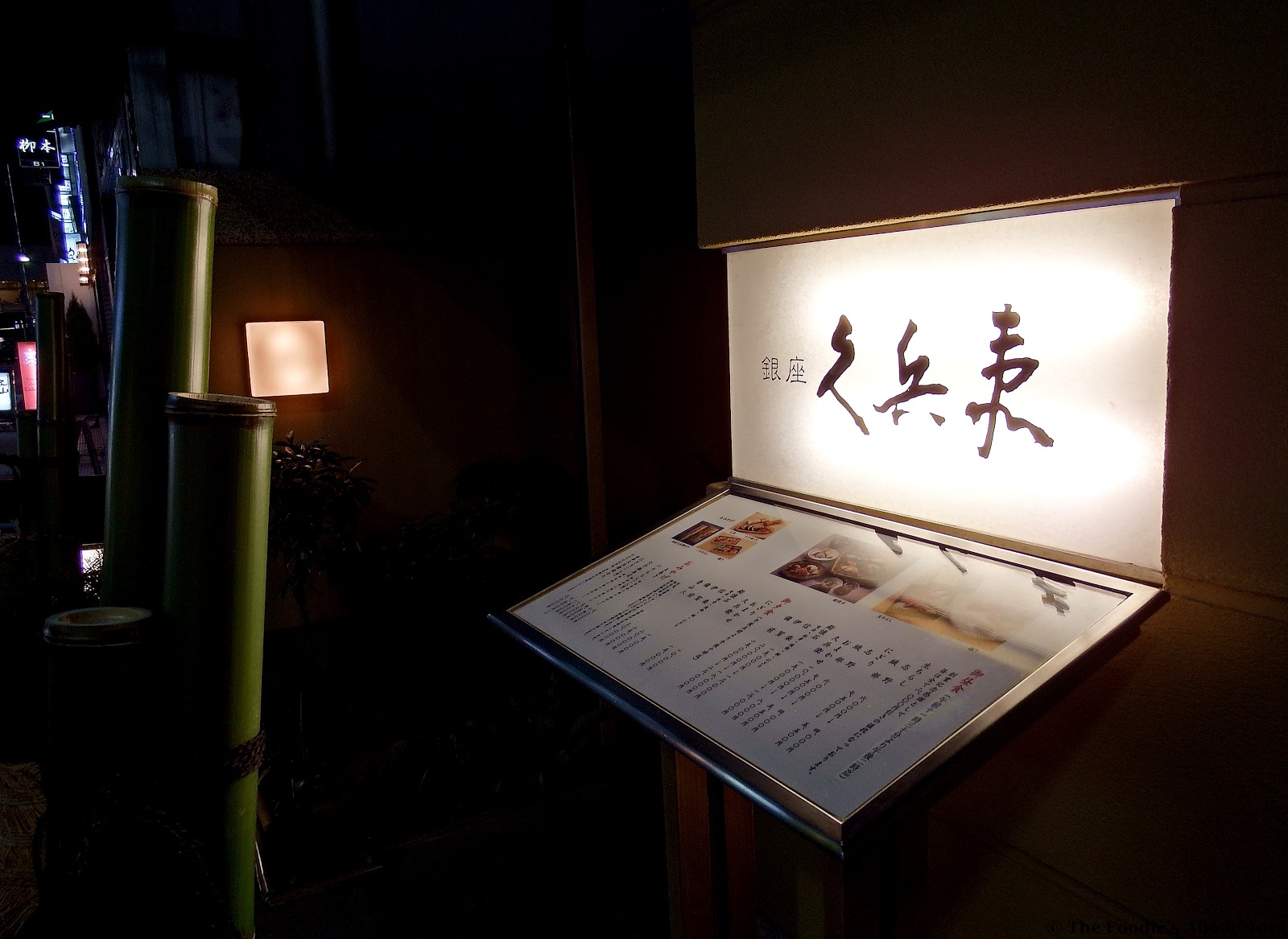
Harutaka's location, as with many high-end restaurants in Tokyo, is extremely obscure, on the 3rd floor of a nondescript Kawabata Building in the Ginza area - we spent a good half hour circling the area's narrow streets trying to figure out where it really was! Even staff of nearby restaurants we approached along the way didn't know the building. Finally, running about 10 minutes late for the 7.30 pm reservation, and already with a sore neck from looking up the sides of buildings, I spotted the discreet illuminated sign in kanji for the restaurant. What a relief.

The building is really narrow and the restaurant on the third floor is really just a hole-in-the-wall; the corridor was barely wide enough for me to pass through!

Fortunately, once past the noren, the environment got much less claustrophobic. This exclusive restaurant seats only about 10 at any time, but individual spaces are pretty ample and the atmosphere is cosy enough, though rather more formal than at Kyubey yesterday evening. The dinner service was already in full swing when we arrived. We were the only foreigners this evening. Our presence was promptly and politely acknowledged by Harutaka-san and his sous chef at the counter, and with typical no-nonsense Japanese efficiency the feast began once we were sat at our places and green tea was served.

There must have been some inconsiderate smokers outside the restaurant (as the building is shared with other offices) due to an unmistakable stench around where we were sitting, but I was assured by Harutaka-san that his entire establishment is non-smoking. He sent someone out to check after I expressed my concerns, and thankfully the stench dissipated soon enough and didn't return to ruin the rest of the evening. High-end sushi can be extremely subtle and complex in flavour, and diners are even requested not to wear strong perfumes and colognes, so cigarette smoke would have been utterly destructive. I mean, this isn't exactly a cheap salaryman's izakaya.
Harutaka-san only opens for dinner, and only two omakase options are available. We went for the sushi omakase at 20,000 yen. There is a more expensive option with sashimi and o-tsumami (side dishes) at 30,000 yen, but I had read numerous reviews about the latter not being particularly impressive, so I decided to stick to what Harutaka-san does best, as one of Jiro's top protégés.
By the way, I have seen several online reviews where customers complained that they were left out of dishes such as abalone, fugu, octopus, an uni platter etc. - they were probably unaware of this but to be fair to Harutaka-san, he will ask you at the beginning which omakase option you want, and if you specify the cheaper option, or don't understand him, you will get the 'basic' omakase as reviewed below. Yes, local/regular customers may get one or two extras (and why not?) but I believe that the treatment of all customers here is generally fair, regardless of nationality or frequency of visits. The frills do come at a significantly higher price, so please don't suffer from unnecessary food envy watching your fellow diners.
The sushi rice here was a little warmer than I was expecting (in fact the warmest of the three sushi restaurants I'd been to), and the fishes were served at a comfortable room temperature, which allowed their flavours to emerge most effectively. Sushi overseas is often served stone-cold in the name of freshness, but through all these experiences in Tokyo I already know that's not the way to go. Seasonings for both the rice and fishes were just right. Also, from the start, there was an impeccable precision to the form and size of each piece of sushi. The fish always enveloped the solidly-packed rice ball underneath perfectly, and every piece fitted comfortably in one mouthful. The fish was always at the right thickness for optimum texture and taste, and the proportion of fish to rice expertly grasped. I was extremely impressed by this constant attention to detail, at an even higher level than at Kyubey. One could even say that each picture-perfect nigiri presented before us was a work of art in its own right.
We started with hirame 平目 (flounder). Its lean and firm flesh with a delicate sweet taste made for a very pleasant beginning to this gastronomic journey.

Next was ika イカ (squid). Its beautifully translucent flesh was cut to just the right thickness so that I was still able to see the rice grains beneath its glistening surface. Because the squid wasn't too thick, it was also extremely easy to work through - no additional fine slits into the flesh needed as is usually the case, and not a hint of unwelcome chewiness at any point. Instead, it was very tender, with a lovely mild sweetness and slightly viscous/creamy mouthfeel. If you're not a fan of squid, this might convert you.

All this while I had been watching Harutaka-san's assistant constantly and deftly making slits into a particular fish for fellow diners, and this was to be our next course. As a pianist, I would certainly have thought twice about putting that sharp knife so close to my fingers and making quick narrow slits like these! Such preparation takes real skills and years of experience.


The result of this expert knifework was an incredibly beautiful piece of sayori さより (halfbeak). This fish was a first for both of us. It is caught off the shores of Japan’s Mie, Ishikawa, Hyogo and Hiroshima prefectures. Prized by the Japanese, it is expensive and usually served in finer restaurants. Visually speaking, this was probably my favourite item of tonight's dinner. The clear translucent flesh somewhat reminiscent of fugu (puffer fish) was slightly more thicky filleted than the previous two items, and had shimmering bits of skin left on (similar to kohada, which would come later). Numerous shallow slits made at equally small intervals were a true test of the chef's skills, as sayori is a very small fish, so if the knife goes just slightly deeper the flesh falls apart. These slits weren't just for aesthetic purposes, of course; they contributed a delightful layered mouthfeel and allowed the nikiri glazing to permeate through and season the flesh more thoroughly. The flesh itself was delicate, clean-tasting and firm, as one would expect from a thin, muscled fish, with only a slight hint of fishiness from natural oils.

The meal started to intensify quickly, and next was a piece of akami 赤身 (lean bluefin tuna), lean and succulent in texture, and full-bodied and complex in taste, as you might be able to imagine from its vivid red colour.

These tantalising cuts of tuna lay direct before me on the counter, and I could hardly wait for them to be served.

It was truly captivating to watch Harutaka-san make his nigiri with such effortless precision and finesse. Foodie theatre at its finest.
The preceding short clip showed our chutoro 中トロ (medium tuna belly) being made, and this cut of tuna had a much tenderer texture and warmer fattier flavour due to the greater presence of natural oils.

And now for the best cut of them all: ootoro 大トロ (fatty tuna belly). With its striped and even marbling and slender appearance, this was the most beautiful piece of fatty tuna I'd ever seen. It tasted every bit as good as it looked - utterly melt-in-the-mouth, and the creamy oily goodness delivered an explosive punch to the tastebuds. This absolute richness, coupled with a mildly sweet aftertaste, was unforgettable.

It was time to descend from cloud nine, and aptly we continued with a firmer and leaner, but equally strong-tasting cut of kohada こはだ (gizzard shard). As described in my previous review of Kyubey, this fishy and strongly vinegared item might be an acquired taste for some, but is particularly effective after that luxurious piece of ootoro. The slits in the kohada here were made even deeper and longer than at Kyubey, presumably to allow the curing to take place more efficiently, as well as for aesthetic reasons. I found the kohada here somewhat gentler in taste and less fishy than at Kyubey.

An even more refreshing nigiri followed. This was hamaguri はまぐり (clam), brushed over with a viscous nitsume. Its juicy crunchy texture and mild briny taste with a tinge of sweetness made for an excellent palate cleanser before the next item.

The next course was a most impressive cut of buri ぶり (amberjack). I was a little surprised when Harutaka-san told me it was buri, as it looked very different with its light pink flesh, intense marbling and no signs of red muscle or skin. He didn't elaborate further, but I guessed correctly that this was from the belly, which I've never actually tasted. This dainty-looking cut packed a real punch with its sweet oily flavour and amazingly melt-in-the-mouth texture. I'm not kidding when I say that it could easily have been passed off as a far more expensive slice of ootoro to unsuspecting diners. It was that good!

The indulgence continued with the best ikura イクラ (seasoned salmon roe) gunkan I'd ever eaten in my life. Look at those juicy glistening jewels! I have had it so many times before, occasionally in fine restaurants (overseas), and yet this was still a remarkably enlightening experience. This evening, I learnt that top-quality ikura is served at room temperature (not cold), and that it doesn't 'pop' in the mouth - the fragile membranes simply give way due to the warmth of the mouth, unleashing a wave of briny buttery goodness that envelopes the palate. This was the first time I've had ikura that felt so smooth. My only regret was that it went down my throat way too quickly - I wanted to savour this sensation again and again!

A second palate cleanser followed, this time with another type of clam akagai 赤貝 (ark shell). It is high in hemoglobin, which explains its red color. In fine sushi restaurants, it is typically cut and presented in the form of a butterfly as you see here. Miyagi, Kagawa, and Chiba Prefecture have the largest catch of ark shells in Japan, and the best season for ark shells in Japan is from November to February. The highest quality ark shells are harvested in deep waters free of pollution, full of nutrients and very cold, contributing to the clams' delicate sweet taste. Unlike hamaguri, the best akagai are usually eaten raw with a touch of wasabi, and brushing of nikiri instead of nitsume. This piece of sushi before me had a firm and chewy flesh, whose mildly sweet flavour and briny aroma slowly became more prominent with each bite. This is one shellfish that needs time getting into, and should be enjoyed slowly.

Moving on, we had a much richer piece of saba さば (mackerel). This was probably taken from near its belly, as its distinctive oily taste was still very much evident despite the curing. The meat was very tender and succulent, and coated with a nice layer of fat as you can see from the photo. It was definitely a better cut than at Kyubey last evening.

Our last palate cleanser of the evening came in the form of a kobashira 小柱 gunkan. While Harutaka-san's sous chef explained it to me as 'soft clam', these small pieces are actually the adductor muscles of the aoyagi 青柳 (mactra clam), commonly used in fine restaurants to fill gunkan sushi (of course, a few clams will be needed as each clam has only two pieces of this muscle). This was my first experience with this part of the shellfish and I found it extremely light and with a lovely spring to each bite - one of the most memorable pieces this evening, mainly for its texture, but also for its juicy sweetness. Kobashira is sometimes erroneously called 'baby scallop' because they are very similar in taste and texture. It was certainly very different from the tougher adductor muscles of the hamaguri that we had yesterday evening at Kyubey. It was also a direct contrast to the previous saba, and reset our tastebuds effectively for the richer sweet items to follow.

From this point onwards, the meal built up quickly towards its ending climax. The first step in this process was a stellar piece of shiro-amadai 白甘鯛 (white tilefish), another first for me. Shiro-amadai is considered a luxury in Japan, an exclusive relative of another high-grade but somewhat more common fish tai (amadai literally means 'sweet bream'), and only fine sushi restaurants can afford to serve this rare and expensive fish. The best season for it is winter, when it is at its plumpest. This piece had a very creamy and soft texture, more so than I would expect for most white fishes, but still not quite as melt-in-the-mouth as that amazing piece of buri we had earlier. Its subtle sweetness made for a lovely continuation of the preceding kobashira gunkan.

With the next uni 雲丹 (sea urchin) gunkan we were back on familiar ground, and it was impossible to dislike this full-bodied, sweet and creamy topping from Hokkaido. The visually appealing bright-orange pieces of uni were far plumper than anything I'd ever seen. Truly to die for!

The final piece of nigiri featured a generous slice of anago 穴子 (conger eel) that had an incredible melt-in-the-mouth softness, and a rich fatty flavour with a delightfully sweet aftertaste, no doubt enhanced by the brushing of nitsume.

We were not quite done yet, though; the most unlikely pièce de résistance came as two chunks of tamago-yaki 玉子焼 (layered Japanese omelette) with a touch of prawn stock. This was truly the stuff of gods, so soft and fluffy it felt like butter sponge instead of egg! The evenly caramelised top layer really made it look like a piece of cake too.
The method for making perfect tamago-yaki of course originates from Jiro (fans of the documentary will remember that there was even an apprentice chef who recounted how he had been made to repeat the process 200 times before the old master finally became satisfied with the outcome); it was obvious that Harutaka-san had also taken his mentor's teachings to heart, as this stunning and unique tamago-yaki illustrated; that alone might have been well worth the visit. The tamago-yaki here was definitely not just an afterthought to a sushi omakase, and I don't think I'll ever have anything like it again, unless I get a reservation at Jiro's, or the restaurants of his best protégés.

After this, Harutaka-san informed us that we were at the end of the omakase with one more hosomaki course to go, and we were given the usual options of negitoro, kanpyou etc. We finally chose to have 鉄火巻 tekkamaki (with a filling of sliced akami) as this is rather unusual as well. The dense maki roll, packed tightly with rice and tuna, filled our tummies just nicely.

Harutaka-san then asked if we were full, and whether we would like to repeat any particular items. My partner couldn't eat any more but I went ahead with two more orders of tamago-yaki and uni gunkan (how could I not!). In hindsight, I probably would have repeated the buri, ikura and shiro-amadai as well, if my stomach would allow it.


The next video clip of Harutaka-san's sous chef grating fresh wasabi will show you what the real thing is like - it is hardly the thick green goo that comes out of a tube or is scooped out of a container in all cheaper places. Needless to say, the taste of real wasabi is infinitely better than the cheap fake versions as well.
 |
| Harutaka-san at work with a fillet of saba. |
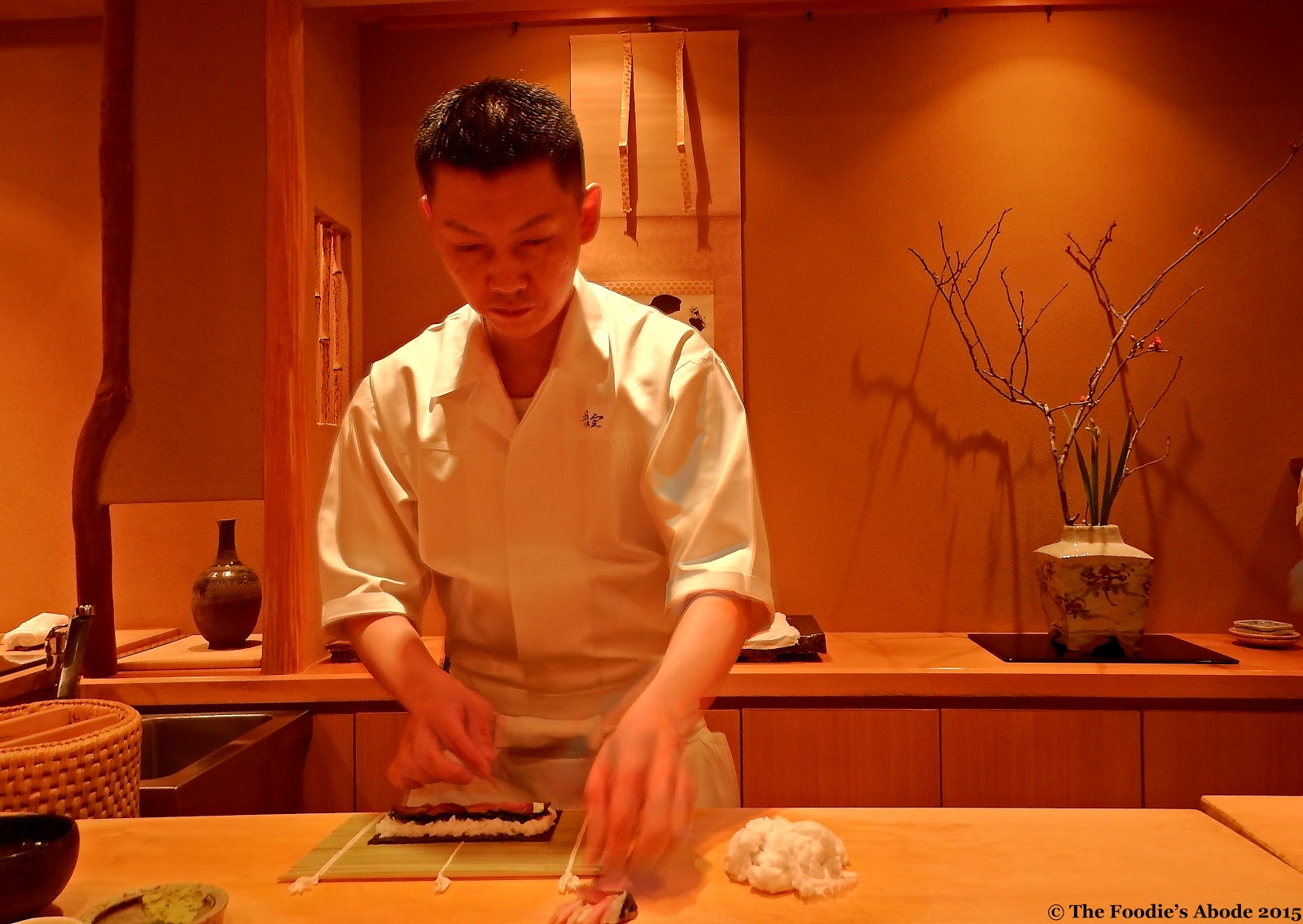 |
| Moving on to kanpyou maki... |
 |
| And making sure it's all packed in firmly, pressing down while rolling up. |
Surprisingly, the final bill came to slightly above 41,000 yen for two (no drinks, just complimentary green tea), which was lower than I had expected considering two extra items, and the tax and service charge that fine restaurants usually take. I'm not sure how that worked, since top restaurants in Japan always present the bill as a total amount, not as an itemised list - maybe the extra items were meant to be on the house (?!), or maybe there was no tax and service charge at all?
The meal had been very well-paced, the ambience was remarkably comfortable for such a small and quiet restaurant, and watching Harutaka-san make his nigiri with a machine-like exactitude and speed had been a mesmerising theatrical treat in itself. As we got up to leave, both Harutaka-san and his sous chef bowed and bade us farewell, then went back to their work, almost without missing a beat. We were seen to the door and thanked once again by a member of the service staff. As we exited the tiny building, I couldn't help thinking what a dream the past two and a half hours had been. There may well be better sushi restaurants in Tokyo, but for now I was completely satisfied.
Details for Harutaka (青空)
Address in kanji: 東京都 中央区 銀座 8-5-8 かわばたビル3F
Tel.: +81-3-3573-1144 (reservations compulsory through a concierge)
Business hours: 17:00 – late (last orders Monday-Friday at 23:30; Saturday at 22:30; closed Sunday and public holidays)
Credit cards: all accepted
Credit cards: all accepted