Showing posts with label The World's 50 Best Restaurants by St. Pellegrino. Show all posts

Wednesday, 6 May 2015

Lunch at Restaurant André, Singapore

This afternoon, I finally revisited my favourite restaurant in Singapore for a long-overdue lunch with an ex-student Dylan. He had been wanting to experience what it was like in a top restaurant and I thought there was no better place in this country to take him. With a multitude of awards to its name, and definitely more to come, Restaurant André is undoubtedly one of Singapore's finest gastronomic establishments. My first solo lunch here last year had been most impressive. It is very rare, if at all possible, to come across a restaurant in Singapore that possesses a complete mastery of both food and service, and Restaurant André simply ticked all the right boxes, just like during my best gourmet experiences in Europe and Japan. Naturally, I was very excited to be returning.

As requested, we got a lovely table by the window this time, great for the view outside as well as for taking food pictures with ample lighting. It should be mentioned that currently,  Restaurant André only serves its cheaper set lunch (price unchanged at 5 courses for $128++) on Wednesdays and Fridays, not every day as was the case before this year. Book well in advance as seats are extremely limited and demand is constantly high - even more so for the twice-a-week lunch service.


Dylan, who has truly blossomed into a fine young man
since I taught him a couple of years ago!

Today's menu
(it changes every day depending on what's best from the market)

Amuse-bouche: rice cracker topped with sea urchin emulsion, Oscietra caviar, gold leaf, egg white, dill and oyster leaves.


A crisp plain rice cracker made for the perfect backdrop to a multitude of tasty toppings to stimulate the palate. These included sweet and creamy sea urchin emulsion, juicy and briny caviar, and bits of oyster leaves which tasted exactly as their name suggests, adding a further touch of umami. The canapé was also kept fresh and light by small blobs of soft egg white and strongly aromatic dill leaves which complemented the deep taste of the other toppings perfectly. Scattered bits of gold leaf imparted a final hint of luxury to this pleasant morsel.

Starter: stone crab and sea urchin tartare, sour cream, compressed cucumber, cucumber pearls, elderflower jelly, chamomile powder, shallots, wild herbs (kinome, cress) and flowers.


This was a most sophisticated and wholesome salad. The luscious base consisted of chunks of shredded crabmeat mixed with sea urchin to form a sweet, succulent and creamy tartare, which was itself surrounded by a ring of light sour cream for balance. Discs of compressed cucumber were then carefully arranged on top, and their fresh concentrated sweetness and firm juicy texture were perfect complements to the tartare. Gelatinous cucumber pearls provided an additional bite and burst of flavour, while chamomile powder sprinkled on the discs and bits of elderflower jelly scattered throughout the salad imparted the most delightfully sweet floral aromas. Herb garnishes of kinome and cress completed this dish on a very clean and spicy note. Despite the multitude of seemingly disparate ingredients, they all came together to form a truly well-balanced and satisfying starter.

Bread and butter came next, and the coupling of a warm, crisp and full-bodied sourdough with silky, creamy and delicate Échiré butter from Western France was perfect. French butters are indeed one of life's greatest pleasures.


Soup: chicory soup with chicken skin and liver, millefeuille of chicory terrine, crispy fried cockscomb and tarragon emulsion.


This light foamy soup was very tasty and moreish. The mild bitterness and roasted coffee-like flavour of chicory was an extremely effective balance for the crisp paper-thin slivers of roasted chicken skin and creamy and musky pieces of chicken liver within the soup. On the side was probably the most unusual combination of ingredients I'd ever seen - deep fried aromatic cockscomb with a firm gelatinous crunch (like soft bone) contrasted with juicy and mildly bitter leaves of white Belgian endive arranged in layers, wrapped with a sugarloaf leaf and skewered. For further freshness, a surrounding emulsion of French tarragon, the best variety of tarragon and one of the four fines herbes of French cooking, imparted a distinctive sweet aroma reminiscent of anise and licorice. The emulsion's fruity and slightly astringent olive oil base certainly helped too. On the whole, this was a very well balanced dish with lovely touches of indulgence.

Fish: charred Spanish mackerel, served with sea lettuce, iceberg, celery, smoked carrot tartare, smoked eel sauce and seaweed powder.


This fillet of Spanish mackerel came from Japan, where it is known as sawara and is considered the best kind of mackerel. It is in season from late autumn till the end of spring, so we caught it just in time. Its flesh was perhaps not quite as oily as the ones caught in the height of winter, but still remained very moist and firm, with a characteristically rich taste. The skin was nicely charred, which added a nice crispy bite and further depth of flavour. Surrounding the fish were a variety of accompaniments selected to enhance its smoky umami. In particular, I loved the clear smoked eel sauce for its lightness, and the bits of carrot for their juicy sweetness amidst an unusual smoky depth. Sea lettuce (a kind of seaweed) was a first for me, and I liked its succulent texture and delicate briny taste. Shreds of iceberg, slivers of celery, and garnishes of shallot and cress kept this dish feeling very clean and crisp throughout. Indeed, it was quite remarkable how a dish could feel this delicate yet possess such an intense overall flavour.

Meat: poached baby lamb saddle, crispy wild granola with Israeli couscous, deep-fried lamb fat, roasted onions and potatoes, potato skin, smoked onion and potato jus.


The most substantial dish of today's lunch, the lamb saddle was absolutely tender and melt-in-the-mouth, with a rich gamey flavour thanks to the meat's ample fat content. This robust meat was aptly matched by equally full-bodied accompaniments, including a tasty jus of smoked onion and potato, with a good portion of roasted onions and potatoes to go along. The roasted potatoes were perfect - nicely browned and crisp on the surface, with a light and airy body - not the slightest hint of greasiness or starchiness throughout. Crispy bits of deep-fried lamb fat scattered throughout the dish, similar to deep-fried lard in a much humbler local hawker context, were utterly sinful but oh-so-delicious. For further bite and flavour, toasted granola with an intense nuttiness was paired with firm and chewy large grains of Israeli couscous made from hard wheat flour, a very different variety from the common fluffy powder-like North African couscous derived from semolina. A semblance of delicacy was provided by a fresh oregano garnish and ephemeral slivers of potato skin (how do they even achieve that thinness?!). I was completely sold on the sheer opulence of this elevated take on Sunday roast.

Dessert: whipped watermelon, red fruit Ispahan (rose and lychee sorbet, red berries, strawberries, rhubarb).


Anyone into French pâtisserie, specifically macarons, will know of the rose-lychee-raspberry combination known as Ispahan, created by the famous Pierre Hermé during his early tenure at Ladurée, and now a signature confectionery at both establishments. André's version of Ispahan featured a dainty sorbet combining the deep sweetness of lychees with the delicate aroma of roses, enhanced by bits of dried rose petals scattered over it. The sorbet was surrounded by a pool of whipped watermelon that had the consistency of a very light and smooth mousse. Hidden at the base of the dish were fresh berries, strawberries and chunks of rhubarb, which balanced the overall sweetness with their juicy tanginess. On the whole, this was a crisp and elegant dessert that contrasted very nicely with the rather heavy preceding meat course, almost like a palate cleanser.

Dessert: 'apple tart'.


Another creative take on a classic dessert, this was essentially a deconstructed apple tart. Within two concentric rings of soft cinnamon dough lay a generous amount of apple compote with fresh diced apples and caramelised apple & cinnamon film, poached blackberries and raspberries, chopped hazelnuts and seaweed crystallised with sugar, topped with a scoop of milk ice-cream.

I was particularly impressed by the crisp paper-thin apple film which carried a remarkably intense flavour despite its appearance, as well as the apple compote, which was soft but not mushy, and had a light tangy flavour much easier on the tastebuds than the typically cloying pie/crumble filling. The other fruit components also had a delightful juiciness. It was not all delicate and airy though; the deep, warm and mildly spicy aroma of cinnamon permeated this dessert, the milk ice-cream on top was absolutely luscious and full-bodied, while chopped roasted hazelnuts provided both a substantial crunch and a distinctive toastiness. Finally, in what must be the most unusual and inspired touch ever in a dessert, tiny stalks of seaweed crystallised with sugar contributed a subtle and astonishingly effective umami that, like jewels in the crown, really enhanced the elegant sweetness of this 'tart'. I couldn't have asked for a more sophisticated conclusion to an excellent meal.

As always, André came out to greet every table towards the end of the lunch service. I love his personal touch and hands-on approach, which sets him apart from many other celebrity chefs who are busy doing everything else except being in their own kitchens for quality control. This time I didn't miss the opportunity to congratulate him on the recent opening of his new restaurant RAW in December 2014 back in his hometown of Taipei, and we had a nice chat about his reasons for wanting to establish a presence in his home country. It's more than a business franchise; his patriotism is well-known and I got the impression that for him as a pioneer in the fine-dining scene, it was mainly about wanting to give younger Taiwanese chefs a chance to hone their craft in this industry, to showcase the possibilities of Taiwanese produce to the world and to create a unique brand of fine-dining - a fusion of European and Taiwanese culinary cultures. His heart is certainly in the right place, and it seems that RAW is already one of the most sought-after tables in the city; I hope I get to try it one day! But please André, don't leave Singapore just yet!


Service was stellar as always - warm, eloquent and knowledgeable, an experience here is probably as close to top European standards as you can get. There were a couple of new faces, but my two favourite members of staff, managers Stepan and Alain, were still around and they actually remembered me (maybe because I talk too much!). Unfortunately, I learnt that Alain would be leaving the restaurant very soon for his native France for an extended break, before deciding where in Europe to work next. Singapore has been his first and only Asian sojourn and he's loved it so far, but he feels it's now time to be closer to family. It's a real shame that we couldn't get to know each other even better in Singapore, but I did express my interest to stay in touch, and I know he'll do very well wherever he chooses to go. All the best Alain!

Needless to say, one can hardly go wrong coming here for the occasional indulgence - I can't wait for my next visit already!

Friday, 11 July 2014

Lunch at Restaurant André, Singapore

After a pretty long break from fine restaurants due to work commitments, I finally made time for lunch today at Restaurant André. The restaurant is the brainchild of Taiwan-born André Chiang, who had trained in France under giants such as Pierre Gagnaire and Pascal Barbot. Upon his return to Asia in 2008, he first made his mark in Singapore's gastronomic scene as the former head chef of Jaan restaurant in Swissôtel The Stamford, pushing it to international attention by making the St. Pellegrino World's Top 50 list in 2010, before deciding to set up shop in this small space just next to Majestic Hotel in the Chinatown area. His own flagship has since garnered numerous awards, including Best Restaurant in Singapore at the inaugural St. Pellegrino Asia's Top 50 list in 2013, and the Chefs' Choice Award this year.

Upon arrival, I was struck by the presence of an olive tree. As the maître d' Alain would later tell me, this is the only real living olive tree outside Europe! In this weather it is obviously non-fruiting, but it is indeed a fitting tribute to Chiang's French culinary roots, and a lovely gesture that transports diners immediately to another part of the world.


Waiting lounge

Private dining area / chef's table

Main dining room

The restaurant seems very popular amongst Japanese people, and I was literally surrounded by them on this occasion. They even have a Japanese sommelier on the service team. As you will see from the dishes very soon, this is perhaps not too surprising considering that the cooking often displays very strong Asian (particularly, Japanese) influences. Much of the fish and seafood is also imported daily from Japan, presumably for their quality. Chiang himself is a champion of nouvelle cuisine which advocates light, creative and beautiful dishes with strong regional influences, made only with fresh ingredients and natural seasonings, not dissimilar to the kaiseki aesthetic.

The rest of the staff is pretty international too, and with very impressive backgrounds; Alain is of Brazilian-French parentage and grew up and trained in France at top restaurants such as Pierre Gagnaire and Guy Savoy, while general manager Stepan is Czech and had been responsible for running the now-defunct Gordon Ramsay outpost in Prague before relocating to Singapore.

The main dining space was very elegantly appointed yet retained a charming shophouse feel to it. I felt at easy very quickly in this intimate and cosy environment.

Adorable ceramic doves by the window!

Chiang is best known for his 'Octaphilosophy' dinner menu, a tribute to his personal and culinary heritage, featuring eight courses that highlight one characteristic each (for example, 'Texture' or 'Terroir'). Lunch is however much cheaper at less than half the price for 5 courses, which is a good idea if you're just wanting to test out the place without breaking the bank. When making the reservation, I had requested for an extended lunch menu at a small supplement.

It is worth mentioning that only tasting menus are available for both lunch and dinner (i.e. no à la carte). Also, with two notable exceptions (which you will see later), no two dishes are the same from one day to the next, as Chiang fixes the menu only during the morning before the restaurant opens, depending on what he gets sent for the day. I do love this element of surprise, but only in the hands of a good chef!

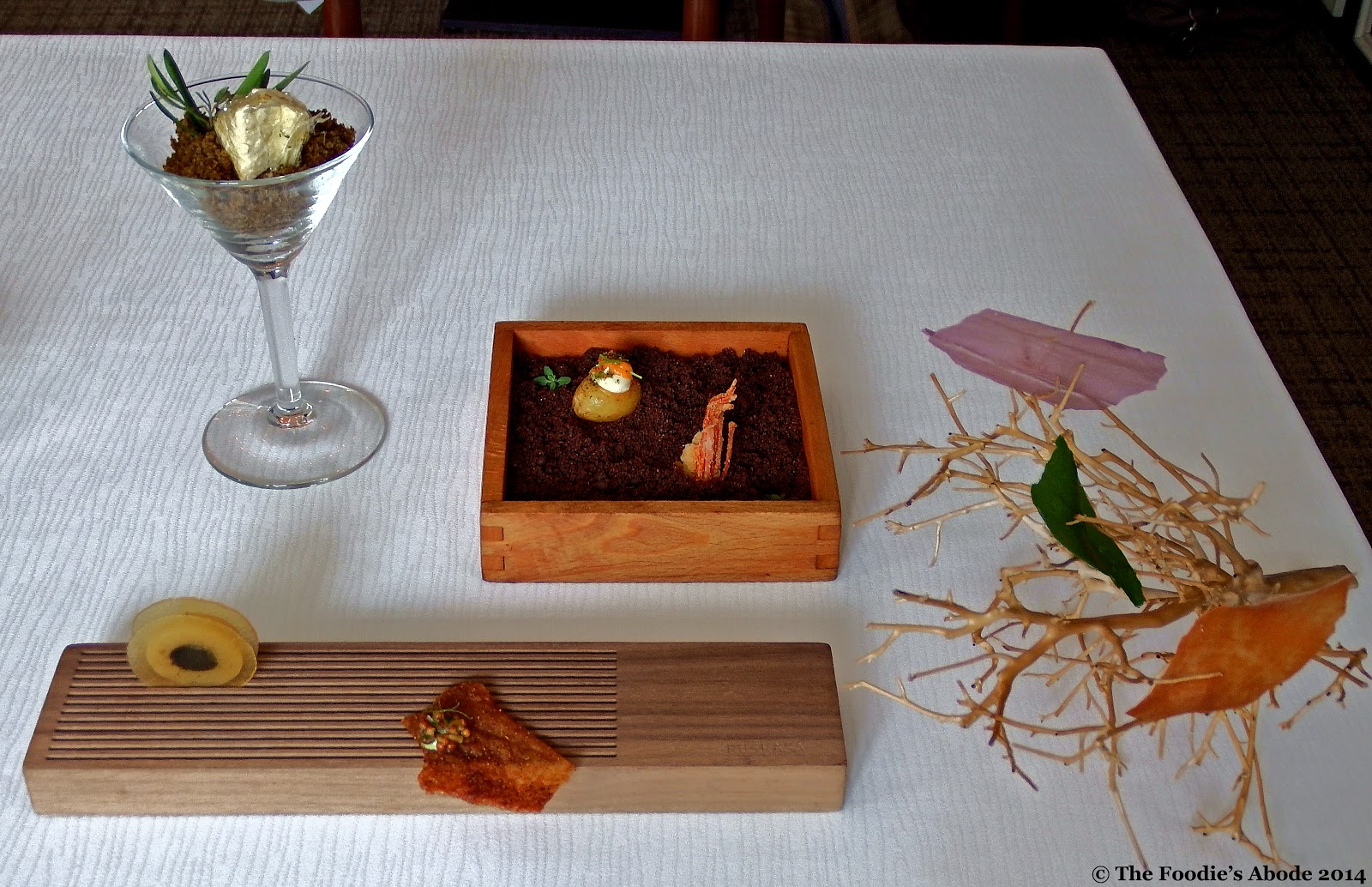
The meal started off with an apt flamboyance; a whole array of canapés was served in quick succession, and this proliferation of colours and textures was very impressive indeed.

'Snacking'


These were thin crispy films of Japanese purple yam (beni-imo), Swiss chard and scallop. Note that I called them 'films', not 'crisps' or 'chips'. I have no idea how the kitchen achieved this, but the feather-light and translucent pieces were just bursting with incredible flavours and aromas. I loved especially the deep umami of the scallop one. Each bite was so brief and ephemeral, yet more than sufficient to tantalise the tastebuds.


Next came two stronger bites: chicken masala cracker with mint cream and cep mushrooms, and a disc consisting of various textures of onion (jellied, puréed and caramelised). These distinctively Indian morsels were very tasty. The cracker had an intense spiced flavour that was aptly enhanced by an earthy touch of ceps and balanced by some fresh and light mint cream. The onion disc had a surprisingly sweet flavour and was not as pungent as I thought it would be. The three different textures also displayed a sophisticated technique that was as effective to the palate as it was striking to the eye.


Next, a wooden box containing a deep fried prawn head and a roasted baby potato with aioli cream and chorizo coulis, on a bed of chocolate and garlic soil. The contents were all warm, and this was sheer comfort food. The prawn head done tempura-style was extremely light, crispy and fragrant. Its slightly heavier jacket potato-like companion was very tasty (you can't go wrong with an garlic-and-chorizo flavour combination) and still rather less starchy and more fluffy on the inside than I was expecting it to be. For me however, the truly inspired touch came in the soil - who thinks of using chocolate in this manner?! Its slight bitterness and fruitiness was a remarkably effective pairing for these morsels and for the intense garlic aromas permeating this box. This soil was so delicious that I was still eating it with my fingers well after I had finished the two main bites; I would have finished it if I weren't embarrassed about being in a fine restaurant! Upon seeing how much of the soil had been finished when he came to clear the box, Alain couldn't help but chuckle as well.


Lastly, 'gin and tonic' in a crispy nougat-like form on green olive soil. Again, no mean technical feat with the 'G&T' - no idea how the kitchen did it, but despite its chunky nougat-like appearance it was absolutely crisp and light, with no resistance or stickiness whatsoever when chewing. Each bite released authentically fresh and bitter flavours - a truly striking re-interpretation of G&T. The soil introduced a savoury dimension, but even though I do love olives, this dried soil version was a little too intense and briny for me, and threatened to overpower the 'G&T' even when the latter was just lightly dipped into it.


Amuse-bouche: blanched asparagus with textures of broccoli (puréed, fresh and deep-fried), macadamia shavings and miso cream.


The asparagus was crunchy, juicy and sweet, while the variations on broccoli highlighted different aspects of the vegetable's flavour. I liked the deep-fried bits best for their caramelised flavour and crispness. Macadamia shavings imparted a lovely crunch while dollops of miso cream enhanced the delicate vegetal sweetness of this dish very effectively with a deep umami. On the whole this was a simple, elegant, and wholesome way to begin the meal proper.

First course: lightly cured kanpachi (yellowtail) sashimi with a touch of yuzu vinaigrette, on a bed of fromage blanc. Toppings of tapioca pearls, Oscietra caviar, celery and mustard pearls, daikon strips, grapefruit pulp and olive oil.


Japanese sashimi with a French slant, the delicate flavour of the fish was wonderfully complemented by the yuzu vinaigrette, which was the first condiment to strike me due to its unmistakable aroma. The bed of fromage blanc, a fat-free unfermented fresh cheese similar to yoghurt, was very light and imparted a delightful smoothness to each mouthful whilst not overpowering the subtle flavours of this dish at all. The rest of the accompaniments also did their part in enhancing the fish. The caviar and olive oil in particular were of particularly high quality; the caviar had a juicy salinity to it beneath the thin gelatinous membranes, while the olive oil was incredibly fresh and fruity with a slight bitter edge.

Second course: 'white on white' - warm salad of cauliflower (shaved and puréed), fromage blanc, ajo blanco (white garlic) sauce, ika (Japanese squid) à la plancha.


This warm dish made an immediate impression with an intense garlic aroma combined with a lovely caramelised edge from grilled squid. Despite its monochrome appearance and seemingly chaotic plating, it tasted every bit as good as it smelled. The delicate sweetness and freshness of cauliflower and fromage blanc were perfectly contrasted by the rich and foamy garlic sauce. The cauliflower shavings had a pleasant juicy crunch while the purée was smooth and creamy. The solid bits of fromage blanc snow surely made a visual impact when the warm garlic sauce was poured over the dish, half-'melting' the snow into bigger viscous blobs. Hidden between the layers of shaved and puréed cauliflower were amazingly tender, succulent and tasty pieces of squid. We all know how easy it is for seafood such as squid/cuttlefish/octopus to be overcooked and become rubbery and chewy, so this was surely proof of the chefs' skills.

Third course: 'paella' of gambas and potage - with Mozambique prawn done two ways (pan-fried and deep fried), poached Japanese abalone and Spanish prawn, rabbit wrapped in Bigorre bacon, senbei (rice & nori cracker), edamame and piquillo pepper purées, and saffron-infused paella sauce.


Stepan announced this dish with, 'Now you don't have to leave the restaurant to be transported to Spain, on the other side of the world!' Indeed, they had taken me there with a deconstructed luxury version of the classic Spanish rice dish - although there wasn't a single grain of rice here, this dish was still absolutely comforting and bursting with flavour from all the premium seafood and meat in the plate. The Mozambique prawn stood out for its different textures (firm juicy body with a light and crispy head), the abalone for its tenderness, the rabbit for its rich gamey flavour aptly enhanced by the bacon wrap, and the senbei for its crispness and deep umami. All these were bound together by a generous pool of very tasty paella sauce, infused with the bright colour and subtle aroma of saffron. This dish, familiar in so many respects, also demonstrated a strong and effective fusion of Japanese and Spanish elements. Presentation-wise, it was really colourful and appealing when it arrived but too bad I couldn't snap a picture in time before the paella sauce was poured in, submerging the meticulous plating beneath!

Fourth course: 'champignons' - textures of mushrooms: puréed, grilled, blanched, dried and dehydrated (powdered), using black trumpet and cep mushrooms. Surrounded by herb oil and purée, and topped with shavings of Périgord truffle.


Mushroom broth poured in - heavenly!

For a mushroom lover this was pure bliss; the deep earthy flavours and aromas of mushrooms in their various forms were omnipresent and simply intoxicating. The incredible variety of textures present within just one main ingredient was testimony to the chefs' technique, and a sheer delight for the tastebuds as I worked my way through different layers in one mouthful. Carefully-shaved truffle discs formed the jewels to the crown. The surrounding herbs were a very good idea indeed for keeping the palate fresh through all this indulgence.

Fifth course: slow-braised Japanese abalone in seawater, konbu (Japanese kelp) risotto with okra and wild kelp coulis. Topped with grated botargo and a leaf of Japanese sea lettuce.


The basic ingredient of Japanese cooking, konbu, was wonderfully combined with an Italian staple here. For a while I couldn't quite decide whether this was more of a zosui (Japanese-style porridge) or risotto; both appeared to be equally credible options. This seemingly delicate dish had a remarkably deep flavour from konbu and botargo, while the rice grains had retained the firm and satisfying bite typical of a good risotto. The abalone came in much thicker chunks than in the earlier 'paella' dish but was still amazingly tender and easy to chew through - no signs of dryness or rubberiness whatsoever. The truly ingenious touch for me, however, was mixing okra (lady's finger) with the risotto to re-create an authentically rich, silky and creamy texture without actually using cream or butter in the cooking sauce. The result was a rice dish that felt really luxurious to the palate, yet remained extremely light, fresh and wholesome throughout.

Sixth course: 'memory' - warm foie gras jelly, Périgord truffle coulis, fleur de sel and Japanese chives.


This dish was clearly a tribute to Chiang's classical French training as well as a delightful re-interpretation of the popular Japanese side dish of chawanmushi (steamed savoury egg custard). It is actually the only true staple of this restaurant - part of the more elaborate dinner menu but also served at lunch. The foie gras jelly had a very soft and rich consistency and intense musky flavour, and it met its equal in the deep earthy aroma of the truffle coulis. A sprinkling of sea salt and chives was the icing on this petite but extravagant creation.

Seventh course: 24-hour sous-vide short rib, charcoal-grilled baby leek, XO beurre blanc purée, pickled shallots, shredded dried scallops, garlic bread crouton, beef jus.


The most substantial course of this lunch, this beef fillet was absolutely tender and juicy, and it had a most delightful crispy top layer as it had been pan-seared just before serving. Its rich flavour was well-matched by the creamy purée, which had a very familiar taste due to the addition of XO sauce (which, despite its name, is actually just a spicy dried seafood sauce popular in Cantonese cooking, and does not contain any cognac). Dried scallops, another popular ingredient in both Cantonese and Japanese cooking, were also featured, and contributed a lovely deep flavour to the delicately sweet and juicy leeks. The latter also went hand-in-hand with the crispy garlic bread croutons and pickled shallots, both of which had a similarly pleasant pungence. On the whole, this main course was luxurious, really tasty and aromatic, and ended the savoury part of the meal with considerable aplomb. I couldn't wait to see what other surprises the desserts might offer.

Meanwhile, Chiang was doing his rounds in the restaurant and greeting every table, and of course I didn't miss the opportunity for a photo with him (thank you Alain for this!). I could only say to him how great the food had been so far, but he's probably heard it thousands of times now!


First dessert: 'pineapple cake' - shell of fresh pineapple containing a filling of small chunks of caramelised pineapple, and coated with fine biscuit crumbs. Served with vanilla ice-cream and coconut chantilly cream.


With this first dessert, Chiang finally returned to his personal roots. There is arguably no pastry from Taiwan more representative than pineapple cake (鳳梨酥). This posh take on the popular Taiwanese snack seemed somewhat plain and straightforward compared to the preceding dishes, but what really mattered was how it tasted, and on that count it certainly delivered. Texturally, this was a sheer delight with crunchy and juicy fresh pineapples encasing a filling of soft and pulpy caramelised pineapples. The biscuit layer of this pastry came as no more than a fine coating of crumbs over the outer pineapple shell, making it possibly the purest and most lavish pineapple cake I would ever eat. The accompanying vanilla ice cream and coconut cream were a very solid combination which enhanced the tropical slant of this dessert very effectively. I particularly liked the coconut cream which, though seemingly copious and cloying, was in fact extremely light, airy and aromatic.

Second dessert: 'Snickers 2014' - chocolate and peanut soil, caramel jelly, vanilla ice cream with fromage blanc and fleur de sel. The ball contains a parfait of chocolate and nougat, with a caramel centre.


A standard dinner item for the whole year, this was yet another deconstruction, now of a Snickers bar, with its components put together in the prettiest and most decadent forms imaginable. This dessert had obviously been designed to impress and surprise, though I did feel it was somewhat more style than substance. The main ball was pure comfort food if a tad excessive, considering how refined and balanced all the preceding courses had been. I particularly liked the base of vanilla ice cream with fromage blanc, which are not actually part of a Snickers bar, but helped to temper, with their own freshness, the somewhat cloying nature of the other components. A sprinkling of fleur de sel also imparted a unique depth of flavour to a dessert that might have otherwise only been described as being uniformly sweet. Snickers is after all neither the most sophisticated nor subtle of snacks, so these diversions were both essential and effective in a fine-dining context.

No petit fours followed the last dessert, which was a little surprising for me, but I was already very full anyway so I didn't mind just finishing like that. In any case one shouldn't expect all the bells and whistles for a significantly lower price at lunchtime.

My extended lunch had taken me longer than the other customers to finish, and I was yet again the last person to leave a restaurant. The staff however remained entirely professional, and when I was ready to go at nearly 4 pm Alain sent me off very warmly and without a trace of impatience. I can tell you that such levels of service cannot be taken for granted in Singapore, even in fine-dining restaurants; the idea of hospitality as a legitimate and professional career is largely non-existent in this country, which often relies on cheap foreign labour and students/part-timers with very little true commitment to the F&B industry.


Already in the heat of preparing for the dinner service.

I was well and truly impressed with my first experience at Restaurant André and felt that this was so far the only fine restaurant I've been to in Singapore that truly matched up to European standards in terms of food and service. The staff were attentive but not obstrusive, and Alain and Stepan in particular made my day with their friendliness and warmth, as well as knowledge of, and passion for, food and hospitality in general. They all seemed genuinely happy and proud to be working here, and the positive vibes were infectious. I can't wait to be back for the actual 'Octaphilosophy' dinner when my pockets are more ready for it!

Sunday, 27 October 2013

Sunday lunch at The Ledbury

Back home in a couple of days, and I thought I'd pay my favourite restaurant in London one last visit before leaving. I also brought a friend along for his first visit.

Canapé: poppy seed tartlet with Gruyère cream & shavings and finger lime. Lovely, as always.


Amuse bouche: ceviche of hand-dived scallops with Tokyo turnips, seaweed oil, frozen horseradish and apple jelly.


Lovely touch of generosity, as always. For regulars to the restaurant, you will know that this is a full dish in its own right, as well as a signature item. For more detailed comments, please refer to this recent review from June.

Starter 1: poached ceps with 2 year old Comté, Wiltshire truffle shavings & cream, dried black cabbage, and a broth of grilled onions with a dash of truffle & hazelnut oil.


My choice; this dish was very similar to another signature item, the Hampshire buffalo milk curd with mushrooms and onion broth. Most significantly, the buffalo curd had been replaced by a layer of molten cheese, and the strong and slightly sweet flavour of this wonderfully aged cow's milk cheese was the perfect complement to the intense and earthy ceps. The ceps' succulent texture was extremely satisfying when paired with the smooth and creamy cheese. The black cabbage (a kind of kale) also stood out in this dish, imparting a delicate sweet taste and crispy texture. The other accompaniments could of course have been taken for granted by me by now, but I should state that they were no less effective than they were in the original signature dish.

Starter 2: Crapaudine beetroot baked in clay, with smoked eel and dried black olives.


My friend's rather unusual choice turned out to be a very good one indeed! Just when I thought what miracles could possibly be worked with the humble beetroot, here came this masterpiece of flavour and plating. This, of course, was no ordinary beetroot; the Crapaudine variety from France is the oldest in cultivation, dating back to the time of Charlemagne. Stealing a few bites, I found its dark red flesh incredibly juicy, and baking in clay had resulted in a lovely firm texture as well as concentrated all of the beet's sweet earthy goodness; I couldn't have imagined a more flavourful beet. The crisp tuiles added another unexpected textural dimension. This astonishing vegetable was very aptly and proportionately paired with savoury touches such as a sprinkling of crushed & dried black olives, and dollops of smoked eel mousse. I did wonder, in hindsight, why there were no actual pieces of smoked eel, as most other pictures of this dish seemed to show them - had we been shortchanged?! Whatever the case, this was a thoroughly enjoyable dish which truly allowed high-quality produce to speak for itself, with minimal intervention.

Main course 1: roasted neck of lamb with fresh figs, baked root vegetables, fennel and dried black olives.


I had remembered the excellent lamb dish from my visit last month; both the neck and loin had been featured, but it was the former that I couldn't get enough of, with its melt-in-the-mouth texture and deep flavour. Now I had a much bigger chunk of neck alone to enjoy! On top of that, the accompaniments included my favourite figs, which complemented the luxurious meat perfectly with their creamy texture and sweetness. I really didn't want this to end!

Main course 2: aged fillet and short rib of Ruby Red beef from Devon with bone marrow, celeriac baked in ash and enrobed in juniper cream and dried black olives, crisp potato galette, wild garlic and spinach purée, celeriac purée, toppings of wild garlic, bone marrow and celeriac chips, sorrel garnish. (£10 supplement)


This was the highlight of the lunch for my friend. He had wanted to go for a fish or seafood dish but I persuaded him to take this, remembering the excellent beef dish I had had as part of the tasting menu in February. It was indeed worth every penny of the supplement charged; both parts of the beef were of course as tender, succulent and tasty as they could get, while the small blob of bone marrow contributed a truly decadent touch of creaminess and muskiness. What really surprised both of us, though, was the celeriac baked in ash; its sweetness, coupled with a surprisingly smooth and rich texture, was extremely satisfying. The layer of ash coating imparted a pleasant hint of bitterness, while the juniper emulsion, made with a mixture of soft boiled eggs, truffle juice and sherry vinegar, contributed a lovely complex flavour that was nothing like I've ever tasted. This humble root vegetable had been transformed beyond recognition! Wild garlic in this dish was another first for me; I was expecting something strong and pungent, but as a relative of the chive family it was actually rather mild and sweet. On the whole, this was an absolute masterpiece.

Dessert 1fig leaf ice cream and crushed figs, with vanilla and fig coulis, meringue pieces, finger lime garnish and a drizzle of olive oil. Served with a side of lime beignets.


We were nearly at the end of the black fig season so I considered myself very lucky to be able to taste this excellent fruit again. The figs came this time crushed and shaped in the form of a terrine, and their rich texture and intense sweetness were very comforting indeed. Most unusually, the fig leaves were also used to make an ice cream, which tasted uncannily similar to coconut, with an mild aftertaste of warm spices. Very memorable first experience with this part of the fig! (A brief online search revealed that fig leaves are very good for you, being loaded with antioxidants; it is also often made into tea as a supplement for the control of diabetes.) A touch of vanilla cream was the perfect complement to this warm coconut-y taste, while the olive oil provided an essential touch of freshness together with the crisp and fluffy citrus beignets on the side. On the whole, this dessert was extremely sophisticated and well-balanced.

Dessert 2: brown sugar tart with stem ginger ice cream, Muscat grapes and a touch of balsamico.


Hardly my first encounter with this signature item of course, and I recommended that my friend try this for a first visit; needless to say he was also very impressed with the tart's richness and similarity in taste to gula melaka, and how the stem ginger ice cream balanced it with a pleasant spiciness. I certainly believe that this is one dessert that would appeal to all Southeast Asian people!

Complimentary dessertbanana and chocolate malt tartlet.


This was new to both of us, and although I had thought of ordering it on a previous visit, I hadn't gone ahead then, as I wasn't sure that a banana and chocolate combination would throw up any surprises. There's probably a reason why most fine restaurants shy away from bananas in their desserts, since they might feel compelled to display a certain level of sophistication and technique. But since this dessert was on the house now, perfect! No reason to complain, and I was sure it was going to be good anyway.

As expected, compared to the two previous desserts, this was relatively 'safe'. No earth-shattering endeavours here; this was indulgence pure and simple, given a slightly more classy presentation in line with fine dining standards. A tart pastry case contained a viscous banana purée with tiny banana chunks, smothered by a generous layer of rich gooey chocolate. Some textural definition was imparted by toppings of a crisp chocolate caramel tuile and chopped hazelnuts, and a sprinkling of chocolate malt soil on the side.

Petit fours to end the meal: blood orange jelly, juniper biscuit with caramel cream, and chocolate ganache with eucalyptus filling.


The only pity in this afternoon's lunch was that Laurens had gone back to the Netherlands on holiday and was not around to take care of us (though needless to say the service was still excellent). This meal was a truly fitting conclusion to my gastronomic experiences in London and other European cities. I consider myself extremely fortunate to have been able to eat at so many lovely places over the past two years, and look forward to a new chapter of foodie adventures back in Singapore and around Asia!

(Update 28/04/2014: The Ledbury is now no. 10 on the St. Pellegrino's list, up 3 places from last year - congratulations on a well-deserved upgrade!)