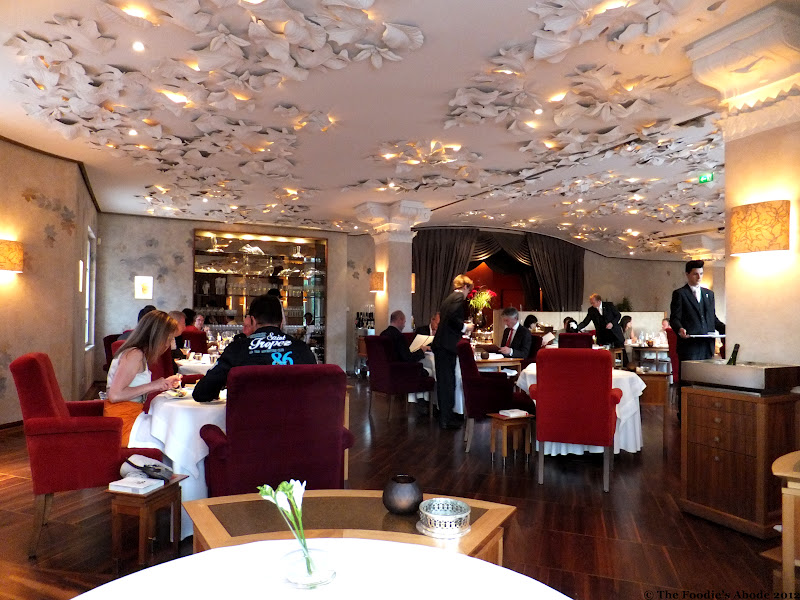
To round off a few days on official matters in Vienna, I decided to revisit Steirereck this afternoon before flying back to London. This highly regarded Austrian gastronomic establishment had in the meantime climbed 2 places from last year to reach No. 9 on the World's Best Restaurants list.
It had been a warm and sunny week in Austria, and Suzanne the hostess informed me when reconfirming my reservation that all diners would be made to sit out on the terrace. I can appreciate why Westerners love eating al fresco when the weather's nice, but I had my reservations on two counts: 1) it would be too hot to sit comfortably through a tasting menu, knowing how extreme Austrian summers can get, and 2) the lax Continental attitude towards public smoking meant that I was very likely to be assaulted on all fronts by diners puffing away.
I asked over the phone if it was possible at all to have a table in the dining room itself, and was promptly told no. Right. Ok, then could I at least have a table in a non-smoking section of the terrace? Thankfully, this was at least granted to me (or so I thought). Temperatures today were rather pleasant, with a cool breeze every now and then, so it was surprisingly comfortable under one of those big umbrellas, even when fully suited. Less happily though, there seemed to be no obvious distinction between smoking and non-smoking areas; people were puffing away on both sides of the terrace, and I feared the worst when I was seated right behind a group of loud chain-smoking Turkish/Middle Eastern-looking men who looked and behaved like they surely had more money than class. It was really the first time I saw anyone smoke for 4 hours straight, only taking short breaks to eat when being served. Mercifully, a huge potted plant separated our tables and acted as a natural filter, while the breeze was blowing most of the smoke away from me so I wasn't hugely affected; woe betide the couple who would be made to sit diagonally across me though! Why would fine restaurants not ban smoking in their premises if they truly wanted their customers to appreciate the subtleties of their cuisines and wines? For food as expensive as this, I would certainly want my nose and palate to be kept as fresh and sensitive as possible throughout the afternoon.
 |
| An oasis in the middle of Vienna's Stadtpark |
 |
| Nice terrace environment but pity the poor couple who would be made to sit there and have the smoke blown in their direction - thank goodness they didn't turn out to be smokers themselves! |
 |
| Cool wet towel to freshen up before the meal (chain-smoking table behind the plant) |
Enough about my fellow diners though. This turned out to be an excellent tasting menu, somewhat more enjoyable than my first dinner here almost a year ago. Coincidentally I had the same server to start with, a polite and reticent young lad. Suzanne took my orders and assured me that I would be able to visit the kitchen and say hello to chef patron Heinz Reitbauer, as requested in my reservation.
Some lovely canapés to start: first up, pepper and sea salt crackers. These had a perfectly light and crisp texture with a refined flavour - a great way to set the palate in motion.

Next: dried asparagus with a goat's cheese cream topping. This tasted far more amazing than it looked; the concentrated sweetness of the dried asparagus was very well matched to the full-bodied and tart flavour of the goat's cheese cream. The asparagus itself had a most astonishing texture and look; I was expecting it to be somewhat thicker (you know how a normal one looks like) and really dry and crunchy, but this was really long and thin (like French beans) and had a most interesting bite that I would describe as being both crisp and spongy. I had no idea how they did it but this deceptively unappealing morsel was very impressive indeed.

Finally, a tray of goodies on ice for cool summery relief: fresh plum, celery marinated in champagne, and raw mountain trout with amaranth. The plum was very sweet and juicy. The trout had a firm and succulent texture and a rich flavour from naturally-occuring oils, which were enhanced by toasted amaranth seeds with a solid bite and a pleasant nutty taste. The celery marinated in champagne surprisingly turned out to be my favourite, with its crunchy texture and an incredibly crisp mineral taste that cleansed the palate really effectively. I was now ready for the feast ahead!

Amuse bouche: cauliflower variations, fig, day lily, grapefruit.

Sweet beginnings - I loved the cauliflower and fig pairing, with a touch of fresh juicy grapefruit on the side for an aptly tart kick and refreshment. The creativity displayed in preparing different takes of cauliflower was astonishing - besides the usual poached and puréed versions, there was also a grilled floret that had a perfectly caramelised crusty surface and a lovely deep smoky flavour in addition to its natural sweetness, and a most delicate and beautiful-looking chip (no idea how they did that!) that disintegrated immediately upon entering the mouth and unleashed a surprisingly powerful sweetness. The fresh fig had a very pleasant seedy bite and a thick and creamy consistency which went especially well with the puréed cauliflower. A garnish of fresh day lily (much more common in Chinese cuisine, where it is known as 金针 or 'golden needles') not only enhanced the dish's presentation but also contributed a mild lettuce-like sweetness. This little pre-starter set a very promising tone indeed for the rest of the meal.
Shortly after this, a pretty-looking plate of sour cream butter with salted citrus fruit (lemon?) was presented, and the legendary fancy bread trolley with more types of bread than I can ever remember was pushed over to my table. I should mention that the bread waiter appeared very uninterested today as he rattled off hastily for the nth time his bread descriptions, without once establishing eye contact with me. I understand it all gets a bit repetitive and tiring, but still I could hardly believe that the same guy had served me a year ago with such enthusiasm. Nevertheless, being a forgiving customer, I shall concede that everyone is entitled to their off days.
I chose honey & lavender, black olive, Poilâne and hazelnut & apricot. All excellent and certainly good enough to eat on their own. The butter had an unusually light and frothy texture and a somewhat tart taste (especially when taken with the bits of fruit), which reminded me of crème fraîche.

Meanwhile, the tasting menu began and you know it when little information cards that accompany each course are taken out of a drawer and displayed/changed on a small stand in front of you as the meal progresses; this is a unique feature of Steirereck's service which helps the diner to follow and savour the various components without missing/forgetting a single detail, or allowing the food to get cold already while waiting for the server to finish his/her elaborate descriptions. The kitchen's pride in their own work is evident from the amount of details given, from the provenance of various premium (and occasionally rare) ingredients to their painstaking execution. I believe this is something from which other gastronomic establishments can learn, especially if English is not the native language of their servers and they want to promote their cuisine as accurately and convincingly as possible to an international clientele.
On the flipside, the servers at Steirereck generally do not seem to do very much beyond bringing you your food and some of them appear rather unsmiling; hostess Suzanne, a matronly figure, exudes typical Viennese charm in receiving her clients but also comes across occasionally as being curt and unyielding when dealing with special requests from them. I have been here twice now so my impressions should be pretty fair (and I'm very easy to please really!). Indifference and stiffness are hardly positive attributes in the service industry, and especially not with 2 Michelin stars and a 9th placing on the World's Best list, but if you're willing to overlook all that and just enjoy the food, there are truly some gems to be had. Also today there were two servers who really made my day at the end of the meal (to be explained later) and sent me off on a very pleasant note, so all is not lost, despite the overall experience still having some way to go to true excellence, as one might reasonably expect of a restaurant of this level.
Course 1: loquats with celeriac, peas, fresh and steamed Malabar spinach, roasted pistachios.

This salad-like dish was presumably meant as a refreshing start and/or palate cleanser, but came across as a tad too puckering for my taste. The combination of preserved loquat, salted capers and verjus was so overpoweringly tart that I could hardly taste the natural sweetness of fresh loquat, which should have come through the use of loquat juice in the dressing. Still, there were some interesting and effective flavours: the tender and juicy celeriac slices had been cooked with dried loquat kernels, which had an intense marzipan aroma that went very well with the earthy sweetness of celeriac; a sprinkling of roasted pistachios enhanced this lovely combination with a similarly deep and characteristic nutty taste. Fresh peas, celery and spinach contributed a further wholesome touch, while a dash of mildly spicy green pepper oil kept the dish feeling light, and the palate constantly fresh and stimulated. All things considered, however, this dish was still somewhat disappointing, coming as it did after all those wonderful pre-meal nibbles; the flavours just seemed imbalanced and didn't quite hit the spot for me.
Course 2: Chioggia beets with roses, porcini mushrooms and verbena.

This was a better dish in my opinion, very interestingly conceived but not without its misses either. First, the positives: pieces of Chioggia beets, a heirloom variety (no connection whatsoever to the coastal town in the Veneto region of North Italy), were unusually cooked in brown butter for a really rich and sweet taste, lovely aromas, and a tender and juicy texture. The buttery cooked beets were brilliantly paired with porcini mushrooms, diced and sautéed with chopped shallots, pecan nuts and verbena to augment their glorious fresh earthy flavour and aroma, and also for a contrasting meaty and crunchy texture. Both beets and porcini were also featured in various pickled forms. Most prominent was a chunky beet and rose chutney that was somewhat tart and mildly spicy. Beet leaves and slices of baby radish were also marinated with raspberry vinegar and rose oil. Finally, slices of porcini were pickled with verjus, verbena, chilli and rose salt to give a crisp, spicy, salty and earthy mix of flavours that was truly like nothing I've ever had. The elegant sweet-smelling aroma of roses (prized cultivars blooming only once a year between June and August, by the way) permeated all the pickled accompaniments and elevated them into a sophisticated class of their own, while the petals made a very pretty garnish.
So what's the problem you might ask? As with the first dish, it was somewhat imbalanced - the pickled components with a touch of French sorrel and the cooked components were excellent as individual groups, but put together, the flavours just didn't feel right. Again, the pickled group seemed to dominate the plate and left a puckering overall impression. Tart and earthy do not mix well in equally large quantities, even with the delicate sweetness of beets and roses lingering in the background. I found this dish too complex and creative for its own good - a case of having too many cooks spoil the broth - and I wasn't quite sure what it was trying to say. By now I was craving for something truly savoury, honest and substantial.
Course 3: pan-fried Reinanke with courgette, peppers, avocado and walnut leaf oil.

Finally, something that hit the spot! This was Suzanne's recommendation - according to her, Reinanke is a rarer and truly native white fish from Lake Hallstatt (surrounding the famous UNESCO town of the same name), compared to the other fish option of sturgeon, which in all honesty looked very good too. I have a real weakness for well-cooked fish dishes and this was excellent in every imaginable way - the flesh was very moist and tender with a mild flavour, very similar to seabass, and the skin was perfectly crisp. The courgette and pepper pairings enhanced the fresh taste of the fish perfectly with their delicate sweetness. There were dehydrated courgette hearts, sautéed courgette shoots (with a really lovely crunchy and juicy texture), crisp courgette flowers, and grilled courgette juice. The last of these, laced with a few drops of walnut leaf oil (tasting of preserved black walnuts), was a truly inspired touch - never before have I experienced a sauce that was so light, natural and full of depth all at once. Its intense smoky and nutty taste imparted a real character to the dish and gave the fish a very satisfying weight. Keeping things in balance were yellow peppers caramelised with mead and verjus, and avocado interestingly marinated with fresh and dried lime. I loved the latter's creamy texture and mild citrusy acidity - when taken together with the fish the mouthfeel was truly luxurious, and it also helped to keep the palate fresh throughout the dish, without the excessive sharpness of the preceding courses.
Course 4: wild lettuce from Lower Austria with Noir de Bigorre (a free-range, thoroughbred black pig from the Central Pyrenées) pork, bee balm and summer purslane.

Well, it just gets better! This divine strip of pork breast was slowed cooked with juniper (a common flavouring for meats in central Europe) then pan-fried to give it a subtle pine-like fragrance alongside its rich flavour. The meat was tender and moist, with a generous amount of fat and a lovely crispy layer of crackling (sinful perhaps, but that's how I love it - though of course you can't eat like this everyday!). Accompanying this excellent pork was a surprisingly juicy and fleshy wild lettuce (in appearance more similar to a stemmed plant such as asparagus than its leafy cultivated counterparts) stem that had been braised with pork fat and pork stock to give it a real depth of flavour. A wonderfully chunky vinagrette of diced wild lettuce, dried watermelon, chopped olives and bee balm (a highly fragrant herb with a fresh scent between mint and bergamot, nothing to do with bees) contributed just the right balance of sweet, zesty and salty flavours to keep the dish from going over the top. Marinated summer purslane and bee balm flowers provided the finishing touches to exceptional course. I could never get enough of this!
Course 5: roasted venison loin glazed with dried Turkish coffee, May turnips (planted early in the year and harvested in May, hence its name), chestnut mushrooms, hazelnuts, green banana and cress.

I had actually wanted the braised and roasted milk-fed veal option but on the menu that was for 2, and Suzanne wasn't ready to bend the rules for me so I had to take the venison. This turned out to be a real blessing in disguise and the pièce-de-résistance of the entire meal! The venison was lean yet tender and succulent, and its surrounding skin of dried Turkish coffee complemented its richness perfectly with a deep roasted bittersweet taste and aroma. The accompanying jus of chestnut mushroom and venison stock was simply delicious. What was even more brilliant, and almost threatened to upstage the meat, was the turnip on the side, poached with brown butter for an unusually juicy texture and intense sweetness similar to the wild lettuce in the preceding dish. One smaller ball was coated with toasted fruit and nut crumbs for a lovely crunch, while the bigger ball yielded a real surprise; a generous filling of sautéed turnip leaves and stalks with diced chestnut mushrooms and chopped hazelnuts spilled out as I cut through it. This filling had a full-bodied earthy and nutty flavour that was the ideal complement to the sumptuousness of the meat. No details were spared for the garnish either: much more than merely pretty decorations on the plate, a mixture of nasturtium, water and garden cress was marinated with hazelnut oil for a mildly spicy and nutty taste that stimulated the palate in a very pleasant manner. Finally, amidst this sea of opulent flavours, a purée of tamarind and green banana provided an inspired touch of refreshment with its lovely sweet-and-sour taste. This was an absolute masterpiece in which nothing was superfluous or disproportionate; the kitchen seemed to have nailed every detail with utmost precision. Needless to say I was on cloud nine and really looking forward to what the desserts might bring!
Course 6: sweetened vanilla fresh cheese with physalis and cereals.

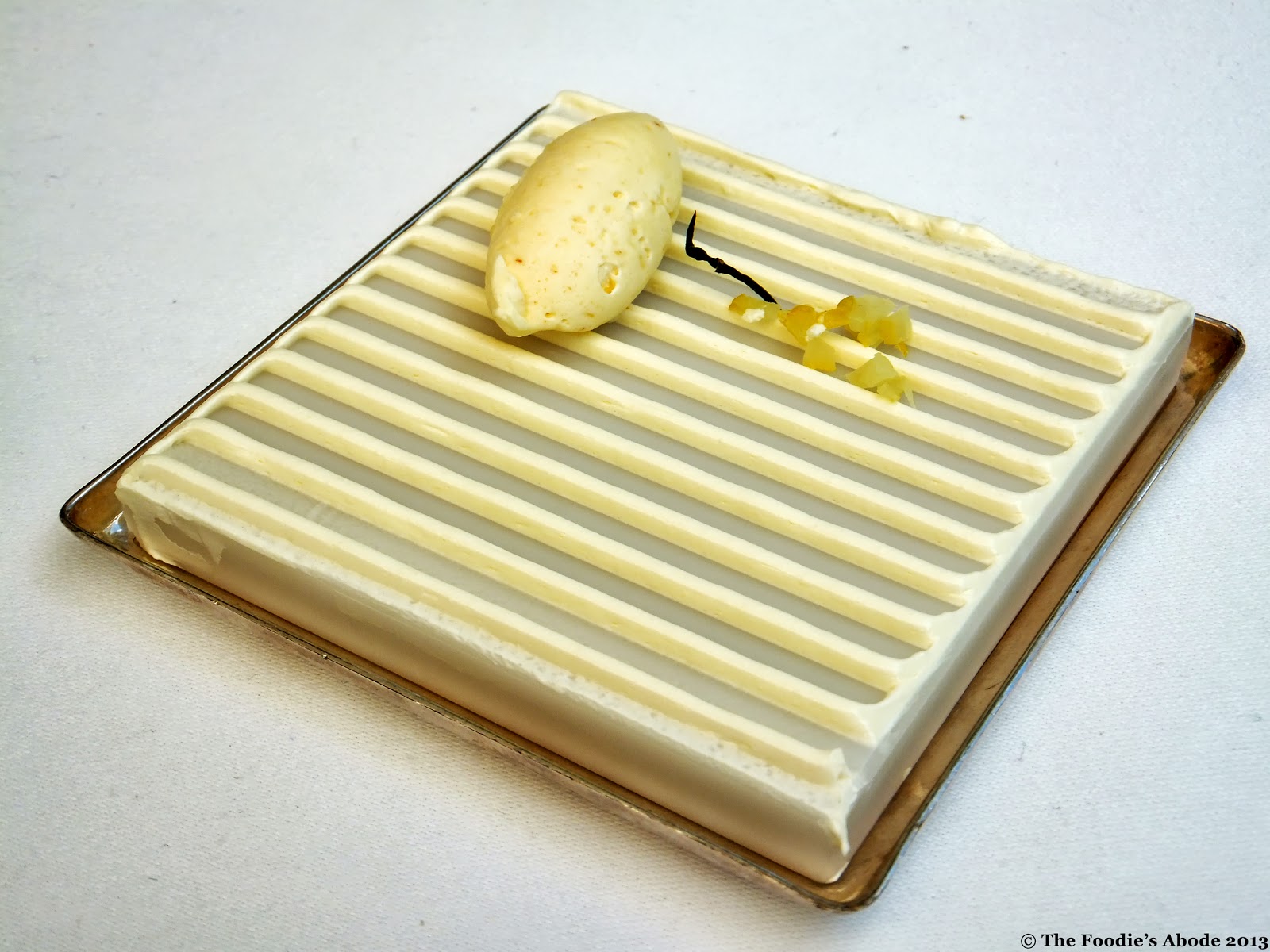
A fresh cheese is a cheese which has no rind and has not been aged. Rennet (a concentrated enzyme solution derived from mammalian stomachs) is added to unpasturised milk which sets the milk and causes the solid curds to separate from the liquid whey. Here, the milk has been infused with vanilla (you can see the crushed pods) and sweetened with sugar to create a sweet version of the normally savoury fresh cheese. The by-product whey has also been used to make a sorbet so that there is no wastage.
The presentation and execution of this dessert at the table was unexpectedly theatrical. It was plated on a huge sieve used to drain off liquid whey in actual cheese production, which added a charming semblance of authenticity.


Coming after a couple of rather heavy courses, this was a most welcome relief. The curds had a light buoyant texture and a warm sweet taste from the vanilla infusion. This was effectively paired with 'little Buddha' physalis (both preserved and dried/crushed) for their tart flavour and firm, juicy and crunchy textures. The standout in this dessert, though, was the unusual dark grey sorbet made from the liquid whey by-product; it had been blended with toasted hemp seeds, black sesame, amaranth and coconut for a pleasant gritty texture, extraordinary fragrance and delightful nutty taste. Black sesame is one of my favourite ingredients, being used in many Asian desserts, and has a stronger aroma as well as many more health-giving properties compared to its more common white counterpart (it is particularly beneficial for your liver and spleen). Not surprisingly, this reminded me of black sesame ice-cream which is a very popular flavour in Japan. Like the pandan dessert I had here last year, this was by Western standards a largely successful attempt at incorporating exotic ingredients in the cuisine, though part of me still wished for an even more concentrated sesame taste, without distractions from other grains and seeds; then again, I may be biased! Full marks for effort, no doubt.
Course 7: spring blossoms with honey, pollen and passion fruit.

A light and refined way to end the menu (though definitely not for pollen allergy sufferers!), this consisted of a sweet pollen and linden blossom honey tuile (thin biscuit) surrounded by a delicately acidic passion fruit cream, and garnished with an vivid mixture of spring blossoms (various flowers including violets, daisies, begonia and honeysuckle) and spring herbs perfumed with bitter orange and honeysuckle blossoms. These were paired with a refreshing ice-cream of bitter orange blossom and yoghurt, and finished with an aromatic violet jelly and bits of pollen sprinkled on the plate. There was nothing particularly mind-blowing about the composition of this dessert, but nevertheless it was still a very solid creation and incredibly pretty to look at.
Some Japanese green tea after the feast was in order, and this is what I got:

Question time: can anyone tell me what was wrong with this set-up? :) Well, amongst other minor mistakes, the one that struck me most was the use of a matcha bowl instead of a normal teacup; the former is used only for powdered green tea, directly mixed with hot water then whipped into a frothy texture using a bamboo whisk, never for leaf tea / teabags brewed in a kettle. I imagine that with Japanese customers this would have been a major faux-pas, but I wasn't too fussed myself as I wouldn't expect a Western restaurant to know about the finer details of Japanese tea culture. As for the tea itself, the sencha served was remarkably fragrant and mellow, considering that it was brewed from a teabag and not loose leaves - very good quality indeed by European standards.
An impressive display of petit fours soon followed. So beautiful, just like a summer garden in full bloom:
An impressive display of petit fours soon followed. So beautiful, just like a summer garden in full bloom:


Here we have a pretty 'flower arrangement' of day lily marinated in nectarine juice and coated with beeswax, and honeydew marinated in orange and mint. These tasted fresh, delicate and sweet, and the first was particularly interesting as I had to remove the layer of beeswax first (slid off very easily though). This soft and chewy airtight coating, though rather tasteless and inedible, kept the flower moist and in shape, and preserved its full flavour.

Finally, a variety of tidbits served dramatically under a bunch of dried cherry blossoms. All tasty little morsels.
 |
| Walnut cream wrapped in blackcurrant leather |
 |
| Tree nut cream (not sure what specifically; my waitress just said 'Baumnuss' and couldn't explain further) wrapped in strawberry leather |
 |
| Mini version of my spring blossom dessert with candied instead of fresh blossoms; and there was also an elderflower jelly (main picture) which was lovely! |
It was time to visit the kitchen after a satisfying meal, and I got the attention of the very kind elderly gentleman who had served me tea a few moments ago, who promptly went to get the all-clear from the chef before showing me in and introducing us.
 |
| With Heinz Reitbauer |
I had a good overview of the spacious kitchen from the pass. Chef patron Heinz Reitbauer came across as a very cordial and humble person. He thanked me for my repeat visit and downplayed his restaurant's increasing fame, saying that he was just happy to be on the list whatever the position, and that it makes no difference to his original mission to serve his customers at the highest levels consistently. He even got his team to turn to my camera for a candid shot - they do look like a happy bunch of people!

From today's service staff I would like to commend two people specifically: the nice young lady who served my fresh cheese dessert and who readily wrote down the descriptions of the petit fours for me despite her limited English, and apologised profusely for potential spelling mistakes, as well as the elderly gentleman (the oldest member of staff as far as I could see) who served me tea, showed me into the kitchen and bade me goodbye at the very end - he was so kind and sincere that I almost felt embarrassed to have someone much more senior than me being so deferential. Little personable touches like these really make my day. Admittedly, there is generally still room for improvement in service, but the food here does mostly deserve the accolades that it has been awarded. Not sure when I'll be in Vienna again, but wouldn't mind returning when I am!