Sunday, 30 August 2015

Dinner at Les Deux Magots, Paris

It is the day after the end of my summer course in Tours, and having returned to Paris this morning together with Angela, we decided to go for a final dinner before she returns to Singapore first. This evening's choice was none other than Les Deux Magots, one of a famous trio of historical cafés in the St. Germain area, including Café Flore and Brasserie Lipp, which have played an important role in Parisian cultural life. Les Deux Magots itself has hosted famous writers and artists in the past such as Verlaine, Rimbaud, Hemingway and Picasso. For anyone interested in French literature and art, Les Deux Magots is a must-do in Paris, if for nothing else but to immerse oneself temporarily in the air of cultural sophistication that this café continues to exude. In my experience, it also happens to serve the best food of the trio, which is why I have decided to feature it in this blog (I'd first visited all three cafés back in 2012). Admittedly, prices here are higher compared to their counterparts, but they are well justified, as you will see.

Les Deux Magots was founded in 1812 and takes its name from the novelty shop that had been on the original premises. A pair of Chinese-style statues (hence 'Deux Magots') adorning one wall of the interior bears testimony to the origins of the café as well as the penchant for chinoiserie in Europe during that era. Its location is also incredibly convenient; you cannot miss it once you've exited the Saint-Germain-des-Prés metro station. Café Flore is right next to Les Deux Magots while Brasserie Lipp is just across the road, so you shall be quite spoilt for choice around that junction!


As they say, when in Rome, do as the Romans do; Parisians love sitting out on the terrasse on a warm summer's day dining al fresco, so that's exactly what we did. Our space felt very cosy despite it being in the open, and I loved the view of the streets and buildings around us. It was quite interesting to note how literally nobody was inside the café; as a typical Asian tourist you might get some bewildered looks from the waiters if you asked to be as far away from the smoke and noise as possible.


Les Deux Magots does not offer any prix fixe menu; everything has to be ordered off a standard à la carte menu with several options for each course, which can add up to a rather significant cost if you're going for the typical 3-course format. Angela decided on just one main course, while I went for all 3 courses, and offered her tasters of my starter and dessert.

Starter: fresh salmon tartare with citrus and crunchy cucumber.


Generous chunks of fresh salmon had been marinated very simply with lemon juice and chives, then arranged as a thick disc and garnished with fresh lemon slices, baby radishes, alfalfa sprouts and dill, before bits of finely grated cucumber were sprinkled over the dish. The acidity from lemon could have been overwhelming on its own, but used judiciously, it balanced the rich oily taste of the salmon perfectly and highlighted its freshness. The other garnishings provided further refreshment, and I particularly loved the sweet and warm aroma of fresh dill, which never goes wrong with any fish dish. There were some lovely textures in this dish too, from the moist and succulent salmon, to the juicy lemon slices, and crunchy radishes and cucumber. On the whole, this was a crisp and elegant starter which effectively cleansed my palate and stimulated my tastebuds.

Main: chicken supreme with seasonal vegetables and thyme lemon butter.


This was Angela's choice and it turned out to be a very good one indeed. Chicken often becomes very dry in the hands of lesser chefs so I'm quite wary of ordering it, but this large thigh cut didn't have that problem at all, even though the meat was quite thick. It had been very well seasoned and turned out very tasty and succulent, with a skin that was nicely browned and crisp from the roasting. The accompanying blanched vegetables retained a slight crunch as well as all their natural delicate sweetness. Finally, the thyme lemon butter not only added a further touch of richness to the texture of the chicken, but also provided overall balance in the dish with its fresh, citrusy and piney flavour. This was certainly one of the best chicken dishes I've tried in a while.

Main: fillet of sea bass à la plancha, with spinach and crustacean coulis.


Having worked up an appetite from my starter, this large fillet was perfect. I love well-prepared fish, and this sea bass was no exception. The fillet was thin enough for the fish to be cooked through quickly by grilling on a very hot metal plate, and very little of the fish's natural moisture had been lost, resulting in a flesh that was both tender and succulent. The skin turned out delightfully crisp and charred. A generous lashing of thick sauce similar to a very rich lobster bisque contributed further intense flavours that complemented the mild-tasting flesh excellently. Finally, this tasty and wholesome dish was completed by the bed of soft-boiled spinach on which the fish sat. Faultless and very satisfying indeed.

Dessert: warm Tarte Tatin with vanilla ice cream.


The dessert options at Les Deux Magots are very traditionally French and there's very little that can go wrong. Unusually, they also offer a small selection of pastries on behalf of Pierre Hermé (no doubt a touristy thing - the brand sells), though at 15 euros per piece, they are more than thrice as expensive as what it would cost to do a takeaway from the nearby flagship Hermé boutique. For that price, it would be better to choose something made in-house. I went for an excellent apple tart, with huge and juicy chunks of apples caramelised in butter and sugar, resting on a puff pastry base. (I shall leave the reader to find out more about the history of this classic 'inverted' French apple tart.) The caramelised apples had kept their shape perfectly while being absolutely soft and melt-in-the-mouth. They possessed a profound sweetness and captivating aroma that were unlike any apple tarts I've had in a long time. By contrast, the light, airy and flaky puff pastry base was an almost fleeting experience, supporting the intensity of the apples with subtle and pleasant buttery accents to each bite. On the side, a scoop of vanilla ice cream made with real vanilla pods complemented the apple tart remarkably with its rich and smooth texture, and warm and sweet aroma. I couldn't have asked for a better way to finish this superb dinner.


In summary, the prices here are somewhat high by bistro standards, but the portions are generous and both the cooking and ambience are outstanding. This place certainly transcends the usual tourist trap. The service is generally efficient if a tad brusque, as is typical in Paris, especially on a busy summer's evening - one just gets used to it, I suppose. No major complaints as we both got what we came for: great homely cooking with refined touches. Well worth a visit when you're in town!

Thursday, 27 August 2015

Dinner at Le Saint-Honoré, Tours

Since arriving in Tours I have been on the lookout for a really nice new restaurant to visit, and I was very happy to have discovered this little gem, tucked away in a quiet little street behind the city's main cathedral. Le Saint-Honoré came up in Tripadvisor searches as a very highly regarded local restaurant, in addition to being on the Michelin Bib Gourmand list for good quality and value, and I decided to check it out this evening together with my singer Angela.

The restaurant is not that difficult to find - just walk straight on from Rue Colbert (the main dining street) in the direction away from the central square and you'll eventually come to it at a crossroads. We had actually tried to walk in without a reservation yesterday evening, but were informed by the warm and friendly couple who run the place that they were already full. Fortunately they still had space this evening! Reservations are absolutely essential especially for dinner.

Le Saint-Honoré is housed in an ancient former bakery dating from 1625, and run by Benoît and Isabelle Pasquier, a lovely couple who manage to do everything themselves without extra help. Benoît grows his own vegetables in a little patch at the back of the restaurant and cooks, while Isabelle, the main face of the restaurant, serves and charms guests with her casual and genuine demeanour.


One feels the homely atmosphere as soon as he steps in. The original brickwork and wooden beams have been carefully preserved, and the place is decorated with all sorts of nostalgic knick-knacks, creating an aptly quaint but not overwhelming environment. It felt especially comfortable and cosy sitting down to dinner with red checkered tablecloths, just as one might do in a traditional French country home.


Whilst perusing the menu, we were given a variety of canapés, consisting of raw baby radishes, cheese goujons, sesame and poppyseed biscuit sticks, and preserved black olives on a plate. This was a lovely way to stimulate the palate - the radishes were crisp and mildly sweet; the goujons warm, fluffy and aromatic; the biscuit sticks very light in texture but nutty and robust in flavour; and finally, the sharp, briny and juicy olives really awakened the tastebuds.


The menu is unfortunately French-only but I believe Isabelle speaks enough English to get by if you need help. There is the standard à la carte menu with multiple options under each course, or one may also choose between two fixed sets, Menu Saint-Honoré at 3 courses for €28, or Menu Homard (lobster menu) at 4 courses for €45, tax and service included. Angela decided on the former set while I went for the latter. After some time, Benoît emerged from the kitchen, took our orders himself and explained some of the dishes. He also readily allowed me to substitute my cheese course with an extra dessert upon request, recommending the apple tart to go with the dessert I'd already chosen, and quipping that 'you are a real gourmand' - very nice of him! We both really appreciated his warm and personal touch, and marvelled at his multitasking ability.

Following that, Isabelle offered each of us an amuse-bouche on a tablespoon, which contained a mound of radish mousse with sesame and rillons


Compared to the previous canapés, this was a lot richer in texture and heavier in flavour. The mousse had a fresh and delicate sweetness that was well enhanced by finely-chopped chives in the mix, while a sprinkling of sesame contributed a pleasant nutty aroma. The few small chunks of rillons (pork breast confit, a Touraine specialty) were smoky and intense in flavour, and had a lovely succulent bite - just perfect with the smooth, airy and creamy mousse. It was quite surprising how this spoonful could pack such a punch, and our expectations were suitably raised for the rest of the dinner.

Starter (Menu Saint-Honoré): disc of crushed heirloom tomatoes with basil, toasted nuts and seeds (sunflower seeds, pumpkin seeds and pine nuts), quinoa and olive oil; mesclun salad leaves with balsamic vinegar; balls of watermelon and rock melon.


This was Benoît's 'suggestion of the moment', and what resulted was one of the beautiful tomato salads I have ever seen. Almost all the produce (except for the nuts, seeds and fruits) had been grown by Benoît himself, and the care with which he had cultivated and plated them was immediately evident. The chunks of heirloom tomatoes (I counted at least two different varieties) were extremely sweet and juicy as expected, and the fruity and mildly bitter olive oil in the mix instantly elevated their crispness and enriched their texture. Fresh basil leaves contributed further pleasant aromas, while bits of quinoa, nuts and seeds enlivened each mouthful with a crunchy bite and robust flavour. At the other corner of the plate, crisp and delicately spicy salad leaves with a dash of tangy balsamic vinegar continued the garden-fresh theme of this starter. The row of fruit separating these two parts of the plating was no less stellar - meticulously shaped into tiny balls, very juicy, and even sweeter than the tomatoes. Incredibly wholesome and satisfying!

Starter (Menu Homard): rosette of lobster on a bed of crushed tomatoes with basil.


This was essentially the same dish as the tomato salad above, but with the addition of generous slices of lobster arranged very prettily like petals in the form of a rose, as well as a whole lobster claw. The lobster had been boiled to just the right degree and still retained all of its juiciness and sweetness, and the flesh was really firm and succulent. The plump lobster claw was particularly tantalising. Coupled with the tomatoes, basil and olive oil, the result was utterly fresh, crisp and luxurious.

Main (Menu Saint-Honoré): Chartres-style beef tenderloin, potato galette, seasonal vegetables and garlic confit.


The original French name for this dish was 'tournedos', referring to round cuts of beef from the end portion of the tenderloin. Chartres-style (taking its name from the nearby city of the same name) refers to a garnish of fondant potatoes and veal gravy with herbs that typically accompany tournedos. This dish had a very homely and down-to-earth feel to it. The medium-rare beef was tender and succulent, and its intense flavour was enhanced aptly by the accompanying soft, pungent and sharp pieces of garlic confit with a mildly sweet aftertaste. The cooking juices with chives were another natural and effective match for this full-bodied meat. On the side (taking the place of fondant potatoes, but similarly prepared), the potato galette, made with just layered paper-thin potato strips and butter, had been oven-roasted to a delightfully browned and aromatic crispiness on the surface, whilst the insides remained meltingly tender and milky without the slightest hint of grease, despite the use of butter. On the whole, this was a robust and rather heavy dish, well executed in all of its deceptively simple components and very enjoyable indeed.

Main (Menu Homard): croustillant of lobster on a bed of gently spiced girolles.


If you're a mushroom lover, this dish is for you. The positives: the bed of girolles was very meticulously prepared, having been minced to an almost paste-like consistency and marinated with various spices for an additional warmth to its already deep flavour. Surrounding the bed of minced girolles were actual sautéed girolles with a firm and fleshy texture and a pleasant hint of caramelisation. The meat jus with finely crushed hazelnuts further contributed to the overall intensity of the accompaniments and provided an occasional crunch. Finally, the individual discs making up the potato croustillant on top had been shaved to an remarkably translucent thinness, and deep-frying not only made them stick together nicely due to the release of natural starches, but also made them incredibly crispy and appealing (who can dislike potato crisps, really?). Needless to say, the lobster was as good as it had been in the salad (this is most likely the other half, so one gets a whole lobster over two courses).

However, my first reservation about this dish was its proportions, as the overwhelming amount of girolles on the plate seemed to have upstaged what should have been the focus of this dish - the lobster. I was also concerned by how the earthy girolles with a meat-based jus might overpower the much more delicate and clean-tasting lobster, though I understand that traditional French restaurants may have a tendency to make everything on the plate taste of meat. Again, to be sure, the individual components were very good, but I must admit that their juxtaposition on this plate felt rather awkward.

Dessert (one chooses from the same list for both menus): apple and honey tart with cinnamon ice-cream.


One can never go wrong with the classic apple and cinnamon combination. This was my replacement dessert for the cheese course, and I was both surprised and impressed by how finely the apple had been sliced then carefully arranged on the equally thin pastry base. The apple slices remained very juicy and crunchy, and the baking had produced a deep caramelised flavour. Both their texture and taste were aptly enhanced by a surface glazing of honey. The pastry base was very light and somewhat crumbly to the bite. On the whole, it was a lovely combination of textures. Topping the tart was a scoop of cinnamon ice cream, made with a generous amount of real ground cinnamon powder, which packed a real punch with its smooth and rich texture, and authentically warm and sweet aroma. It even came with a paper-thin cinnamon feuilletine for extra bite and flavour. A single small strawberry provided a pleasant tart balance to this otherwise rather sweet and indulgent dessert. It was indeed quite a nice way of recovering from the slight disappointment of my main course.

Dessert: strawberries with lemon verbena.


This was Angela's choice, and an entirely apt one coming after her meaty and substantial main course. Fresh strawberries, lightly poached in strawberry juice, had a delightfully soft and juicy texture, with a crisp and tangy taste. The surrounding strawberry juice had in turn been reduced to a thicker consistency and infused with lemon verbena prior to serving, which resulted in a concentrated sweetness with pleasant citrusy notes. Topping the dessert was a  very light, smooth and refreshing scoop of strawberry sorbet and a crispy brown sugar tuile for extra bite. On the whole, this was extremely vivid both in appearance and in flavour.

Dessert: raspberry gratin with basil and Vouvray sabayon.


Gratin refers to a culinary method in which an ingredient (such as sliced potatoes) is sprinkled with grated cheese and/or breadcrumbs in a shallow dish and baked till a golden brown crust is formed on top. This unusual dessert version of an otherwise savoury dish had a base of simmered raspberries swimming in a pool of raspberry soup, similar to the previous strawberry dessert, but here the raspberries were even softer and somewhat mashed up (like in a chunky jam), perhaps due to their smaller size which makes them more prone to disintegration upon heating. This raspberry base had a concentrated tartness which was effectively tempered by the fresh peppery flavour, with a sweet aromatic aftertaste, of the shreds of basil scattered within. Similar in appearance to a Mornay sauce, the sabayon on top was actually a liquid custard-like mixture of egg yolks, sugar and wine, lightly cooked then whipped to its foamy appearance. The use of typically dry and acidic Vouvray wine (a famous white wine made from Chenin Blanc grapes just east of Tours) resulted in a sabayon that was remarkably fresh and crisp, perfect for the strong and spicy basil as well as the rather astringent raspberries. Charred bits of icing sugar on the surface offered a balancing tinge of sweetness as well as a convincing gratin-like appearance, while a halved fresh strawberry completed this picture-perfect dessert like a jewel in the crown. This was a most invigorating way to end the dinner, and now I could also see why Benoît had recommended the much sweeter apple tart to pair with and precede this dessert.

Petit fours: thyme meringue, raspberry financier and grape & peach compote tart.


No meal in a proper French restaurant is complete without the little pastries that arrive at the end of dinner, and these were very good indeed. The meringue was crisp, airy and minty, a great palate cleanser; the financier was moist, fluffy and buttery, with a tinge of acidity from raspberry jam in the centre; and for the tart, who could possibly dislike a thick and sweet jam filling, with a fresh and juicy grape to boot?

I'd wanted to see Benoît's vegetable patch but was unfortunately informed by him that other guests sitting in that area might be disturbed if I did that, so I respected his decision. Throughout the dinner we witnessed the seamless and loving cooperation between husband and wife, and it's frankly remarkable how efficiently the business runs despite having just the two of them. I couldn't leave without asking to take a picture with this lovely couple as a souvenir, which they were only too happy to oblige. They were extremely pleased that we had enjoyed ourselves this much.


Le Saint-Honoré is most certainly the best restaurant I've discovered in Tours so far. Great cooking at reasonable prices, coupled with the most amiable service I've experienced in this city - what's not to love? Go!

Tuesday, 25 August 2015

Dinner at Au Lapin Qui Fume, Tours

This evening I found myself in a rather unusual bistro for dinner, just a few doors down the road from Le Turon. Its name 'The Smoking Rabbit' had caught my attention previously and I thought I'd finally give it a shot. As the bistro's name suggests, it specialises in rabbit cuisine, a somewhat acquired taste for foreigners but particularly popular in French-speaking parts of the world. Of course, they do serve the usual fishes and meats as well, but I was after something different tonight. I've had excellent rabbit stew and confit in Belgium and other parts of France, and was eager to relive those culinary experiences.

When I arrived it was absolutely packed with locals and domestic tourists - not bad for an ordinary weeknight, and always a sure sign that the food's good. I was probably the only foreigner there, and fortunately the warm and efficient lady who received me managed to squeeze me into a table at the back. Reservations (especially for dinner) would probably be a good idea.


Rustic-looking water jug with a grapevine design

I went for a 3-course menu at €29, with a good number of options under each course. Obviously, as I was after the full rabbit experience, this lovely gamey meat would be the focus of both my starter and main.

To begin the meal I had toast with an extremely generous and chunky black olive tapenade spread. The olives' briny juiciness, coupled with the fresh bitterness of olive oil in the mix, was absolutely stimulating to the palate and an effective kickstarter to the lovely meal ahead.


Starter: homemade rabbit terrine with onion jam.


Served chilled, these terrine slices were surprisingly lean but moist, succulent and very well-seasoned. The rabbit's robust gamey flavour was aptly enhanced by a deep smoky edge from curing with salt and various herbs and spices. To make each bite even tastier and more aromatic, a side of chunky onion jam was provided for additional bite as well as to match the full-bodied flavour of the terrine with its sweet pungence. What a simple, homely and delightful starter this was.

Main: rabbit tajine with olives and confit lemon, on a bed of couscous.


With this dish we moved straight from the home kitchens of France into Morocco, where the national dish tajine consists of healthy slow-cooked stews using various meats and fishes together with vegetables and fruits, served in earthenware pots. The sauces for these stews are often quite tangy and heavily spiced. Here, the rabbit meat had become very tender and succulent from the long hours of cooking, and its rich gamey flavour was aptly balanced by the tart chunks of lemon confit and sharp briny olives. In fact, I found the accompaniments almost too astringent on the whole, but fortunately the robust meat held its own pretty well. The surrounding broth, made from rabbit stock with tomato, paprika, parsley, ras-el-hanout (Moroccan ground spice mix) and olive oil, was crisp, tasty and full of warm and sweet aromas. The couscous at the bottom filled out the dish nicely without adding too much weight. Not sure if this tajine could be considered authentic, but it was pretty wholesome and satisfying.

Dessert: Café Gourmand (espresso with a selection of 6 mignardises).


Instead of going for the more fancy-sounding individual plated desserts, I decided to go with my waitress' recommendation and do what a local person might prefer: a small but really strong espresso, with a selection of traditional French confectioneries and seasonal bites. On this impressive platter were (in anticlockwise order) pistachio macaron, apricot roasted with rosemary, vanilla ice-cream with a chocolate feuilletine, dark chocolate brownie, cannelé and meringue. Everything on this stone slab was good. Particular standouts included the juicy roasted apricot, which just like at Le Turon, had a concentrated sweetness from caramelisation, lovely fresh aromas from the rosemary infusion, and a pleasant crunch and deep nutty edge from chopped roasted pistachios. The pistachio macaron was also a delight for its authentic flavour and mastery of textures, from the airy and crisp outer biscuits to the thick and smooth layer of cream that lay between. Finally, the dark chocolate brownie was extremely rich, moist and intense in flavour.

The very robust and bitter espresso packed a real punch amidst the multitude of sweet and potentially cloying morsels, and left one's palate and mind incredibly stimulated even after a rather heavy meal. No worries with food coma here; on the contrary, I left the restaurant feeling invigorated and quite certain that I would revisit if I ever had the chance to. What's not to love about unpretentious places like these with a convivial and welcoming environment, warm and efficient service, and perhaps most importantly, good solid food that won't burn a hole in your pocket?

Friday, 21 August 2015

Dinners at Le Turon, Tours

I am back at the summer course in Tours, France, which I first attended two years ago, and I certainly didn't forget to relive my foodie memories of Le Turon, a lively and unpretentious bistro great for social gatherings and reasonably-priced French classics. Prices have gone up by a few euros since then but remain well within expectations. I had two dinners here with different people over the course of the week, and this post reviews both visits.

Yesterday evening, I came with a singer friend, and both of us went for the Menu Gourmand, now priced at €24.50 for 2 courses or €29.50 for 3 courses. I went for 3 courses whilst she went for 2.

Starter: duck foie gras presented three ways - 'au torchon', in a macaron and in crème brûlée.


Nothing could be more luxurious and more French than a starter of foie gras. 2 years ago I had a similar dish with toast under the Menu Gourmand, though with just a slice of foie gras terrine matched with various condiments, that was in hindsight less interesting than the one I had before me now. The increased creative effort was evident and effective, and showcased foie gras in various preparations from the traditional to the unexpected. First, 'au torchon' (lit. 'in a towel'), in which a whole lobe of foie gras is wrapped in a towel and slow-cooked in a bain-marie, then compressed, chilled and sliced. I thought that this method best highlighted the foie gras' deep muskiness, and the resulting thick and smooth creaminess made for the perfect spread on crispy toast. The other two variations were no less stellar; for the macaron, a rich foie gras mousse filling was sandwiched between two airy and crisp biscuits with a pleasant caramelised taste, while the crème brûlée displayed perfect balance between the sweet and savoury, with small chunks of foie gras amply mixed into the egg-and-vanilla custard to produce the most concentrated explosion of flavours within that mini ramekin. Artery-clogging perhaps, but no regrets licking the plate clean!

Main: lamb shoulder slow-cooked for 7 hours in Chinon wine.


The signature main of Le Turon, this generous ball of meat was utterly tender, juicy and melt-in-the-mouth from the long and gradual cooking process. Its robust flavour was effectively complemented by the equally full-bodied and spicy wine sauce, with a good amount of tannins to maintain the balance of this otherwise indulgent dish. The roasted potatoes were very good too - caramelised to the right degree and crisp on the outside with a sprinkling of dried herbs for additional aromas, and fluffy and non-greasy on the inside.

Main: roasted goose fillet with 'poires tapées'.


Poires tapées (lit. 'flattened pear') is a summer specialty of the Loire Valley, in which pears are peeled and gently heated on racks in ovens for three days to caramelise and soften them. They are then left out in the sun to dry completely, then flattened with a mechanical press known as a platissouerre. The dried pears are typically rehydrated in Chinon wine before consumption, and are used to accompany red meats. Here, the concentrated sweetness of the pear strips, with a hint of astringency from the wine, was a refreshing balance for the deep gamey flavour of the roasted goose. The pear's firm, juicy and somewhat chewy texture also matched the meat's succulent bite very well. The skin was nicely browned and quite crisp, and the roasting juices were very tasty. On the whole, this dish was extremely satisfying and enjoyable.

Dessert: apricots roasted in rosemary, topped with candyfloss ice cream.


Perfect for anyone with a sweet tooth, the roasted apricots were firm and fleshy, with an intense sweetness that came from the combination of reduction of juices, caramelisation of natural fruit sugars and the infusion of floral piney aromas from fresh rosemary. The surrounding roasting juices, enlivened with a dash of apricot liqueur, contained the essences of both the fruit and herb. To top it off was a large scoop of candyfloss ice cream, unusual in French cuisine but nonetheless very nostalgic with its unique toasty and almost cloying taste. Fresh strawberries and a twig of rosemary completed this dessert that was as delicious as it was visually appealing.

Dessert: strawberry gazpacho with 'floating island'.


This was a fruitier (and healthier) take on the classic French dessert 'île flottante' (lit. 'floating island'), in which a mound of soft plain meringue is usually surrounded by a pool of vanilla custard sauce. Here, the custard sauce was replaced by a very light and tangy soup of strawberries with dashes of strawberry coulis. The meringue itself was extremely airy and fluffy despite its intense sweetness. As a whole, this dessert felt perfectly balanced and easy on the stomach after the rather substantial preceding courses - a lovely way to end the dinner indeed.

This evening, I returned with a group of Japanese friends from the course. They were rather small eaters and chose just one or two courses each from the slightly cheaper Menu Détente, which made me look like such a glutton as I continued with a full 3 courses from the Menu Gourmand. Haha...

Bread with a dip of crushed green and black olives in olive oil to start.

Starter (Menu Gourmand): carpaccio of scallop marinated in chorizo.


Freshness is paramount when dealing with raw seafood, and the thinly sliced scallops here did not disappoint. They were very sweet and juicy, and their natural umami was enhanced by marination in a smoky and savoury chorizo oil, with strips of real chorizo and aromatic chopped chives to boot. The taste of chorizo is quite strong (like all cured meats) and could have easily overpowered the delicate flavour of the scallops, but fortunately this dish was surprisingly well-balanced and effective.

Salad (à la carte): large seafood salad with smoked salmon, prawns, white asparagus, diced tomatoes, mesclun, cream cheese with chives and a sprinkling of Espelette pepper.


A meal in itself for one of my friends, this huge salad featured an impressive mound of crisp mixed leaves topped with a good amount of succulent seafood, sweet and juicy white asparagus, and a generous dollop of tangy and aromatic cream cheese to keep things fresh and light throughout. The portion was quite incredible; this would certainly suffice if you're not a big eater.

Starter (Menu Détente): salad with pork confit and a crispy crêpe with a filling of warm Sainte-Maure cheese.


This was extremely representative of the region's produce. The pork confit ('rillons' in French) is a Touraine specialty that is made pretty much the same way as duck confit. Chunks of pork breast are marinated in salt and herbs for hours, then slow-cooked at low temperatures in lard, and finally preserved in sealed jars, also in its own (filtered) fat. The two slices here bore a striking similarity to gammon in appearance, but were infinitely more tender, succulent and tasty than the latter. The surface of the meat was also very nicely browned and crisp, just like the skin of a great duck confit. In the foreground lay a wrap with two discs of Touraine Sainte-Maure cheese, an unpasteurised white, soft and creamy goat's cheese made from full-fat milk, and presented in the form of a small cylindrical log. This cheese had a slightly salty taste which made for a great match to the rillons, and its fresh nutty walnut-like aroma went perfectly with the mildly bitter and spicy salad leaves below. Final lashings of a rather puckering vinaigrette kept this otherwise indulgent starter in a good balance.

Main (Menu Détente): casserole of monkfish, scallops, red mullet and salmon with rice and béchamel sauce.


This was simple and effective - a generous variety of stewed seafood with rice, topped with lashings of béchamel sauce; what could go wrong? The fishes and shellfish were all very fresh, moist and full of distinctive flavours that were aptly enhanced by the warm, buttery and milky sauce. The sauce also worked well with the plain cooked rice and saved it from coming across as too dry, which is a common problem with the Western method of cooking rice in a pot by simply boiling off all the water within. On the whole, this dish was very homely and satisfying.

Dessert (Menu Gourmand): moelleux au chocolat (chef's recipe) and vanilla ice-cream.


I first had this dessert here two years ago, and was very glad that it has remained on the menu despite changes to many other dishes in the meantime. Nobody knows how to handle chocolate better than the French, and this moist and fluffy chocolate sponge with an oozing intense dark chocolate centre was still every bit as good as I had remembered it to be. The vanilla custard and ice cream with traces of real vanilla pods were also very aromatic and authentic. Compared to two years ago, I noticed some extra touches for balance and texture; first, a tangy raspberry coulis and fresh strawberry for refreshment amidst this indulgence, and secondly a long thin biscuit perched atop the ice-cream for an additional crisp bite. I couldn't have imagined a better way to finish a traditional French meal.

Definitely (still) worth a visit if you're in town!

Friday, 29 May 2015

Dinner at Han (Cuisine of Naniwa), Singapore

This evening, I went for a rather unusual Japanese experience with my mum and partner to end a busy week. We had a couple of vouchers from credit card privileges to use up before the end of this month, so why not? Actually I'd noticed this restaurant for quite some time but could never bring myself to pay full price for fine Japanese food in Singapore, so the discounts were admittedly the main catalyst for our visit - and what a lovely dinner it would turn out to be.

Most Japanese food lovers here will be familiar with the common deep-fried specialties such as tempura and tonkatsu, but relatively few would have tried kushikatsu, a traditional street food from Osaka consisting of skewered meat/seafood/vegetables coated in batter and panko (breadcrumbs). The 'Naniwa' of the restaurant's description refers to an ancient Japanese capital, located in present-day central Osaka city. Head chef Seiichiro Arakawa has made a serious business of these humble skewers, having trained at Michelin-starred A-Bon in Kobe city where similar fine-dining Naniwa fare is served. All the ingredients used at Han are flown in seasonally from various regions of Japan, as one might expect from such a restaurant. There are of course other side dishes as well as the usual sushi and sashimi on the menu, but it is with his uniquely fine kushikatsu that Arakawa has made a name for himself in the local Japanese dining scene.

Grand entrance at Odeon Towers


Dinner at Han doesn't come cheap - starting at $120, you get to choose from a variety of kushikatsu sets with side dishes and/or sushi/sashimi. I chose the 10-stick kushikatsu course with side dishes and sashimi, my partner the same with sushi instead, and my mum the full kushikatsu experience with 15 sticks (a safe choice since she doesn't take raw food anyway).

We all started with an appetiser of simmered tsubogai (Japanese ivory shell) and a salad of konnyaku and shiitake mushrooms tossed in white sesame dressing.


壺貝煮


The ivory shell, having been boiled on a low fire in a light soy-based broth with mirin, sake and a touch of sugar, but served cold as the Japanese like it, was extremely succulent and springy to the bite, and its fresh briny taste was pleasantly enhanced by the delicate sweetness and umami of the simmering broth. Tsubogai is also known as baigai and it is in season from spring to summer. The Japanese call it the king of shellfish - I'm not in the least surprised!  Very easy to like, and gone in a jiffy.

蒟蒻と椎茸の白胡麻和え


More luxurious in mouthfeel and robust in flavours was this salad of thinly-sliced konjac strips and shiitake mushrooms bound together in a white sesame dressing. The deep earthiness and meatiness of the mushrooms were well matched by the intense nutty aroma and rich creamy texture of the dressing, while the firm and chewy konjac strips provided a lovely bite, as did random bits of unground sesame. Both starters were very different, yet equally effective in kick-starting the palate for the feast ahead.

Next up was my sashimi platter consisting of tsubugai (whelk), shima aji (striped jack), hirame (halibut), kanpachi (greater amberjack), chutoro (medium tuna belly) (in anticlockwise order).


お造り:つぶ貝、縞鯵、平目、カンパチ、中トロ


The fish was all extremely fresh and moist. Particular standouts were the tsubugai and hirame for their firm and crunchy texture and delicately sweet taste. I liked the rest very much too. The shima aji, a premium fish which happened to be in season, had a firm and clear pinkish flesh with a sweet and mild oily taste. Despite its name, its elegant flavour was very different from the common aji (horse mackerel) with its characteristic fishiness. On the heavier end, the kanpachi, another species of jack similar to shima aji, was slightly oilier and hence richer in taste, while the chutoro was the most robust of them all, combining the full-bodied umami of red fishes with a delightfully smooth and oily mouthfeel. For the garnishes, I felt that the wasabi used could be better especially in a restaurant of this level; its piercing spiciness and thick paste-like texture were indications that it was definitely not 100% pure grated wasabi, the kind that one expects from fine Japanese restaurants - I don't know if that's too much to ask because we were not in Japan after all.

A side dish of katsuo tataki (seared skipjack tuna) in ponzu sauce with raw sliced onions and togarashi (spicy grated radish) followed shortly for both me and the partner.


小鉢:鰹の叩き、ポン酢、玉ねぎ、唐辛子


These succulent slices of fish had the characteristically fresh and deep flavour of lean red cuts, enhanced by searing on the surface for a delicate smoky edge to each bite. However, I felt that the surrounding combination of ponzu sauce and raw onions was somewhat too sharp and pungent for the fish, threatening to overpower its natural taste. I thought that the dish would have been just fine without the onions - a mild kick is all one needs to highlight the freshness of good fish, which the ponzu and togarashi already did very well. A case of too many cooks spoiling the broth methinks.

Finally, the specialty of this restaurant that we'd all been waiting for! Our table was set rather elaborately with various condiments (from left to right: black sauce, mustard sauce, sanbaizu, sea salt, and fresh slices of lemon and lime) to accompany the following multitude of skewers, as well as a bowl of palate-cleansing raw vegetables (cabbage, zucchini and daikon) for between skewers, just like in a fine tempura meal.


北海道産ズワイ蟹 Hokkaido snow crab leg


First up was some lovely snow crab from Hokkaido, which we were advised to eat with a touch of salt and a few drops of lemon juice. The crab was extremely sweet and succulent, and its fresh clean taste was effectively deepened by the salt and enhanced by the lemon. I should also mention the mastery of deep-frying technique that was evident from the very beginning and would continue to apply throughout this meal. While panko or breadcrumb coatings are usually thought of as being rather chunky and heavy (like in tonkatsu), the ones here were absolutely thin, light and powdery, resulting in an ephemeral crispness that almost immediately gave way to the full glory of their contents. Not a single hint of greasiness, amazingly!

北海道産帆立 Hokkaido scallop


Next was a large whole scallop from Hokkaido, which had been lightly seasoned and turned out very tasty, tender and juicy. It only needed a slight dip in tangy sanbaizu (a mixture of rice vinegar, soy sauce and mirin) to enhance its already deep umami and highlight its freshness.

浜松産うなぎ Eel from Hamamatsu


With the next skewer we moved on to another region of Japan and a fish richer in both taste and texture. This was unagi or eel from Hamamatsu in Shizuoka Prefecture, which possessed a creamy fatty texture and sweet buttery taste due to the abundant presence of natural oils. A somewhat unusual touch of wasabi on top played an effective balancing role with its sharp spiciness, while dipping into soy sauce brought the eel's flavour to another level. This was indeed one of the more memorable courses of the evening.

金目鯛 Splendid alfonsino


Splendid alfonsino (kinmedai in Japanese) is a deep-sea fish with distinctive large eyes due to great water pressure and darkness at the depths in which it lives. As might be expected of deep-sea fishes, this piece had a delicate sweet taste and a rather oily but firm texture. Touches of lemon juice and salt sufficed to enhance its flavour. Most interestingly, the panko coating did not cover the whole piece of fish, and it was deep-fried with the skin and scales intentionally left on and exposed, which created a certain visual impact and made every bite delightfully crunchy.

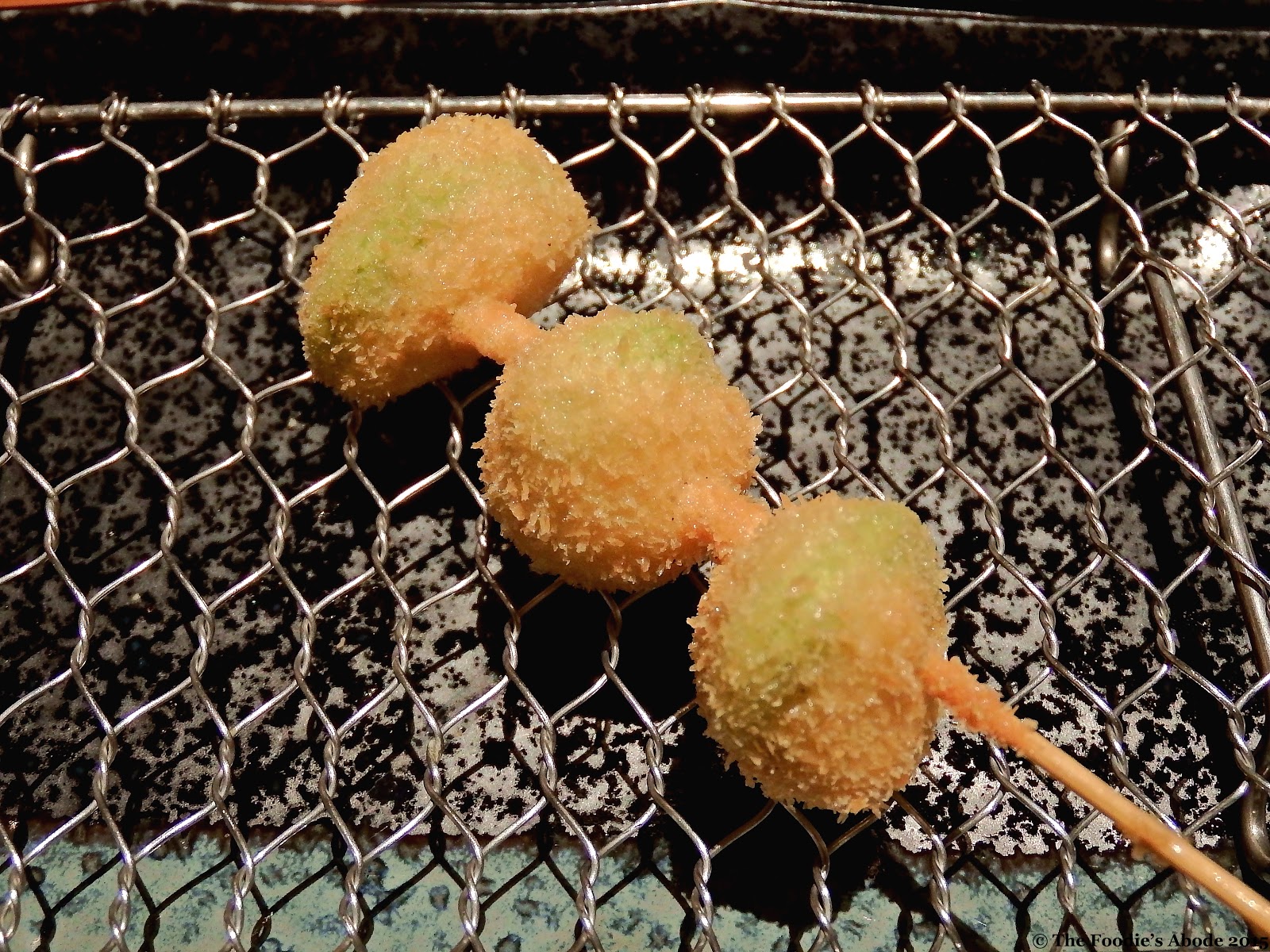
鹿児島産空豆 Broad beans from Kagoshima


One normally expects beans to be rather crunchy and starchy, but like the delicate panko layer that barely covered them, these were unexpectedly light and fluffy. We were advised to eat them with a touch of salt, which complemented their mild sweet taste very well. These broad beans were very moreish indeed, and all gone in a jiffy!

福岡産烏賊と北海道産雲丹 Squid from Fukuoka with fresh Hokkaido sea urchin


One can seldom go wrong putting a large dollop of fresh sea urchin onto anything, and this was no exception. The squid was remarkably tender and moist, and its clean delicate taste was aptly contrasted and enriched by the creamy sweetness of the sea urchin. As with the luxurious eel skewer, a touch of wasabi provided balance, while dipping into soy sauce as suggested deepened the overall umami of this course. On the whole, it felt incredibly smooth, rich and satisfying.

ニュージーランド産天使の海老 Angel prawn from New Zealand


More commonly known in fine Western restaurants as the Obsiblue prawn, this exclusive species native to New Caledonia is the only non-indigenous shrimp to be deemed fit for sashimi consumption by top sushi chefs in Japan, where it goes by the more poetic name of tenshi-no-ebi (lit. angel's prawn). Here, the prawn's plump and springy texture and unique briny sweetness (closer to lobsters and langoustines than shrimp) made it an instant winner. It was served with the head and the tail left intact, both of which were surprisingly light and crisp and could be enjoyed without any fear of pierced gums from the sharp edges. There was almost no wastage here. The head, which one usually discards first when peeling a prawn, was in fact particularly aromatic and full-bodied in flavour. Touches of lemon juice and salt could have been added to enhance the prawn's remarkable freshness and umami, but I really preferred it au naturel  in this case.

A chilled dish arrived at this point to cleanse our palate and prepare our tastebuds for the most substantial item of the evening.

大阪風サバとキュウリ漬け、辛子ソース
Osaka-style pickled mackerel and zucchini with mustard sauce


Pickled mackerel sushi or sabazushi is a popular dish in the Kyoto/Osaka region, and originates from pre-refrigeration days, when fish could only be pickled if they were to remain fit for consumption by the time they arrived in the old capital from the Sea of Japan. Mackerel was plentiful and nutritious, and therefore became the fish of choice for transport. The fish is pickled first with salt, then filleted, before a second pickling in sushi vinegar and finally extracting any remaining small bones with a tweezer. These two fillets before us were moist and robust due to the abundant presence of natural oils, but fortunately not too fishy as mackerel can be, due to the pickling. Their refreshingly tart aftertaste was well complemented by a side of juicy and thinly-sliced pickled zucchini, while a lashing of spicy mustard sauce really helped to stimulate the palate.

滋賀県産近江牛 Ohmi beef from Shiga Prefecture


This was for me the pièce de résistance of the evening. Ohmi beef is known as one of the top three varieties of authentic Japanese wagyu, along with Matsuzaka and Kobe beef. While the last of these is probably the most famous and expensive internationally, it is actually Ohmi beef that has the longest history dating back some 400 years. Stock cattle are bred by the clear waters of Lake Biwa in Shiga Prefecture, following a strict and balanced nutritional plan. I'm not sure about its grading, but this lovely chunk of meat in front of us was incredibly succulent and melt-in-the-mouth due to its ample marbling. However despite the marbling, the meat was also remarkably well balanced and mellow in flavour; for people who dislike red meats due to what they perceive as an overwhelming heaviness, Ohmi beef must be perfect. Here, the beef had been lightly seasoned with truffled salt, which enhanced its taste and contributed an aptly deep and pleasant aroma, while dipping in the mustard sauce as suggested resulted in an elegant piquant balance. I was on cloud nine and I didn't want this to end so soon.

Shortly after the beef, another chilled dish was served both as a palate cleanser and as an anticipation of the flavours and textures of the next skewer.

素麺、半熟ウズラの卵、つゆ 
Chilled thin wheat noodles with a soft-boiled quail egg in a light sauce


These noodles, which barely filled a mouthful, were extremely delicate. They were also rather bland, but fortunately supported by a tasty and tart sauce made from bonito flakes and perhaps a touch of citrus juice. This refreshing and popular summer dish was made more luxurious with the addition of a soft-boiled quail egg. When the fragile egg white was pierced and the runny yolk was mixed adequately with the noodles and sauce, the overall result was delightfully rich and creamy.

クリームチーズと熊本産トマトペスト
Cream cheese with sun-dried Kumamoto tomato paste


This Italian-inspired course was probably the most unusual one of the evening. A thick and smooth tomato paste was generously spread atop a battered ball containing equally rich and creamy soft cheese. This item was remarkably lighter than it looked though - the robust and tangy tomato paste worked wonderfully with the fresh yoghurt-like astringency of the cheese, making for an effective transition back into the swing of things. This was the only item of the evening that needed no further dipping in any condiments.

シュウマイ Chinese-style pork and shrimp dumplings


A dim sum staple that has become popular amongst the Japanese as well, siew mai (shumai) typically consists of a ball-shaped mixture of minced pork and fresh shrimp, encased in a thin wrinkly layer of dough and steamed. The deep-fried skewered version here did away with the dough and was chock-full of well-seasoned and succulent minced pork, and sweet and springy shrimp. I thought that the crisp breaded layer worked even better than the original steamed dough casing, as it was more aromatic and fit in more effectively with the overall textures. A touch of tangy sweet-sour black sauce elevated the freshness and flavour of the contents. This course was indeed very moreish and easy to like.

寿司盛り合わせ:ネギトロ巻き、炙り中トロ、スミイカ、車海老、雲丹、帆立、漬物


Next was my partner's sushi platter, which consisted of minced lean tuna rolls, seared medium fatty tuna, squid, Japanese imperial prawn with Oscietra caviar, sea urchin and scallop, served with the usual pickled ginger and radish. The seared tuna made a particularly strong impression due to its creamy melt-in-the-mouth texture and rich fatty flavour with a pleasant charred edge. The rest of the seafood was equally faultless; in their raw state (except for the prawn) their freshness and sweetness were even more evident than when they had previously been encased in batter.

The skewers that follow were for my mum only, as she had chosen the full kushikatsu experience without any sushi or sashimi.

北海道産ししゃも Hokkaido smelt


This small soft-boned fish, a popular side dish amongst the Japanese for its eggs, is meant to be eaten whole. Under its crisp charred skin and a very thin layer of bittersweet flesh was a lump of roe so generous it seemed almost anatomically impossible to hold all that in (but of course this is naturally occuring). The roe had a mild briny taste and was rich and pleasantly grainy to the bite. For this fish, a dash of lemon juice and salt sufficed to enhance its freshness and delicate umami.

平目とフォアグラ Flounder with foie gras


While the combination of fish and foie gras may seem strange to many, this was in fact remarkably harmonious. The firm succulent texture and delicately sweet taste of the fish were well contrasted by the creamy smoothness and deep muskiness of the foie gras. A dip in truffle salt introduced further earthy aromas complementing the foie gras and elevating the natural umami of the fish, while a touch of oroshi ponzu (grated radish with citrus vinegar) kept the balance in this indulgent morsel and freshened the palate.

アワビ Abalone


This generous piece of fresh abalone (very different from the canned ones we usually get here) was extremely tender despite its thickness, and every bite released ample juices that were briny and mildly sweet, as one might expect from the highest-quality shellfish. A slight dip in soy sauce was all that was needed to enhance the abalone's elegant flavour.

北海道産白い玉蜀黍 Hokkaido white corn


White corn grown in Hokkaido has been gaining traction amongst gourmands in recent years for their juicy sweetness and delicate texture compared to ordinary yellow sweetcorn. It is also highly seasonal and much more difficult to harvest, which makes it a truly rare delicacy even in Japan. Overseas, one is very likely to be able to savour it only at fine restaurants. I was fortunate to be able to pluck a few grains off to taste, and I can attest to its extremely fragile bite and the explosion of nectar in the palate (weirdly enough, it is not unlike the satisfaction one gets from popping bubble wraps!). Of course, deep-frying had enhanced the corn's taste even further, and a dash of lemon juice balanced the overall sweetness very effectively. This is as close to perfection as any grain can ever get and I can't recommend it highly enough whenever it's in season.

中華風冷やしクラゲ Chinese-style marinated and chilled jellyfish


Similar to the Osaka-style marinated mackerel that arrived before the beef skewer, this dish (which we all received) was particularly effective in refreshing the palate and preparing my mum for her next course. Chilled jellyfish is a staple appetiser at Chinese banquets, and the taste and texture of this were immediately familiar - crunchy, gelatinous, and well seasoned in a marinade that was tangy, spicy and aromatic (due to a dash of sesame oil, I believe).

鹿児島産黒豚 Kagoshima black pork


As my mum doesn't take beef, this was her replacement for the earlier Ohmi beef skewer. This was also very tender and succulent with a good amount of fat, though perhaps still not quite as robust or captivating in flavour as the beef (then again, one cannot compare apples and oranges). Dipping in the spicy and tangy mustard sauce, as we did for the beef, enhanced the pork's taste and made it very enjoyable indeed (who can say no to great comfort food such as tonkatsu?).

アサリ味噌汁 Clam miso soup


As the meal was approaching its end we were all given a bowl of miso soup filled with small clams. As expected, this was very tasty, with a briny sweetness from the clams, and the latter were remarkably plump and juicy.

長崎産アスパラガス Green asparagus from Nagasaki


If you like chewing on carrot or celery sticks, you would love this deluxe version featuring a large whole stalk of asparagus. This was crunchy and sweet (particularly at the tip where the flavour is concentrated), with a fresh and mildly bitter aftertaste, which made for an aptly light ending to a rather heavy set meal for my mum. A light dip in salt enhanced both the freshness and sweetness of this vegetable.

Dessert, as one might expect from a high-end traditional Japanese restaurant, consisted simply of the best seasonal fruit imported from Japan. This evening, we were served musk melon from Shizuoka and seedless Kyoho grapes from Nagano, together with a final cup of sencha (roasted green tea).


果物:静岡産マスクメロン、長野産巨峰


High-quality Japanese fruit is incomparable and they are one of my indulgences at Japanese supermarkets here whenever I feel like spoiling myself a little. I've never actually bought those famed musk melons because they are simply too expensive, so whenever I get a slice at fine restaurants it feels particularly precious. The juiciness and sweetness of this particular slice fully lived up to my expectations, and true to its name, its deep honeyed aroma lingered on my palate and fingers even well after tea had been finished - this melon really needs to be tried to be believed. The Kyoho grapes, a representative grape cultivar which I've had rather more often, were very good too - plump, sweet and juicy, and even the skin which easily fell off the flesh did not have any hint of astringency, as one might expect from normal grapes. Finally, the sencha aptly eliminated any prior feelings of greasiness, and left us feeling rejuvenated and satisfied. On the whole, this had been a really lovely dinner.

What a pretty cup!

Some final pictures of the restaurant near to its closing time:


Counter seating right next to the fryer


The service was generally prompt and attentive, and the food excellent. Having said that, we've probably covered most of the skewered options already, so no plans to go back just yet. Like specialist tempura restaurants, this is a place that one might consider sporadically. However, it is definitely worth a visit if you don't know how good deep-fried food can get, and how guilt-free it can feel with the right technique!

(Update 22/2/2016: Han will close its doors at the end of this month, and a new restaurant, also run by Arakawa, is scheduled to open in April on the same premises.)