All good things must come to an end. Just before flying back this evening, we had our final lunch of the trip at Nakamura, an extremely well-respected traditional Kyoto establishment dating from the Bunka-Bunsei period (1827). Originally specialist fish merchants and purveyors to the imperial court, the family business had evolved into a kaiseki restaurant by the third generation. The foundations of the modern-day ryotei, housed in an ancient Kyoto building known as a 'machi-ya', were laid by the fourth-generation heir, after the demolition of the original restaurant building and a brief disruption to the family business, due to the war.
The current head chef is sixth-generation Motokazu Nakamura 中村元計, who started learning kaiseki cuisine seriously from his father (fifth-generation Bunji Nakamura 中村文治) in 1986 at the age of 24, after graduation from university and a 18-month stint at Kyoto's Tenryuji in preparation for the succession of the family restaurant. Like many historical Japanese establishments, Nakamura takes the isshi-souden 一子相伝 tradition very seriously; all the skills and secrets of their trade must be inherited by the eldest son of each generation and stay only within the immediate family, never to be taught to outsiders (in-laws included). This insistence on a pure culinary bloodline must be a doubled-edged sword in today's world; on one hand, it preserves the authenticity of the original recipes, but on the other, all their eldest sons must sacrifice individual aspirations for the greater good of continuing the family business, which can be a difficult pill to swallow for ambitious young men, I imagine. Nevertheless, Motokazu Nakamura has excelled at his duty throughout these three decades, and under his leadership the family restaurant is today a top 3-starred ryotei. He was also a former director of the Kyoto-based Japanese Culinary Academy.

The main entrance was so nondescript and similar to other old buildings on the street that one would not have expected a top restaurant within. Once past the narrow sliding door, though, a whole new world opened up in front of us; our young kimono-clad waitress for the afternoon, who was already anticipating our arrival, appeared promptly, knelt before us and greeted us with a deep bow and a wide smile. The initial reception was warm and deferential. We were then led through some winding corridors to our incredibly spacious private room, and the largest we've had of all restaurants on this trip - now who'd have guessed that such a large space was possible beyond the tightly-squeezed façade of a machi-ya? And all of this for just the two of us!
Elegant artworks adorn the space, making for a restful and inspiring ambience. I was loving this place already.
A large and distinctive vase in the style of mingei 民芸 (contemporary Japanese folk art) caught my eye. The most prominent exponents of the mingei movement were Kawai Kanjiro 河井寛次郎 and Hamada Shoji 濱田庄司, both of whom had famously refused all official honours during their lifetimes, including the designation of Living National Treasure, and most of their works were deliberately left unsigned. The adorable stylised design of birds on a tree added a fresh whimsical touch to an otherwise very prim and proper environment. I also loved the vase's beautiful deep cobalt glaze. I forgot to ask specifically for its maker's name, but I'm guessing that this vase is pretty valuable, being where it is.

Our room's folding screen contained calligraphy by fifth-generation Bunji Nakamura. Like the chef-owner of Wa Yamamura in Nara, his passion for calligraphy is displayed in various artworks throughout the restaurant. Top kaiseki chefs, more so than in any other fine-dining context, usually have to be well-versed in other art forms as well, in order to curate this unique gastronomic experience. Room displays, tableware and plating are highly seasonal and usually contain some specific cultural reference. Kaiseki is never about being fancy for its own sake. It does take a while to get the deeper implications of this cuisine (I'm still learning myself) but I daresay that this is the most sophisticated and 'complete' food culture that exists today.
煎茶
Sencha to begin. Our server was very friendly and eager to please. She readily admitted to and apologised for her lack of English, but I was keen to practise my Japanese anyway so it all worked out fine. She would be very detailed in answering all my questions about the food, and remained extremely patient when she had to repeat or rephrase something that I didn't understand immediately.

This beautiful jade-green tea was very aromatic, with a rich velvety mouthfeel and deep umami. This could only have been possible with generous amounts of highest-quality sencha leaves steeped in Kyoto's excellent spring water. Sencha overseas just doesn't quite cut it somehow. Also, as opposed to being a typically bland accompanying drink throughout a Japanese meal overseas, here we had just one small opening cup which didn't even last two mouthfuls - but what an impact it made on our tastebuds! Immediately we were perked up and our attention was now entirely focused on the impending feast. In fact, I found this sencha even better than the one we had accompanying our vegetarian banquet at Daitokuji last evening.
食前酒
Sake apéritif - of all the pre-meal sakes I've had on this trip, this was the most balanced and mellow, with very little astringency and lovely sweet floral notes. The only way to fully experience the nuances of such heavenly nectar is to drink it chilled, and on its own! My only regret was forgetting to ask for more details, so that I might buy a bottle or two of this to enjoy back home later.
An elderly lady walked into the room at this point to welcome us by kneeling and bowing deeply by the side of our table. There was of course a ritualistic tea ceremony-like dimension to all of this, but I must admit that the sheer display of deference was a tad embarrassing for me because we were at most half her age!
True to my assumption that she must be a major figure in this restaurant, she turned out to be the mother of the current 6th-generation chef Motokazu Nakamura. She was really warm and grandmotherly, and we were immediately put at ease in her presence despite the rather formal setting. She explained that as her son was away today on business, our meal would be cooked by her husband, i.e. 5th-generation Bunji Nakamura instead. I definitely wasn't going to complain about having an even more experienced master handle our food - what an honour, in fact!
 |
Chopsticks with a colourful stand, and a cover
aptly decorated with a New Year's mizuhiki design. |
The first dish arrived soon, and somewhat surprisingly in a teabowl that one usually associates with matcha at the end - not beginning - of a meal. This choice of plating was most likely a reference to kaiseki's origins as small dishes to accompany the tea ceremony, as well as a tribute to the 3rd-generation Nakamura's accomplishments in the area of cha-kaiseki ('tea kaiseki'). No other type of ceramic embodies the austerity of the Japanese tea ceremony better than a plain black Raku teabowl. While the 4th-generation Nakamura had been responsible for the foundations of the modern-day business, his father had been the one to conceptualise and establish, at the turn of the 20th century, all essential aspects of the dishes served even till today. As you will see, that might explain why an elegant simplicity pervades the cooking here.
先附:松葉蟹、長芋、ふぐ白子、韮、千きり揚げポテト、ポン酢
Starter: shredded Matsuba crab, mountain yam strips, fugu shirako, Japanese garlic chives, deep fried shredded potato, ponzu sauce.
We savoured this dish in the watchful company of our elderly hostess. Some people might see this as being somewhat intrusive, but it is actually quite common, especially amongst elderly hostesses, who want to make sure that the meal is off to a good start before leaving customers to enjoy the rest of it - just think of how your own grandmothers might have waited to see your response to the meal that they have just prepared. Anyway, there was no need to worry here; the pleasure that showed on our faces was immediate and genuine.
I was delighted to find out that the creamy substance wasn't just ordinary cod milt, but that of fugu! Its rich musky sweetness was the perfect foil for the equally luxurious and succulent shredded Matsuba crab meat. A touch of ponzu provided balance with its refreshing tartness, while strips of chives and potato contributed further aromas and crunch. Despite the diminutive portion size, this starter packed a real punch with its opulent combination of flavours and textures.
The next dish was served in a Wajima lacquered bowl 輪島塗り featuring snippets of the classic Japanese epic 'The Tales of Genji' 源氏物語. In addition to the exquisite maki-e 蒔絵 (lacquered drawings), the presence of nashiji 梨地 (gold dust background - lit. 'pearskin finish' due to its resemblance to the fruit) was testimony to the particularly high quality and status of this bowl within the restaurant's collection. I could never bear to use such beautiful artworks myself for serving food, but that's what kaiseki is about!
 |
Surprise! A quote from the epic 'The Tales of Genji'
on the underside of the lid. |
お椀:祖傳白味噌雑煮、焼き餅、辛子
Tradition in a bowl - this is one of Nakamura's signature dishes, which has remained unchanged since the restaurant was founded. The recipe is said to have originated from the imperial kitchen, to which the Nakamura family had regular access as purveyors of fish in the olden days. Unlike most miso soups which are dashi-based, this white miso soup is prepared purely by combining homemade white miso with underground spring water into a smooth creamy consistency. No other seasonings are used. The only significant addition to this soup was a fragrant, soft and chewy grilled rice cake with a touch of mustard sauce - no garnishes either, compared to the typically more fancy and colourful versions of this soup especially around this time of the year.
This deliberate austerity allowed the sweetness of Kyoto white miso to shine through, and the full-bodied soup was further bolstered by a mild spicy kick from mustard. It was a stark reminder of how the best things in life are sometimes the simplest. To achieve this simplicity requires utmost sensitivity and respect towards the ingredients in question; Motokazu Nakamura has said in an interview that 'it is necessary to ensure the perfect balance of these four ingredients... for example, if the rice cake is not sufficiently charred, the sweetness of white miso will stick out very cloyingly'. He also recalled his father telling him to grill the rice cakes with a 'do-or-die spirit'. This complete dedication of mind and soul to even the simplest of procedures must be what defines the masters.
お造り:ぐじ(木の芽入)、車海老、干ざけ、イカ
Sashimi: red Wakasa tilefish (also known as guji, amadai or sweet sea bream) marinated with shredded kinome (Japanese pricklyash), Japanese imperial prawn, air-dried and cured salmon (according to our waitress, preparations for the salmon start in mid-December so that it is ready in time for the New Year), and squid, served with the usual garnishings of shiso, grated radish and wasabi.
The tilefish was particularly memorable for its firm texture and spicy aroma, while the salmon had a surprisingly mild flavour, very different from the often over-salted Western-style smoked salmon. The vivid but natural-looking orange colour and subtle marbling were also indications of its wild, not farmed, origins - no prizes for guessing which has the better taste and texture. This sashimi course had been beautifully plated within a small star-shaped dish, and the composition seemed very well-balanced despite its compactness.
I didn't miss the deeper symbolisms behind the choices of seafood at this time - salmon not only has an auspicious colour but also signifies success and triumph against adversity (due to its natural tendency to swim upstream); prawn signifies longevity due to its similarity to the bent backs of older people; and finally, sea bream and squid are general metaphors for happiness and celebration.


Next, another soup dish, served in another equally beautiful Wajiima-lacquered bowl. Yet again a feast for the eyes as well as the tastebuds. Some sort of seafood perhaps judging from the design of the lid?
 |
| The river continues on the underside... |
蓋物:若筍、蛤真蒸(豆腐、長芋)、ワカメ、木の芽
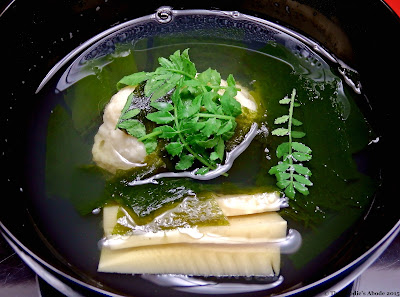
Steamed tofu and nagaimo ball with a filling of hamaguri clam, with young bamboo shoots and wakame seaweed, in a clear dashi broth with kinome garnish.
It is always comforting to have a warm bowl of soup during chilly weather, and this course hit all the right spots. The soft, fluffy, and slightly gooey white ball felt surprisingly substantial on the tummy, and its filling of a single large and succulent hamaguri clam added a further touch of luxury. The clam was extremely fresh, full of umami, and perfectly complemented by the equally deep taste of the soup and seaweed. Generous slices of bamboo shoots, one of my favourite produce as well as a symbol of growth and prosperity over this season, were simply delightful with their crunch and elegant earthy sweetness. To top it all off, the spicy characteristic aroma of kinome, present here in a remarkably ample amount for a garnish, subtly perfumed each bite and kept the whole course in a sophisticated balance till the very last mouthful, such that one felt utterly satisfied, but not the least bloated.
From here, the meal swiftly ascended to its climax. The hassun is the centrepiece of every kaiseki experience, and this one featured an assortment of typical New Year Kyoto delicacies in a fine wooden box. In the spirit of Japanese discretion, part of the contents of the hassun (most likely the best bits) initially came concealed underneath a large yuzuriha 楪 leaf, which is commonly used in Japanese New Year decorations (e.g. shime-kazari) as a symbol of good relationships between the different generations of a family. Ferns beneath the various morsels completed the plating with hopes for progeny and prosperity, due to their numerous small leaves.
八寸:数の子、たたき牛蒡、田作、柿と大根の紅白なます、半アワビ、鯛の竜飛巻、鯛千枚ずし、鴨ロース、青味大根、栗、はじかみ、クワイ
Hassun: (in the bamboo container) pickled herring roe, seared burdock root with sesame, dried anchovies marinated in soy sauce and sugar; (in the other bowl) shredded and lightly pickled persimmon and daikon; (on the bamboo skewer) lightly salt-cured raw bream rolled in vinegared kelp, and half a steamed abalone; (in the foreground) cured raw bream wrapped in thinly-sliced pickled turnip and kelp, roasted duck loin with mustard sauce, green daikon, roasted chestnut, pickled ginger rhizome, arrowhead.
The symbolisms of all these delicacies have already been explained in previous reviews of Kichisen, Dainagon, Wa Yamamura and Daitokuji Ikkyu; I shall leave the interested reader to explore them. For me, four morsels stood out. On the skewer, the steamed abalone was remarkable for its tenderness and juiciness, while the roll of sea bream and kelp possessed a lovely firm bite and a delicate balance of sweet, salty and sour, the result of a sophisticated umami. The succulent and full-bodied slice of duck loin was given a touch of fresh spiciness by the small drop of mustard, while the roasted chestnut was very sweet, with a mild charred earthy edge and a satisfying starchy texture.
Of all the kaiseki hassuns I've had on this trip, Nakamura's was not only the simplest-looking, but also presented with the least pomp. However, this didn't detract one bit from our overall enjoyment of this course. Quite the contrary, I felt that it displayed a very grounded sincerity towards the customer, as well as a quiet confidence in the quality of their own ingredients and preparations. There was no need to impress with further bells and whistles; keeping things simple and to-the-point seems to constitute a large part of Nakamura's kaiseki aesthetic.

The culinary highs continued with the next dish, served in a somewhat whimsical bowl.
揚物:白子トロ揚げ出し
Mashed cod milt lightly battered and deep-fried, and served in a pool of dashi soy broth, with garnishings of grated radish and finely-chopped scallions.
If you like the common Japanese side dish of agedashi tofu, you will absolutely love this - just imagine it being ten times richer in texture and flavour! The smooth creamy texture and intense muskiness that awaited beneath the crisp and delicate outer shell sent me straight to cloud nine. Who could have imagined that with these two humble-looking chunks? The small pool of dashi broth reinforced the luxuriousness of this dish with a deep umami, while the generous garnishings provided an essential touch of freshness and balance.
A short breather then followed in the form of a palate cleanser, served in a most exquisite teacup. We were informed by our waitress that these teacups were in fact amongst Bunji Nakamura's favourite pieces, for their colour and design.
It is actually quite common for food to be served in the best tableware that a kaiseki restaurant possesses, as a welcoming gesture towards their esteemed customers. The value of the tableware used may also vary with the price of the kaiseki chosen. In fact, I'm pretty sure that some of the pieces out of which we ate and drank today (including this teacup) were antiques.
The undersides of both teacup lids were as intricate as the exterior!
口直し:昆布だし茶(梅干入)
Palate cleanser: konbu dashi tea, with a slice of fresh konbu and umeboshi.
This was both extremely tasty due to the konbu's natural umami, and stimulating due to the mild salty astringency of the pickled plum. A lovely transition which set the stage effectively for the arrival of our next main course.
And here it was, the pièce de résistance of every meal at Nakamura, served in a large earthenware bowl.
焼物:ぐじの酒焼き
Grilled dish (main course): tilefish grilled with sake.
True to the family business' origins as specialist importers of tilefish (guji/amadai) from the ancient province of Wakasa, the other signature dish of Nakamura features a generous portion of guji (seen earlier in the sashimi course), grilled with scales and bones left on so as to fully preserve its natural flavour. Prior to that, the fish is left to marinate in salt overnight, then seasoned with sake. Lovely strong aromas hit us the moment the heavy lid was lifted, and I could hardly wait to dig into this succulent and tasty flesh!
Before leaving us to enjoy the fish, our waitress advised us to leave all remains in the bowl, as there would be a little extra after we finished. Something's brewing in that beautiful cast-iron pot which she placed at my side...
Shortly after we were done with our fish, our waitress returned. True to the Japanese ideal of non-wastage, a clear konbu dashi-based tilefish stock was poured from the iron pot into our bowls, combining with the grilled but inedible parts to result in an even deeper flavour with a subtle charred aroma that left me speechless with awe. As with the seemingly plain white miso soup earlier, I hadn't expected to be this captivated.
I commented to our waitress how this way of eating reminded me of adding grilled fugu fins to sake in other parts of Japan, and she replied that adding soup to fish remains is a very popular regional (Kyoto/Nara) practice. Actually, in my limited experience the Kansai people don't seem to care much for fugu - except maybe for its milt, which is a true delicacy. One definitely sees a lot more tilefish, bream and mackerel all around, including in top restaurants.
Earlier I had asked for a copy of today's menu; imagine my surprise and delight when our waitress brought this in, written by the chef himself (just like in Wa Yamamura a few days ago). What a lovely gesture! Truly no detail was spared in making sure that the service exceeded customers' expectations. I also felt that there was something rather direct and austere about the chef's calligraphy - surely a reflection of his own culinary style.
御飯、香物
Finally, rice and pickles, signifying the impending end of the meal.
Served in another black Raku tea bowl, but in contrast to the one used for the chilled starter, this was deeper and narrower in order to better maintain the warmth of the rice.
Such bowls are also commonly used in tea ceremonies conducted during the winter, to prevent the matcha from getting cold too quickly after whisking.
イクラご飯、海苔ふりかけ、三つ葉、わさび
Rice with ikura (salt-cured salmon roe), a sprinkling of nori furikake (dried seaweed seasoning), mitsuba (wild chervil) and wasabi.
As you might have sensed by now, rice dishes at top restaurants in Japan aren't the least boring or bland. In fact, the rice is often already good enough to stand on its own anyway, so anything else that goes with it makes a real treat. Here, the rice was soft, fluffy and slightly sticky, with a delicate sweetness and aroma that supported the intense umami and smooth buttery texture of the ikura very effectively. The garnishings of mitsuba and wasabi contributed a crisp spiciness and fresh aromas that left the stomach feeling very light at the end, despite the bowl's rich and starchy contents.
水菜、昆布、大根、生姜の漬物
Of course, I shouldn't forget to mention the excellent side dish containing pickled mizuna (Japanese mustard greens), konbu, daikon and ginger. No Japanese rice dish is complete without pickled vegetables or tsukemono, and those produced in Kyoto are particularly highly regarded. Everything in this dish was clean-tasting, refreshing and juicy, but two of them stood out. The finely-diced mizuna (a popular winter vegetable) had a lovely crunch and crisp piquant taste (similar to rocket, but less strong), while the konbu impressed with its remarkably firm bite and powerful umami - one thin square at a time, alternating with mouthfuls of rice, felt just about right; you couldn't eat that all on its own.
水物:文旦、あまおうイチゴ、バニラクリーム、白いワインゼリー
Dessert: pomelo, Amaou strawberry, vanilla cream and white wine jelly.
One might best describe this dessert as a gastronomic take on the common combination of strawberries and cream. This was a refreshing way to finish, in more ways than one, in the context of all the extremely traditional courses that had gone beforehand. The core of this dessert was of course still very Japanese (ending a kaiseki with high-quality Japanese fruit) but the uniqueness and effectiveness of the foreign touches in the accompaniments could not be discounted either. Both fruits were very fresh and juicy, and possessed just the right balance of sweetness and tanginess. The white wine jelly, loosely draped over the fruits, complemented the overall lightness with its soft fragile texture, subtle aroma and delicate tannic edge. Bringing all these components into perfect harmony was a delightful base of vanilla cream (with real crushed vanilla pods), which contributed an apt weight to this dessert with its warm rounded sweetness and rich velvety texture.

This is what we got when we were ready to leave and asked for the bill. Having the total amount written in kanji was a first for us - how much more traditional does a ryotei get? (In case you're wondering, today's lunch cost 49,600 yen, including tax and service - not an unreasonable amount to ask in establishments of this level, in major Japanese cities.)
The following picture is of the elegant little courtyard which our room was facing. At this point, our elderly hostess returned to ask us how it had all been, to thank us for our visit and to bid us goodbye - again with all her warm grandmotherly demeanour, deep bowing, and genuine respectfulness and gratitude that are the hallmarks of Japanese omotenashi at the highest level.
Admiring the artworks along the corridors, on our way out:
This set-up in the main entrance hallway caught my eye - a free-style calligraphic representation of isshi-souden 一子相伝 with typical Japanese New Year decorations, such as a shime-kazari hung above the scroll, and a large kagami-mochi sitting on a sturdy wooden offering base beneath the scroll, with a daidai orange perched atop it. This orange symbolises the continuity of a family's bloodline, which must be particularly significant for the Nakamura family, if their ryotei's survival through the generations is to be ensured.
 |
五代目中村文治大将さん、女将さん
5th-generation Bunji Nakamura and his wife |
The 5th-generation Nakamura and our lovely elderly hostess were waiting for us by the front door to see us out, and just as I expected, they wouldn't go back in until we'd turned the corner at the end of the street.
I felt that of all the great restaurants we visited this time in the Kansai region, Nakamura was the only one who really ticked all the boxes in terms of food, service, presentation and ambience. But to reduce this lunch to a set of criteria would be to diminish the complete cultural experience that it had been.
There was also that unmistakable pride in the family's culinary history, and sense of tradition as manifested in the living members' insistence on their forefathers' time-honoured recipes, despite various fancy developments in gastronomy these days. I'm so glad that we had our last fine meal in Japan here, and I'm absolutely certain that we'll be back in the near future.


