This afternoon, we headed to Restaurant Tim Raue for what was supposed to be the culinary highlight of our short Berlin trip. Tim Raue, a sort of enfant terrible in German gastronomic circles, is well known for his unusual love and reinterpretation of various Asian cuisines, often travelling to the Far East to learn about various exotic ingredients and recipes. His flagship restaurant has just obtained a second Michelin star this year in recognition of its increasing standards and popularity. As part of his efforts to promote Asian cuisines amongst the German public, he has also recently opened a second and more casual restaurant Sua Bra in the luxury Hotel Adlon, serving dishes with strong Thai and Japanese influences.
Why, you ask, would we as Asian people want to go for our cuisines interpreted by a German chef? Would the same spices and ingredients not be more aptly and skilfully utilised by cooks from the region without all this 'fusion' or 'pan-Asian' hype? Nevertheless, we thought that the Michelin guide couldn't be too far off the mark, and so we approached the restaurant with an open mind, eager to be surprised and maybe even enlightened about the possibilities of this vast culinary repertoire which we'd come to take for granted.
The restaurant is not the easiest place to find. Unusually located near to Checkpoint Charlie in a somewhat gritty and industrial part of town, it is the last kind of area in which one would expect to find a top gourmet restaurant. The nondescript façade blends so well into the generally bleak architectural style of the area that we walked right past the restaurant twice, wondering where it was exactly. It took us some time to finally locate its entrance through a private courtyard.
Raue's love of all things Asian is immediately evident from the pair of Chinese guardian lions at the door. The reception area contains some rather tacky cushions in the form of various exotic animals, as well as a pair of jade pixiu sculptures, which are mythical Chinese winged lions playing the role of protector in the practice of fengshui. Our initial impression of the restaurant was one of amusing incongruity with its somewhat grey and depressing environment.


A friendly front-of-house staff led us past the open kitchen and private dining area to our table in the sleek and cosy main dining room. Spacious and bright with lots of natural light, the atmosphere was casual and relaxed, and we felt at ease very quickly. The Asian theme continued in the austere and elegant table setting consisting of linen tablecloths (not the usual thick white ones covering the whole table), lemongrass scented towels, a vase of purple orchids, chopsticks (the Western cutlery only came in later) and Japanese-style crockery. Everything felt pleasantly familiar.


Not surprisingly, bread and butter are not part of the service routine here. Instead, what we got even before being presented with the menu, was a lovely array of Asian-style nibbles not unlike what one might expect before a Korean feast.

First up, sakura ebi sashimi with cognac sauce and cocktail dressing. Despite its diminutive size, the Japanese shrimps were plump, fresh and sweet, and sparing amounts of sauce and dressing gave them a good depth of flavour without overwhelming their naturally delicate taste. Quite impressive.

Next, cucumber slices marinated in black vinegar. I am personally not a fan of these Chinese-style pickles as I don't like the taste and smell of black vinegar (very different from a good balsamico, I should emphasise), so I probably took just 2 pieces. To the kitchen's credit, these were pretty authentic with an expectedly sharp acidic taste, and the cucumber had a nice juicy crunch.

To follow were cashew nuts seasoned with yellow curry powder. Perfect for snacking, these were incredibly tasty and moreish, and disappeared into our tummies all too soon!

Finally, dashi crackers with satay duck liver. Probably the most sophisticated of the four appetisers, the weightlessness of these morsels belied an incredible umami that came from dashi (a classic Japanese stock made from kelp and bonito) in the cracker base, and bits of musky duck liver on top. The mildly spicy satay seasoning accentuated the already rich taste of duck liver with a nice kick to the palate, and a nutty edge from finely-ground peanuts within. Creamy and crunchy with a perfect balance of flavours, this was the ideal canapé.

Meanwhile, the menu had been presented to us and our lunch options explained. There was an impressive variety to choose from, and one could take between 3 to 6 courses in any combination of starters, main courses and desserts. Each member of the party is allowed to choose a different number of dishes if desired. A selection of more complex dishes from the tasting menus are also available at a supplement. Two tasting menus are offered (for the whole table) but we were there to try as many different dishes as possible, and the lunch menu was considerably cheaper (even after all the dishes that came with a supplement) so it definitely made sense to do that. Between the two of us we covered 12 dishes this afternoon, which is almost the entire lunch menu except for 1 dish from each category! We noticed many familiar Asian ingredients and cuisines in the menu descriptions and were very intrigued as to how these might turn out. (By contrast, the tasting menus appear to be somewhat more Westernised.)
I'm not sure if one would consider this a service glitch but considering that so much of Asian food culture revolves around communality and the sharing of many different types of dishes, it was quite bewildering that our waitress insisted that our individual orders be clearly separate even though it was quite clear that we would be sharing every dish. I had hoped that the dishes could arrive in succession like they do in a Chinese restaurant, with a small plate for each diner, but I suppose this is a Western establishment after all, and sharing in this manner probably doesn't convey an appropriately formal and posh image. (I do know that some excellent restaurants actually go out of their way to plate each half-portion individually when accommodating such sharing requests - whatever the culinary style - but I wasn't expecting that.) Anyway, we ended up doing our own thing and switched plates halfway through each dish, to the bemusement of some of our fellow diners.
The starters arrived soon after we had finished the appetisers. In a succession of pairs, we had:
Starter 1: raw Ikarimi salmon, with a sauce of grapefruit, sesame oil and vanilla, and garnished with fresh sesame and grapefruit.

A unique take on the ubiquitous Japanese salmon sashimi, this was an excellent way to start. The premium sashimi-grade salmon slices were extremely moist and firm, with a deep flavour. In place of the typical soy sauce dip was a generous pool of grapefruit sauce, whose surprisingly mild tartness effectively enhanced the freshness of the fish. The sauce was also masterfully tempered by warm touches of sweet vanilla and aromatic sesame oil. In particular, the sesame oil was what nailed it for me as a person of Chinese origin - characteristically nutty, but not overpoweringly so. This clean, balanced and sophisticated dish was a clear winner.
Starter 2: lobster with lobster cream and lobster crackers, mandarin gelée, mango sauce, paprika and green Thai pepper. (8€ supplement)

This sounded very promising but turned out to be a mixture of hits and misses. Visually, it was very beautifully plated indeed. The fresh lobster chunks were slightly chewy (an indication of overcooking) but still edible. With only 4 small pieces though, it was a tad miserable even by 'budget' lunch standards. The lobster-derived cream and crackers were excellent in both texture and flavour. The citrus jelly was also an apt touch in enhancing the delicate taste of the lobster. However, the one thing that really killed the dish was the mango sauce - the latter was so overwhelmingly plentiful and sweet that it would have all but wiped out the natural crustacean flavours, were I to finish it. Exotic? Yes. Effective? Not quite. We both love the taste of mango but that really wasn't the point here. Furthermore, (but less offensively) I found the usage of whole peppercorns in addition to paprika somewhat excessive as well - again, we both love spicy food, but chew into one of those green balls and you won't be able to taste anything else in this dish. To be sure, these were all excellent individual components which could have been made to work really well together had their balance been more carefully thought out.
Starter 3: dim sum 'lamb, cumin and pomelo', with bean sauce and a sprinkling of Espelette pepper.

Unfortunately, the disappoinments continued with this dish and in hindsight I can safely say that this was the worst dish of the afternoon, despite the 'dim sum' items being this restaurant's signature lunch dishes. The lamb filling was very dry and the dumpling skin was way too thick. If the kitchen is serious about making these steamed delicacies properly, the chefs might do well to undertake a study trip to Hong Kong or Beijing. I also had my doubts about the accompaniments - pomelo is rather fibrous and not naturally very juicy, so it only reinforced my negative impression of the dry lamb filling, and I couldn't see how it contributed to the overall flavour profile of the dish. Ditto the bean sauce - not sure of its role either. However there was a single saving grace in the use of spices - both cumin and Espelette pepper were effective in masking any excessive natural smells from the meat, whilst stimulating the palate with lovely aromas. Not recommended on the whole, though, unless cooking technique and accompaniments are significantly improved.
Starter 4: dim sum 'suckling pig, leek and ginger', topped with Japanese mayonnaise and shredded fresh spring onion, with leek cream and suckling pig sauce.

An imitation of Japanese gyoza or pan-fried pork dumplings, this was much better than the previous dumpling dish. The skins were still too thick but the filling was much juicier, if a tad meagre in portion. Bits of leek and ginger within the rich pork filling imparted a fresh spicy kick and lovely aromas. The pan-frying also enhanced the overall flavour of the dumplings and produced a nicely browned and crispy base in each. Not too sure about the generic mayonnaise topping though - it seemed to belong more in fast food restaurants than in gourmet temples, and it didn't do anything to enhance the multitude of flavours in a carefully cooked dish, even if it was inoffensive. The other sauces were excellent though - dollops of leek cream with a subtle sweetness and delightful fragrance, and an appropriate amount of pork sauce whose light colour belied a lovely depth of flavour.
Starter 5: dim sum 'calamari and five spice, lime', mayonnaise dip with chilli, sauce mixture of jalapeño and Japanese mustard.

A common street snack in many parts of Asia (and made to look so here with the Chinese newspaper cutout), this was again slightly disappointing. By the time the dish was served, the calamari had cooled off and its batter had become soggy. Hot and crispy it wasn't for sure, though the calamari itself was nicely cooked and still quite tender, while five-spice powder in the batter mix delivered a pleasant umami and kick. A slice of lime and dollops of spicy green sauce on the calamari rings helped to counter any sense of greasiness effectively. The only thing that really bothered me, again, was the dip - nothing screams 'cheap' more than the use of generic mayonnaise, regardless of whether it was home-made or squeezed out of a bottle. Admittedly the chilli (wasabi?) mixed into the mayonnaise did give a nice kick, but it felt somewhat redundant considering that we already had the spicy green sauce. Surely a two Michelin-starred restaurant could come up with a more sophisticated condiment even for a 'budget' menu?
Main courses followed, and after a couple of lacklustre starters we were hoping that things would pick up with these very attractive-sounding dishes.
Main course 1: turbot and kailan (Chinese kale) with slices of young ginger and chopped cashew nuts, in a thick sauce of veal and fish stock with a dash of yuzu (a Japanese citrus fruit). (12€ supplement)

This reminded me very much of a typical Chinese stir-fry that we might have at home, though with more expensive ingredients I must say! Sautéed fish slices with ginger (and often spring onion as well) are a classic combination of freshness and spiciness, while boiled kailan in a thick oyster sauce (here replaced by a similarly savoury veal and fish stock) is a common side dish. It was all very tasty and both the fish and kailan were cooked just right; the fish remained moist and firm while the kailan had a very nice juicy crunch. Proverbial icings on the cake came in the forms of yuzu in the sauce and chopped cashews; the yuzu, sparingly used, imparted its characteristically fresh flavour and aroma to every mouthful, while the chopped cashews contributed a lovely crunch and nutty edge that blended right into this richly flavoured dish. Very familiar and effective on the whole, with well conceived modifications and individual touches.
Main course 2: dorado (commonly known as mahi-mahi) fillets with yuzu gelée coating and furikake (a dried fish/seafood-based Japanese condiment), garnishes of green paprika coulis, ginger, Sansho pepper and fresh cordifole, in a clear broth of buddha's stock infused with fish maw.

Somewhat similar to the previous fish dish, but cleaner and lighter, the fillets were only slightly cooked and maintained a pinkish hue and a firm and succulent texture. Their mild taste was appropriately enhanced by the surrounding condiments - furikake topping and a seafood and soy-based broth for greater umami, yuzu and Sansho pepper (which despite its name is not actually a pepper but a member of the citrus family) for highlighting the freshness of the fish, and ginger and paprika to awaken the tastebuds to the subtle flavours of this dish. This dish (especially the broth) reminded me very much of steamed fish dishes that we would sometimes have at home, albeit without the Japanese twist. On that note, if I had any suggestions for improvement, it would be to tone down the somewhat overpowering citrus element (yuzu) - lovely as it was, I felt it almost threatened to get in the way of the more savoury components; I must state though that in this case it is very much a matter of personal taste.
Main course 3: chicken with miso sauce, foam and chip; eggplant, marinated radish, rocket, Japanese mustard and miso mayonnaise.

This was pure comfort food. On the right, various miso-based condiments were slathered over a generous mound of tender grilled chicken, accompanied by a chunk of roasted eggplant dressed in various garnishes and miso mayonnaise, in a manner that resembled the classic Kyoto side dish nasu dengaku. Everything felt utterly rich and satisfying, due in no small part to the liberal use of miso, which enhanced the flavour of just about anything. The succulent textures of both chicken and eggplant were a perfect match, while the mildly spicy and acidic garnishes helped to balance the understated sumptuousness of it all. We both loved this dish unreservedly.
Main course 4: pigeon massaman curry, with pumpkin, spinach, fresh almond, popped rice and grape on an arc of basil purée. (8€ supplement)

This was a clear tribute to Thai cuisine, one of Raue's favourites and also a popular ethnic cuisine in Germany herself. In particular, massaman curry has gained somewhat of a cult status internationally, having been given the No. 1 spot in CNN's World's 50 Most Delicious Foods in 2011. This Southern Thai curry dish is thought to have originated in Malaysia and like typical curries there is based on peanuts/cashews and potatoes, with spices such as cardamom, star anise and tamarind - very different from the thick coconut milk and herb (basil)-based curries one usually associates with Thai cuisine.
I found the version on offer here lacking in authenticity - just not quite nutty and aromatic enough; only the sweet-sour taste of tamarind was evident. This sauce was probably closer to a pigeon jus than a real massaman curry. Taken on its own merits though, it was still pretty tasty and complemented the rich flavour of the meat well. The pigeon was astonishingly tender and succulent. Its accompaniments were excellent too; fresh and wholesome, they provided a good balance to the intensity of the meat and its sauce. Standouts for me were the fresh almonds with their gelatinous crunchy texture and refreshing bittersweet taste, and the basil purée for its lush licorice-like taste and scent. On the whole, this dish was quite enjoyable.
Main course 5: 'Peking duck interpretation TR' served three ways - crispy duck breast on a pancake filled with apple purée and leek, surrounded by five-spice sauce; liver terrine and mousse with pickled cucumber and leek-ginger purée; duck bouillon with offal (liver, heart and tongue), diced winter melon and bamboo pith. (12€ supplement)

Of course I had read overwhelmingly positive reviews of this dish prior to our visit, but after a couple of hits and misses with some of the preceding courses, I was afraid that this might fall short of our high expectations. I needn't have worried - notwithstanding minor snags, the elevated status of this pièce de résistance was entirely justified, as was the supplement charged. Effectively three dishes in one, this course displayed both creativity in the introduction of Westernised touches, as well as a deep understanding of the authentic flavours of this classic Chinese dish. Fusion gone right, fortunately! I shall elaborate on each of the components in further detail.

First, to get the negatives out of the way - the skin of the 'crispy duck breast' wasn't quite what it promised to be, as anyone who has had authentic Peking duck would be able to tell. Chinese cooks typically spend years perfecting the technique of achieving a paper-thin crispy skin barely concealing the succulent flesh beneath, with the fat layer in between more or less melted away from the prolonged process of roasting over a straw or wood fire in a brick oven. To be fair to this restaurant, this method of cooking obviously wasn't going to be possible due to typical fire and safety regulations in Europe, and the authentic procedure itself is both laborious and difficult, so taken on its own terms this duck was probably as good as a Western-style roast would get. The skin was still nicely browned and the flesh quite tender and succulent. Most importantly, what this restaurant got right was the sauce - it was as viscous, aromatic and tasty as they come in good Chinese restaurants. A perfect match for the rich gamey taste of duck, and fair compensation for the somewhat mediocre texture of the supposedly crispy skin.

The ingenuity of this first component came hidden under the duck breast - a waffle-like base with a filling of apple and leek in each cavity, which imparted a refreshing sweetness and slightly piquant aroma to each intensely savoury mouthful. I was reminded of the traditional English roast pork and applesauce combination - this version with duck worked brilliantly too! The only slight pity in all of this was that the pancake pastry itself had become soggy from being sandwiched between the meat and the sauce, and lacked the fluffiness and crispness that I was hoping for.

The most classically French component of the trio, this was superlative in every aspect. The terrine and mousse were creamy in texture and musky in taste, just as they should be. The Chinese reference was not completely lost either - small dollops of the excellent five-spice sauce were present to remind the diner of the dish's original taste. Balance came in the form of a juicy strip of pickled cucumber, which contributed a fresh and mildly acidic crunch, as well as leek-ginger purée, which both cleansed and stimulated the tastebuds effectively with its delicate spiciness and sweet aroma.

This last component, an excellent duck broth that tasted uncannily similar to the herbal duck soups that one might get with a main order of duck rice or noodles at good hawker stalls in Singapore, was very impressive indeed. Incredibly aromatic and tasty, the generous use of various herbs and spices was evident here. The inclusion of offal also contributed to the broth's intense flavour, and I particularly liked the tongue which had a nice gelatinous crunch. Diced winter melon contributed a lovely mild sweetness to the soup, while pieces of bamboo pith, a premium mushroom popular in Chinese soups for its healthful properties, imparted a fresh earthy aroma and a remarkably light and crisp bite to each spoonful. Undoubtedly, this course was the highlight of the afternoon for both of us.
Dessert 1: in the main dish - cold tapioca soufflé in raspberry sauce; in the side dish - rhubarb sorbet, freeze-dried rhubarb, rhubarb cream and pepper cream. Garnishes of fresh raspberries, lemongrass and chopped pistachios in both dishes. (8€ supplement)


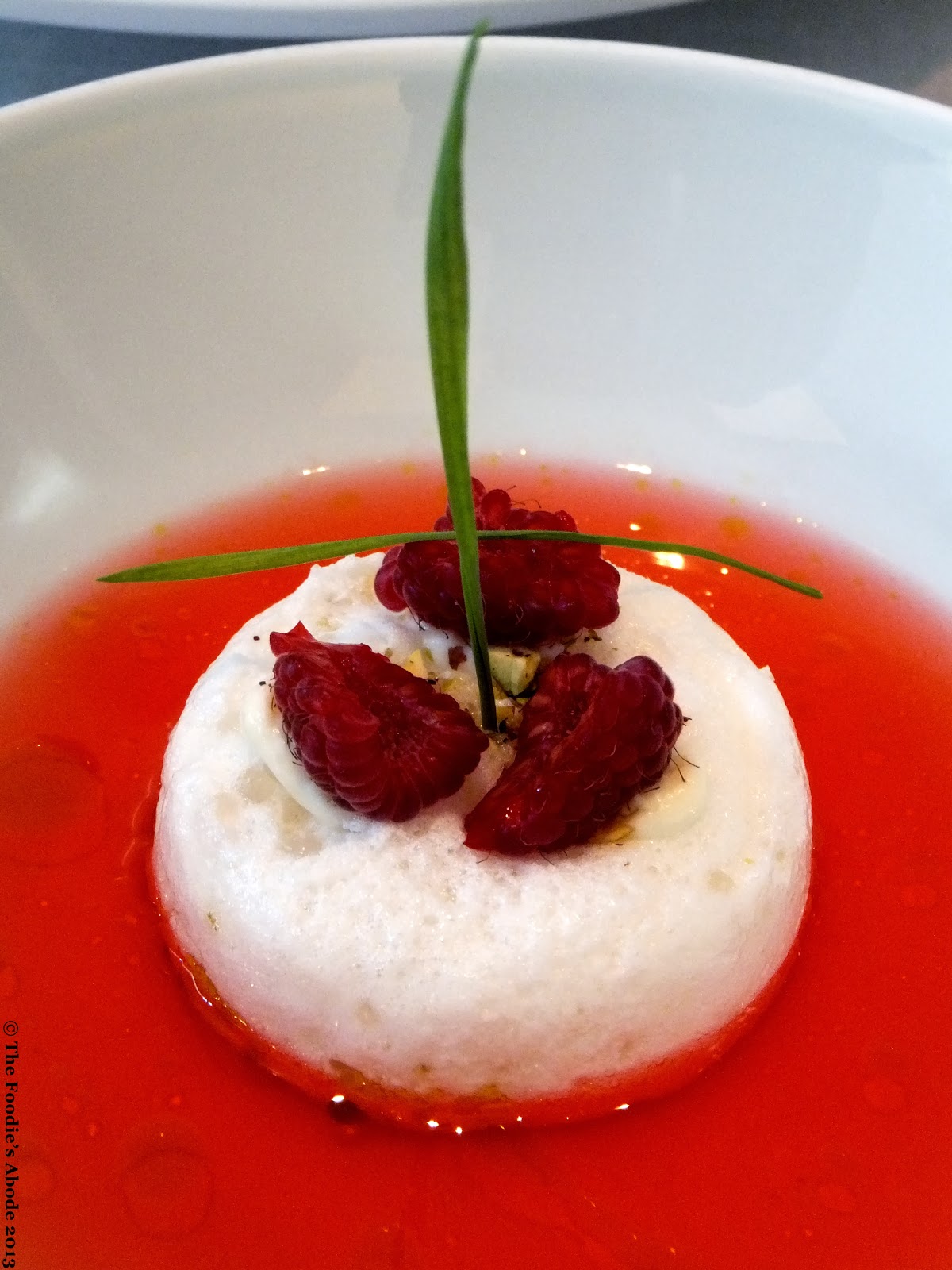
While this was a well-intentioned contrast to the indulgence of the preceding courses, the dessert as a whole didn't really do very much for us. The combination of raspberry and rhubarb made the overall taste much too acidic, and the main tapioca 'soufflé' was astonishingly tasteless. Furthermore, its texture was somewhat strange - more like a foamy mousse than soufflé - and taken together with the watery pool of raspberry sauce caused it to become rather soggy and even marshmallow-like to the palate. Quite disappointing indeed. I did appreciate other details though - in particular, the pepper cream for its mild kick to the palate, the crunchy freeze-dried rhubarb bits and chopped pistachios, and the ever so subtle aroma of lemongrass wafting through each mouthful (probably infused into the sauce or cream). The crispness of this dessert was evident, but I would have liked a greater sensitivity towards the harmony of flavours and textures. I thought that this was a bit of a hotchpotch that looked somewhat better than it tasted - didn't help either that it was one of the dishes that came at a supplement!
Dessert 2: mango and passion fruit sauce, fresh and jellied mango, vanilla ice cream, tapioca sago, meringue and cardamon cream.

The more agreeable of the two desserts, this bore an uncanny resemblance to the popular Hong Kong chilled mango dessert 杨枝甘露, albeit more fancily presented. I thought the passion fruit in the sauce (something not usually done in the classic HK version) was very effective in balancing the sweetness of the mango with a fresh and tangy edge. The puréed passion fruit also unleashed all its lovely characteristic aromas while imparting a silky viscosity to the sauce. Tiny translucent balls (commonly known as sago) made from tapioca flour, with a pleasant chewy texture, were present in abundance just as they would be in the traditional dessert. Furthermore, I was struck by two other aspects of this dessert: the creative ways in which the mango was presented, as well as the warm and sweet fragrance of cardamon (who'd have thought of using this spice?) which blended perfectly with both vanilla and passion fruit. The vanilla ice cream was pleasant, though it came across as somewhat of an afterthought and we might have done without it. Tiny meringues sitting on each dollop of cardamon cream provided a nice contrast in texture to the rest of this dessert, with their airy crispiness.
Petit four: blackberry ice cream coated in rosemary white chocolate, topped with pine nuts and honey.

Instead of the customary pastries and chocolates one gets after a fine meal like this, we were each offered a very posh-looking iced lollipop. The blackberry ice cream filling was very light and refreshing and had just the right balance of sweetness and acidity. It was enrobed in a thin layer of white chocolate that, by contrast, was buttery and luxurious in mouthfeel, with the sweet-smelling hints of rosemary coming through in every bite. To top it off, pine nuts provided a further crunch in texture as well as a greater depth of flavour. Garnishes of confited blackberry, fresh rosemary leaves and a drizzle of honey were the icings on this absolute gem of a petit four. What a delightful way to finish - this was clearly one of our most vivid memories of the afternoon.
We checked out the washrooms before leaving, and passed by many interesting artefacts. There was a pretty arresting (though tad messy) display shelf along the stairway to the basement, with all sorts of classic Chinese ceramics, while the basement restroom area itself featured bold colours and an array of contemporary Chinese art. The décor of this restaurant was indeed as eclectic as the food itself.

 |
| Basement lounge |


 |
| Very interesting hook for cubicles in the shape of a rhino horn! |
 |
| Very pretty blossoms |
 |
| Private dining area/chef's table next to the open kitchen |
We were hoping to meet Raue himself but he was away this afternoon overseeing operations at his new restaurant Sua Bra. Not much luck this time round with German chefs, it seems!
Considering its remarkably Asian-inspired styles of cooking we were quite surprised at being the only Asian people in the restaurant the entire afternoon. What can I say about this place? Considering the generally less-than-impressive standards of Asian food in Germany, I can see why this restaurant has got a very strong niche, but for Asian people and anyone living in a more cosmopolitan city like London, quality authentic versions of many of these dishes are to be found readily in casual ethnic eateries and restaurants at much lower prices.
To be fair to this kitchen, the best of today's dishes were very solid and pretty indeed - in particular, most of the tasting menu selections that came at a supplement - and they have done their best at promoting the sheer diversity of cuisines from a very distant part of the world. Of course, it is always difficult to get one up on cuisines with such long and illustrious histories. In particular, we both felt that certain cooking techniques (e.g. for the dim sum and roast duck) definitely had room for improvement. Understandably however, the restaurant wouldn't pull out all the bells and whistles for a 'budget' lunch menu; the much more expensive full tasting menus might be unreservedly brilliant, as most reviews seem to concentrate on promoting them - who knows, I might just give this place another go the next time I'm in Berlin?


