Sunday, 4 January 2015

Delights of Kanto (4): Sweet nothings at Henri Charpentier (Ginza flagship), Tokyo

Dessert before dinner - why not! This evening, after a spot of shopping in the Ginza district, we visited one of our to-do patisseries in Tokyo, Henri Charpentier. The business takes its name from a 19th century French chef, though it is wholly Japanese-owned.  It is a well-known fact that the Japanese make the best French pastries outside France - and sometimes even better than in France if I may say so!

There are many stores nationwide as well as overseas, and we chose to come here in particular as it is one of two flagship stores in the country - the other being in Ashiya city in Hyogo Prefecture, which is where it all started in 1969. The Ginza flagship, draped in the brand's signature dark pink, was opened in 2003 and features a pastry boutique on the ground floor as well as a chic salon de thé in the basement where one can transport himself temporarily to the trendy cafés of Paris.

(There is also a branch in Singapore's posh Dempsey area which is ridiculously overpriced, but here in Japan it is a lot more reasonable, especially with the current exchange rate.)

Distinctive exterior in the style of a 19th-century European building

While the exterior oozes classic grandeur, the modern
interior features bold pink colours and sleek lines.


The menu is Japanese-only, which is somewhat surprising considering that they are selling foreign patisseries here, and a tad unfortunate as I reckon many tourists would probably just take a gamble with their choices and not really know what they are eating, being able to rely only on pictures.

Anyway, we went straight first for HC's signature Crêpe Suzette, prepared at the table. A thin crêpe is first cooked in a copper pan, before a mixture of melted butter and orange juice is added from a small pot. Finally, the whole thing is flambéed and finished flamboyantly with a touch of Grand Marnier.


To be honest, I felt that this had placed more emphasis on the spectacle of preparation than on the actual taste of the dessert. I found the crêpe extremely underwhelming (it was really just that, one single plain piece folded into a quadrant) though the surrounding pool of rich orange sauce packed a surprising punch with its deep bittersweet flavour. On the whole, I'm still not sure why this would be the signature item...

We did order another Crêpe Noisette, presented as two wraps with a filling of hazelnut chocolate spread, and a large pool of milk chocolate sauce in between. Garnished with gold flakes and roasted caramelised hazelnuts. If you love Nutella, this one's for you! I definitely enjoyed this one a lot more as it felt really substantial, and also it seemed like more effort had gone into making and presenting this.


Of course, having come all the way here, we could not just stop at the crêpes. We went on with HC's take on the famous French dessert Mont Blanc, pioneered by Angelina in Paris in 1903.


I am so glad we chose this, because it turned out to be our favourite item of the visit. Instead of the centre being filled with crushed meringue pieces beneath the noodle-like strands of chestnut cream, this had real roasted chestnuts mixed with pieces of soft sponge inside, and the base was sponge too. Served with a little chestnut sauce on the side.

This was at the same time less cloyingly sweet and lighter in texture, yet possessing a much more intense chestnut flavour - better than the French original if you ask me!

The last choice was a pear and vanilla mousse cake, with generous and juicy chunks of poached pear. The mousse was delicate and airy in texture, not too sweet, yet with a fresh deep taste - simply lovely. Perhaps unsurprisingly, all the butter and cream used in HC's pastries are made with raw milk from Hokkaido, a region of Japan particularly famed for the quality of its dairy products.


In general, I sensed that the pastry chefs at HC, perhaps in accordance with Japanese taste, have succeeded in making these French pastries lighter on the stomach and arteries, without compromising their flavour in the least. This was for me a major plus point, as traditional French pastries use a lot of butter and cream, which, though delicious, can feel like too much of a good thing very soon.

If only we had had more stomach space to try the other tantalising items on offer - I know I will be back whenever I'm in Tokyo!

Delights of Kanto (3): Tempura at Sansada (三定), Tokyo

(This post reviews the two visits I made to Sansada tempura restaurant in the Asakusa area of Tokyo.)

On the second day after our arrival in Japan, we went to the Asakusa area for sightseeing in the evening. Not having any specific plans for food, we were searching for a dinner place in the area when Sansada's signboard caught my eye, boasting itself as the oldest tempura restaurant in Japan, in operation since 1837. We decided to give it a go.

Sansada's main shop is extremely conveniently located along the main Asakusa thoroughfare, just round the corner from the two landmarks of the area, Reimon (Thunder Gate) and Sensoji Temple - you can't miss it. The façade and interiors are aptly old-fashioned, and I felt as if I was stepping back into the Edo period as we entered.


The space is surprisingly small for a main shop and fills up pretty quickly, so do expect to wait at peak periods. The setting is casual and somewhat spartan, and the service brisk, but polite as expected. The fragrance of the batter filled the air, thankfully with no traces of an oily stench, and the room was clean and well-ventilated. This restaurant felt like it would make a good brief respite in the midst of a busy day, though it was not exactly the kind of place I would want to linger in (not with the queues outside anyway!). Still, a promising first impression.


The name 'Sansada' is actually a combination of characters from the original proprietor's name Sadakichi (定吉) and his hometown of Mikawa (三河), in present-day Aichi prefecture. He arrived in Tokyo in 1837 and established this restaurant specialising in deep-frying small fishes in sesame oil. It has continued serving Edomae-style (traditional Tokyo-style) tempura since.

We started off with a few side dishes from the seasonal menu.

平目の刺身 Hirame (flounder) sashimi


The best seasons for this fish are in autumn and winter. These thick-cut slices were extremely fresh and firm, with a lovely delicate sweetness. The portion was also very generous and satisfying.

赤白かまぼこ Steamed fishcake in festive red and white colours


These fishcakes or kamaboko are one of many traditional goodies for the New Year in Japan. The texture of these slices was absolutely smooth and the bite was delicate and somewhat gelatinous, exactly like the fishballs and fishcakes I am used to back home. It all tasted comfortingly familiar.

銀杏 Roasted ginkgo nuts with a touch of sea salt


Ginkgo nuts are another very popular autumn/winter produce, consumed not only in Japan but also China, particularly in desserts. A popular recipe back home is a bowl of sweet soup containing dried beancurd skin and ginkgo nuts. Ginkgo nuts are not only tasty but also have numerous health benefits, and are frequently used in Traditional Chinese Medicine and other herbal recipes.

These roasted nuts had a soft fleshy texture, and a bittersweet and somewhat puckery taste that truly stimulated the tastebuds and whetted our appetites for the following main dishes. The light dusting of fine sea salt highlighted the original flavour of the nuts even more effectively. I've never actually had them in this roasted, straight-out-of-the-shell form before so this was a refreshing experience.

And now for the mains:

天丼 (海老特上丼) Ten-don, with premium king prawn tempura on rice


I should state for the record that compared to more modern and lighter forms of tempura, Edomae-style tempura is coated in chunkier batter, and the use of pure sesame oil means a stronger aroma. In addition, in ten-don dishes a thick savoury sauce is usually generously drizzled over the tempura before being served to the customer, so flavours are much heavier as well. On the whole, this style of tempura feels extremely substantial - enjoyable but definitely not for small eaters or weight-watchers!

Having said that, I cannot honestly conclude that I enjoyed this bowl of ten-don entirely. To be sure, I had no doubts regarding the high quality of the prawns used - they were fresh, huge and succulent, and the deep-frying in sesame oil really accentuated their goodness. My only gripe (and most damaging one) was with the texture of the batter; it had become all soggy and greasy from being drizzled with the sauce. It definitely didn't help that there was also a rather thick coating of batter to get through. Perhaps it was supposed to be like that, but what's the point of deep-frying something to crispness and then proceeding to drench it in sauce?

天丼 (特上丼) Special ten-don


A slightly cheaper ten-don with smaller prawns here, but with extra pieces of eggplant and pumpkin. The ingredients were all very good - shame about the thick soggy batter. Either this restaurant isn't quite getting it right or ten-don just isn't for me.

Two days later (today) we found ourselves in the area again and decided to give this restaurant a second chance, this time for lunch in its newer branch located right beside the Thunder Gate, round the corner from the main shop. Mental note: no ten-don this time - I wanted to taste the tempura for what it really is. 


This much bigger branch features an open kitchen - not sure if the same kitchen supplies the main restaurant too?


To reach the main dining room here, you have to make your way up to the second floor.


After passing through all the narrow staircases and corridors, this large spacious tatami room opened up in front of us - I can't deny that I already felt better about this new place!


Side dishes:

もろ胡瓜 Fresh cucumber with a grainy miso dip


This was the considerably healthier Japanese version of cucumber and celery sticks with dip. Instead of the creamy dressing one finds in Western restaurants, a condiment of moromi miso, a chunky miso with added grains of rice and barley was served. Its firm and slightly chewy texture and deep flavour were the perfect complements to the crisp, juicy and mildly sweet raw baby cucumber. A very clean and pleasant way to start the meal.

豚の角煮(味玉子付き)Stewed pork belly with half a seasoned boiled egg


This was heavenly. The pork was tender and succulent, and even the fatty parts felt surprisingly light. The sauce in which it had been stewed was extremely tasty and appetising, and I only regret having to share this! The accompanying boiled egg had also been well seasoned, but I would have preferred a more runny yolk (just like in ramen) for a more creamy and luscious experience; here the yolk had hardened and partially turned light yellow, a sure sign of overcooking.

Mains:

海老天ぷら King prawn and vegetable tempura set


For our mains we decided to go for the sets in which the tempura would be separate from the rice. I went again for the king prawn set with vegetables (shiitake mushroom and green pepper), which for some reason was slightly cheaper than the king prawn ten-don, despite having the same number of prawns and two extra pieces of vegetables. I enjoyed this much more than the ten-don because I could now really appreciate the crisp and light texture of the batter, and the flavours and succulence of the ingredients within also shone through even more clearly.

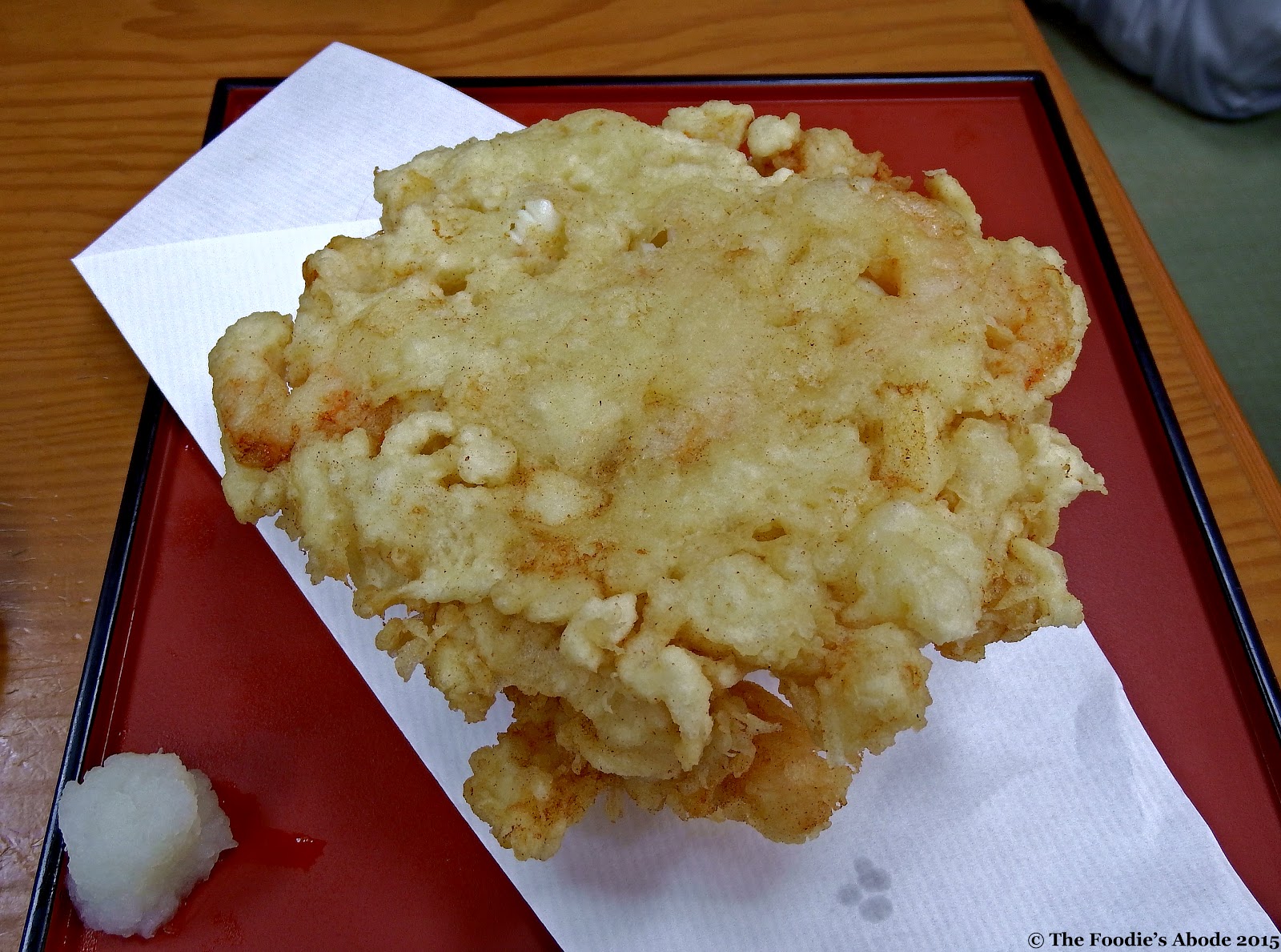
かき揚げ Kakiage set, with a disc of chopped prawns and squid in tempura batter


This disc of chopped prawns and squid mixed with tempura batter was the biggest and thickest I'd ever seen! Despite the enormous chunk none of it felt too heavy and cloying; I was particularly impressed by how the pieces of squid had maintained their tenderness and how easy they were to chew through.

All in all, a much better second experience. I have to mention that for a casual experience eating here is not cheap - expect to pay around 4,000 yen per person per meal if you order the exact items described by this post. At this moment I am recalling the stellar lunch we had last year in Hiroshima at the two-starred Tenkou Honten, for which we paid only 4,200 yen per person. Still, for its location and history, Sansada is perhaps worth a try - but do choose carefully.

Saturday, 3 January 2015

Delights of Kanto (2): Shirasu-don at Wasai Yakura (和彩 八倉), Kamakura

The foodie explorations continued this evening after a long day of visiting and shopping, and Mino brought us here to taste what Kamakura is probably most well known for - boiled whitebait on rice or shirasu-don (しらす丼). Restaurants selling this dish are aplenty within the city centre, and we ended up here at Wasai Yakura, which is supposedly the best place for it. I love shirasu and I could hardly wait!


The relaxed, no-frills setting is great for gatherings of families and friends. Menus are Japanese-only, but should be straightforward enough with pictures. Prices are extremely reasonable too; for less than 2,000 yen per person you will get a substantial set meal which fills your tummy very nicely. Considering how expensive fresh shirasu is to eat outside Japan, this restaurant offers great value for money indeed.

Shirasu is not only tasty but also a low-fat, high-protein food, great for the health-conscious. The delicacy finds its way into every dish that is being served here - I suppose in this case one can't have too much of a good thing! We started off with two sides:

しらすおろし

Shirasu with grated radish, to be eaten very simply with a touch of soy sauce. The shirasu was not overly salty despite having been blanched in salt water. It retained a lovely juiciness and delicate sweetness, which was effectively enhanced by the grated radish. This felt extremely fresh and clean on the palate.


玉子焼のしらす添え

Tamago-yaki topped with a generous amount of shirasu. The moist and savoury layered omelette was another perfect companion for the shirasu. This combination was considerably heavier in taste and texture, and equally enjoyable for different reasons. I should state for the record that the shirasu served here were the biggest and plumpest that I have ever seen, and that there was a remarkable amount of fish even for side dishes - elsewhere (overseas) you'd probably get about half the portions of fish for double the prices, assuming that it is even possible to import such fresh and high-quality fish.


Of course, the main set meals didn't disappoint either. Each set came with clear dashi soup, pickles, a side dish of simmered bamboo shoots with bonito flakes, a large umeboshi (pickled plum) and chawanmushi (steamed egg custard), in addition to a huge bowl of rice topped with all sorts of delicacies. I particularly enjoyed the chawanmushi due to a generous amount of shirasu within, as well as the bamboo shoots for their crunchiness and sweetness.

しらすといくら丼定食

Main meals: shirasu and ikura (salmon roe) rice bowl set. This was my choice, and the ikura was every bit as good as the shirasu, with its fresh briny taste and smooth juicy texture. (Methinks the ikura alone would have been worth the price of the set meal overseas.) The main bowl also came with the usual shredded garnishes of egg, shiso, and nori (dried seaweed), with a touch of grated radish and wasabi for a clean and crisp finish. I was truly sated by the end of this dinner.


Other variations: just shirasu on rice if you can't get enough of it!


しらすと桜えび赤白丼

Or how about this: with fresh sakura-ebi (small pink shrimp) forming a festive pink-and-white colour combination, especially apt for the New Year. I had a few bites of the sakura-ebi and found them very sweet and succulent.


In summary, everything was fresh, portions were great, and the bill didn't burn a hole in our pockets - what else could we have asked for? This is a must-do for anyone visiting Kamakura and wishing to try its representative cuisine.


Details for Wasai Yakura (和彩 八倉)

Address in kanji: 神奈川県鎌倉市小町2-7-28
Tel.: +81 467-61-3070
Business hours: daily from 11 am - 9 pm (last orders 8 pm)
Credit cards: Visa, JCB, Amex

Delights of Kanto (1): New Year's soba at Matsubara-an (松原庵), Kamakura

We are back in our favourite country for two weeks over the New Year period, and what a festive mood the whole of Japan is in! National holidays are officially from 31 December to 4 January, with many shops and restaurants closed till the 5th or even 6th. This is the most extended and important holiday for Japanese people, as they will be visiting shrines and temples throughout the nation to pray for good health and fortune for the coming year, as well as going back to their respective hometowns to catch up with family and close friends. Street food fairs on the grounds of some of the major temples and shrines also add a much needed warmth and vibrancy amidst the harsh winter cold. We actually touched down in Tokyo on New Year's Day, and the sheer crowd at the famous Sensoji Temple in the Asakusa district was truly one to behold.

However I shall start this flurry of holiday food blogging with a delightful restaurant in the historic city of Kamakura, just an hour away from Tokyo by local train. A popular day-trip destination, Kamakura is home to the iconic Great Buddha statue (the second largest Buddha statue in Japan) as well as many other ancient Buddhist temples, and the large central Hachimangu Shinto Shrine where most of the locals gather for New Year prayers.

It is a Japanese tradition to have soba (buckwheat) noodles over the New Year, as the thin and easily-broken strands signify a clean break from the previous year and all its attendant troubles and misfortunes, and with that, hopes for a better new year. I do love good freshly-made soba, so when I came across this place Matsubara-an, highly regarded by locals and tourists alike, in the course of planning for the trip, I knew I had to visit. Most reassuringly, I had also gathered from its website that it would be open throughout the national holidays till 10 pm daily.

And now for the best part of this day trip: we had my friend Mino, from my postgrad days in London and a Kamakura native, accompany us throughout! There was no stress about getting lost in the city's many little winding streets, as she took us round the major sights effortlessly and with the kind of knowledge that only a local could possess.

Matsubara-an is located in an obscure residential area and is not the easiest to find despite its proximity to the Great Buddha. Perhaps that's also what made it the perfect lunch spot for us after experiencing the crowds around the Great Buddha - the grounds of the restaurant are surprisingly large, sparse and tranquil, a true oasis of calm. The main building itself is very traditionally Japanese but there is also a spacious Western-style café and terrace extension, where one can sit during warmer seasons. It is a very tasteful juxtaposition of architectural styles. Passing through the noren, I already had a good feeling about this place.


Please come early if you don't have a reservation, or be prepared to wait for at least 30 minutes! (as we would hear from the front-of-house telling customers who arrived later) We were there by 11.20 am and already there was a short queue forming as the service staff went about getting the tables ready first. Fortunately, it took us only about 10 minutes before we were admitted.


Love these Japanese New Year ikebana.

As the calligraphy below suggests, this restaurant is also famous for its duck - both roasted and infused into the soba's accompanying broth.


The main dining area was rather small and cosy, though the ceiling did feel somewhat low and oppressive - probably due to the height of the tables and chairs (usually one expects to sit at or close to floor level in such traditional Japanese settings).


Soba restaurants are usually a very basic affair, but Matsubara-an also offers two multi-course options to complement their noodles. For just 3,800 yen at both lunch and dinner you get 5 courses plus a drink of your choice (this is the 'Matsubara' menu we chose); there is also a 3-course option with no drinks at 2,700 yen (the 'Yui' menu). A steal at any rate, I think you might agree.

<松原>コース:彩り七種盛り合わせ(鮮魚のカルパッチョ、彩り野菜のバーニャカウダ、茄子の南蛮漬け、揚げ蕎麦の豆腐味噌添え、鴨ロースのたたき、信州豆腐の醤油豆がけ、七殻餅の揚げだし)

Starters: a platter consisting of flounder carpaccio, seasonal vegetable bagna càuda, eggplant nanbanzuke (Chinese)-style, fried buckwheat cracker with a touch of tofu miso, seared duck loin, Shinshu tofu with a topping of red beans marinated in soy sauce, and a lightly battered and fried multigrain bar in a dashi-based broth, with chopped spring onions.


This was a smorgasbord of different culinary styles, and everything was so fresh and crisp. A feast for both the eyes and the tastebuds indeed. The grilled eggplant marinated in a mildly piquant sauce was very creamy and tasty; the lightly boiled broccoli and raw purple radish with an aromatic minced garlic and anchovy bagna càuda dressing were delightfully crunchy; the fish carpaccio was succulent with a refreshing hint of acidity from the dressing; the buckwheat cracker's nuttiness was well enhanced by a strong tasty touch of miso; the duck was tender and moist; the tofu was incredibly rich in taste and texture, a sure sign of its purity and the quality of local water; and last but not least, the multigrain bar which was crispy on the outside and firm on the inside, with the occasional crunch from whole grains. Despite being fried it also felt surprisingly light, and the surrounding dashi broth made it really tasty. The last two morsels described left a particularly deep impression.

厚切り鴨ロース肉の炙り焼き

Side dishes: thick-cut grilled duck loin.


Done Western-style, these slices were so very tender and bursting with juices despite their generous thickness, and the full-bodied gamey flavour of duck was evident with each bite. Grilled leeks underneath enhanced the aromas of this dish and gave it a lovely sweet edge, while a very Japanese touch of shiso and lemon garnish refreshed the palate effectively. This was probably better than some of the duck roasts I have had in fine Western restaurants. I could see why this restaurant prides itself on duck dishes as well. Like the previous starter platter, this side dish also showed how open the kitchen was towards different culinary influences, thus transcending the usual mould of soba restaurants and creating a unique and convincing brand all their own.

旬野菜の天ぷら(薩摩芋、牛蒡、ピーマン、蓮根)

Seasonal vegetable tempura (sweet potato, burdock root, green pepper, lotus root).


Shortly after the duck, our accompanying tempura for the main bowl of soba noodles arrived. This vegetable tempura had a wonderfully light and crisp batter, giving each piece a nice initial bite whilst not drowning out the delightful natural flavours and textures of the vegetables that lay within, with excessive greasiness. The sweet potato was particularly memorable for its creamy and surprisingly non-starchy mouthfeel, while the lotus root stood out for its fresh crunchiness and mild earthy sweetness.

海鮮のあられ揚げ(海老、イカ、大葉)

Seafood tempura (prawns, diced squid, shiso).


For a supplement of just 290 yen, you can upgrade to a seafood tempura consisting of generous amounts of prawn, diced squid, and fragrant shiso leaves - why not! This was my choice and I did not regret it one bit; the prawns were firm and juicy, the diced squid surprisingly tender and not the least chewy/rubbery, and a first for me, shiso in tempura batter, which was incredibly light, refreshing and tasty. The best Japanese chefs do have a way of making deep-fried comfort food feel utterly guiltless!

かけそば

Mains: warm soba in a soy-based dashi broth.


Finally for why we came here in the first place - the excellent noodles garnished simply with finely sliced scallion. The fragile noodle strands were smooth and possessed a good bite, great for slurping - in fact they went down almost too easily and the bowl was emptied before I knew it! The mild nuttiness from buckwheat was very well complemented by the surrounding full-bodied broth and aromatic scallion. How could something so seemingly plain be so good? It was particularly satisfying to be having this in the midst of winter; I had to drink that tasty warm broth to the very last drop.

鴨煮そば

Warm duck soba with slow-cooked duck wings in a duck-based dashi broth.


Mino had a smaller appetite so she hadn't gone with the multi-course option; this was her only order, combining the two signatures of this restaurant within the same bowl. What a punch it packed! If we had thought the plain soba was already very good, this was even more indulgent. To begin with, the duck-based broth was even richer and deeper in taste, as it had been derived over long hours of simmering with the meat and bones, thus concentrating all their flavour like in a good stock. In addition, duck wings, so soft and tender that the meat just fell off the bones effortlessly, generously topped the noodles. Garnishes of fresh sweet baby leek and fragrant mitsuba (Japanese parsley) completed this picture of perfection. Limited number of bowls available daily!

自家製和菓子(黒糖わらび餅ときな粉)

Dessert: homemade brown sugar warabi-mochi (soft bracken root starch cake) with a dusting of kinako (toasted soybean powder).


These morsels were pleasantly chewy and had an unexpected melt-in-the-mouth softness. I've had countless warabi-mochi by now, but I'm not exaggerating when I say that this could be the most delicate texture I've ever experienced from this snack. Its sheer lightness belied a deep (but not cloying) sweetness from the addition of molasses into the starch mixture. A further drizzle of brown sugar syrup and dusting of mildly sweet and nutty soybean powder completed this classic Japanese dessert.

More sweet endings: my glass of grape juice below. (For the final drink you get to choose between hot/iced coffee, Oolong tea, orange/apple/grape juices, Cola and ginger ale.)


This had been an excellent meal in lovely restful surroundings, and the service, as always in Japan, was attentive and polite. All things considered, it had been an extremely good value-for-money experience. A very convenient lunch/dinner spot in Kamakura after visiting the area around the Great Buddha, which I cannot recommend highly enough.